Skip to Content Facebook Feature Image

Tragic construction accident in Sai Kung claims worker's life; Labour Department launches investigation and issues safety warnings

HK

Tragic construction accident in Sai Kung claims worker's life; Labour Department launches investigation and issues safety warnings
HK

HK

Tragic construction accident in Sai Kung claims worker's life; Labour Department launches investigation and issues safety warnings

2025-11-23 08:59 Last Updated At:11:48

Labour Department highly concerned about fatal work accident that happened in Sai Kung yesterday

The Labour Department (LD) is highly concerned about a fatal work accident that happened at a construction in Sai Kung yesterday morning (November 22). In this accident, while a male worker was operating a concrete core drilling machine, his clothing was entangled by the cutting drill of the machine, causing his neck to be strangled by his clothing. He was certified dead later in hospital. The LD is saddened by the death of the worker and expresses its deepest sympathy to his family.

The LD's spokesman said, "We commenced an immediate on-site investigation as soon as we were notified of the accident and have issued suspension notices to the contractors concerned, suspending the use of concrete core drilling machines for concrete coring work on the site. The employer cannot resume the work process until the LD is satisfied that suitable measures to abate the relevant risks have been taken."

The spokesman added, "We will complete the investigation as soon as possible to identify the cause of the accident, ascertain the liability of the duty holders and recommend improvement measures. We will take actions pursuant to the law if there is any violation of the work safety legislation."
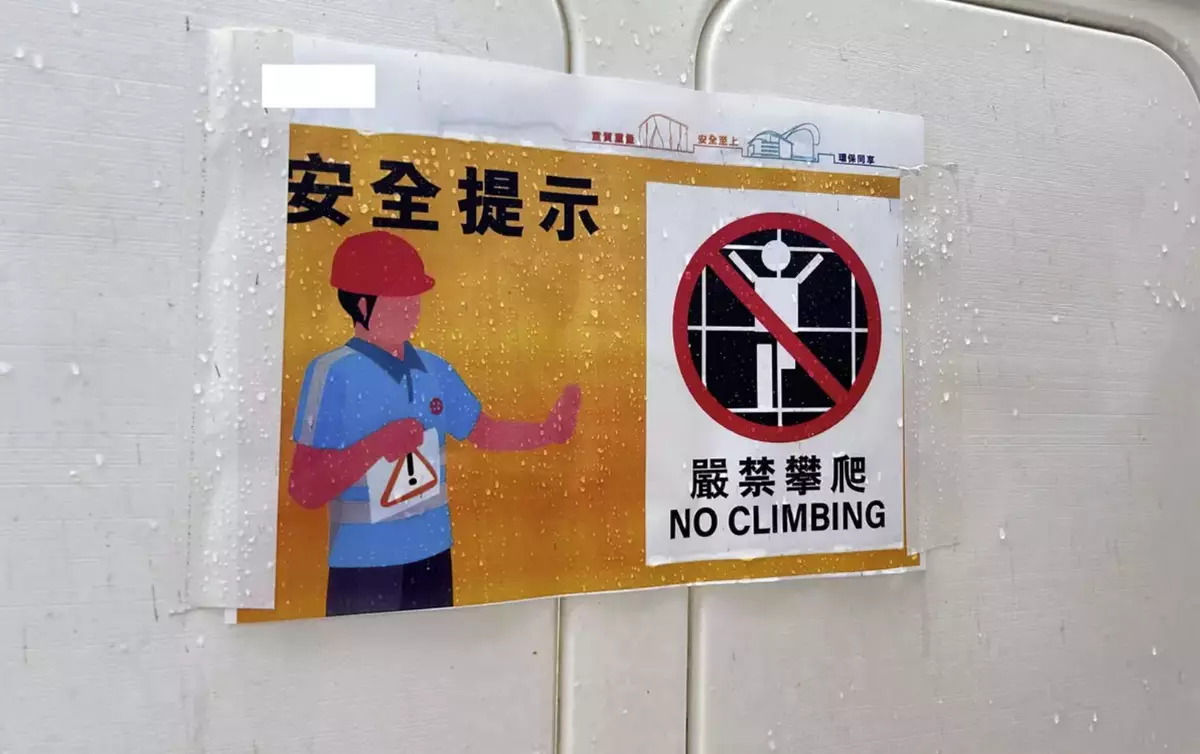
Attention should be paid to work safety on the construction site, Photo by Bastille Post

Attention should be paid to work safety on the construction site, Photo by Bastille Post

To prevent workers from being entangled or injured by the cutting drills of concrete core drilling machines, the LD reminds employers to provide effective guarding to all dangerous parts (including cutting drills), and to ensure that workers do not wear loose clothing or accessories while operating the drilling machine.

The general duty provisions of the Occupational Safety and Health Ordinance require employers to provide safe working environments, plant and systems of work for their employees. Those who contravene the relevant provisions are liable to a maximum fine of $10 million and imprisonment for two years on conviction on indictment; or $3 million and imprisonment for six months on summary conviction.

In regard to yesterday's accident, the LD will issue a Work Safety Alert through its mobile application "OSH 2.0", website and email, giving a brief account of the accident concerned to duty holders, workers' unions, professional bodies of safety practitioners and others, and reminding the industry of the importance of following safety precautionary measures to prevent a recurrence of similar accidents.

The LD will also remind the employer concerned of the liability for employees' compensation under the Employees' Compensation Ordinance, assist family members of the deceased to claim employees' compensation and closely follow up on the case. For those with financial difficulties, the LD will assist them to apply for appropriate emergency funds. Subject to the needs and wishes of family members of the deceased, the LD will also liaise with the Social Welfare Department for financial or other assistance.

For the sake of securing the safety and health of employees at work, the LD appeals to employers to provide plant and systems of work that are safe and without risks to health. Employees should co-operate with their employers, adopt all safety measures and use personal protective equipment provided properly to avoid endangering their own work safety and that of other workers.
The Labour Department
The Labour Department

Re-launch of Reporting Scheme for Unauthorised Building Works in New Territories Exempted Houses

Following the direction of earlier proposals, the Buildings Department (BD) announced today (April 1) the re-launch of the Reporting Scheme for Unauthorised Building Works (UBWs) in New Territories Exempted Houses (NTEHs). The reporting period will last for one year from April 1, 2026 to March 31, 2027.

"In view of the history and unique circumstances of the NTEHs (commonly known as village houses), the Government launched a one-off administrative reporting scheme in 2012 as a special arrangement. Under the scheme, owners could report to the BD about UBWs that were erected before June 28, 2011, posed lower risks or constituted less serious contravention of the law. The reporting period ended in December 2012. The Development Bureau (DEVB) put forward proposals to amend the Buildings Ordinance in December 2024, which included rationalising the policy for handling UBWs. The DEVB also pointed out that in response to the views of villagers and Legislative Council members that the reporting period was too short, the Government prepared to re-launch the Reporting Scheme to allow owners who at that time did not report their UBWs to do so," a spokesman for the BD said.

Relevant stakeholders and Legislative Council members generally considered the above proposals practical and feasible, and they welcomed the proposals. The DEVB and the BD have also consulted Heung Yee Kuk on the relevant implementation arrangements.

The re-launched Reporting Scheme will maintain the original criteria, including:

(1) The types of UBWs that can be reported and their erection dates are the same as the original Reporting Scheme, meaning that only UBWs erected before June 28, 2011, posed lower risks or constituted less serious contravention of the law and were not the First Round Targets (Note) are eligible. Examples include signboards projecting from the external walls of village houses; enclosed rooftop structures with a coverage of not more than 50 per cent of the roofed-over area of the main building.

(2) Same as the original Reporting Scheme, owners are required to conduct safety inspections on the reported UBWs every five years.

"The BD will not require the immediate removal of the reported UBWs unless their structures become obviously dangerous. Regarding UBWs in village houses, the BD is prioritising the handling of First Round Targets. If any relevant UBWs remain not reported after the application deadline of March 31, 2027, the BD will, after dealing with the First Round Targets, take priority enforcement action against the non-reported UBWs. The BD will formulate enforcement strategy for the reported UBWs at a later stage in accordance with the risks and the actual situation," the spokesman added.

To enhance the efficiency of processing applications, reports must be submitted via the electronic platform on the BD's website by technically competent persons or registered professional engineers appointed by owners. In accordance with the user-pays principle, an administrative fee of $600 is payable for each application. Upon successful reports, owners must also pay the relevant administrative fee when conducting safety inspections of the reported UBWs every five years.

Details of the re-launched Reporting Scheme are available on the BD's website at https://www.bd.gov.hk/en/safety-inspection/ubw/UBW-in-new-territories-exempted-houses/index_relaunch_reporting_scheme.html; Villagers who wish to report can call 2626 1616 for enquiry. The BD will also use different channels such as distributing leaflets and posters to Rural Committees to enable villagers to know more about the re-launch of the Reporting Scheme.

Owners who had successfully participated in the Reporting Scheme in 2012 are not required to submit reports again. However, they must continue to comply with the requirements of the original Reporting Scheme, including conducting safety inspections of the reported UBWs every five years, submitting safety certificates and paying administrative fees to the BD.

Note: The First Round Targets refer to UBWs with higher potential risks and more serious nature, such as village houses of four storeys or more, and enclosed rooftop structures covering more than 50 per cent of the roofed-over area.

Source: AI-found images

Source: AI-found images

Recommended Articles