Fiji aims to launch a poverty eradication pilot program, drawing on China's success in lifting 800 million people out of poverty, said Fiji's Ambassador to China Robert Lee, in an interview with China Global Television Network (CGTN) in Beijing.
This year marks the 50th anniversary of diplomatic ties between the two countries. Lee expressed hope for deeper cooperation on the "soft side" of development, such as training, knowledge exchange, and capacity building. He highlighted that this would build on the strong foundation of infrastructure and strategic support China has already provided to the archipelagic nation.
Reflecting on the deepening bilateral ties over the years, Lee praised China's role in supporting Fiji's infrastructure and emphasized the need to now invest in human development.
"If we were to look at the strategic partnership, I think China has done a wonderful job on the 'hard' side in terms of provision of infrastructure or helping us build our infrastructure. But I think there's a lot that can be done on the 'soft' side, improving the capabilities in Fiji, the training, the people-to-people exchange, the understandings, the knowledge sharing. I think that's an area that we can focus on," he said.
Fiji hopes to learn from China's historic poverty reduction achievements as the two countries expand cooperation beyond infrastructure, according to Lee.
"I think going forward it's a lot of learning on our part. China has the capability to show us different pathways. [Fiji will] not necessarily [be] copying China's pathways, but learning from what works, what doesn't work. I think China has developed models in poverty eradication that are very applicable to us in Fiji and it's an area that we'd like to start a pilot, to do a pilot to work out a poverty eradication model and to use the words of China, 'with Fijian characteristics', because I think China is rich with experiences in poverty eradication. It's the only nation that's taken 800 million people out of poverty in one generation. I think we have a lot to learn from China in that in that area on the 'soft' side of development," said the ambassador.

Fiji eyes poverty eradication program with China: ambassador
Merchants in Hangzhou, the capital city of east China’s Zhejiang Province, have innovatively added new elements to scented sachets, which are traditionally worn during the upcoming Dragon Boat Festival.
As the festival approaches, shops on the famous Hefang Street, a lively ancient thoroughfare that has been the heart of Hangzhou for centuries, are filled with a dazzling array of cultural products, including sachets. There are traditional zongzi (sticky rice dumpling)-shaped designs, as well as plush toys and traditional Chinese-style pendants that appeal to younger generations.
"For me, a pleasant fragrance is all that matters. Some might have a hint of lavender, which I would prefer," said Wang Yunhan, a local citizen.
Fang Huichuntang, a time-honored traditional Chinese medicine brand, has launched plush-style scented sachets that combine cartoon images with Chinese medicinal herbs and innovative flavors. In the past month, this series accounted for 47 percent of total sachet sales at the street stores.
"We collected hundreds of medicinal herbs, selected those with pleasant aromas, and had the (traditional Chinese medicine) director help us make several formulas based on their efficacy. The resulting powdered formulas will have a more refreshing and pleasant aroma, appealing to consumers," said Gou Lulu, cultural and creative product director of Fang Huichuntang.
Many sachets incorporating traditional cultural elements are also selling well, among them one with Dunhuang-mural-inspired colors is particularly eye-catching.
"We found this color very eye-catching, and at the same time, we looked for photos of the costumes of the flying apsaras in Dunhuang on social media platforms to see if our color design could create a similar effect," said Jiang Lingxia, deputy general manager of Hangzhou Hu Qing Yu Tang, another traditional Chinese medicine brand that launched the new sachet.
In addition to purchasing ready-made products, primary and secondary schools in the city have recently organized hands-on activities, leading students to experience the traditional festival culture through the process of making sachets by hand.
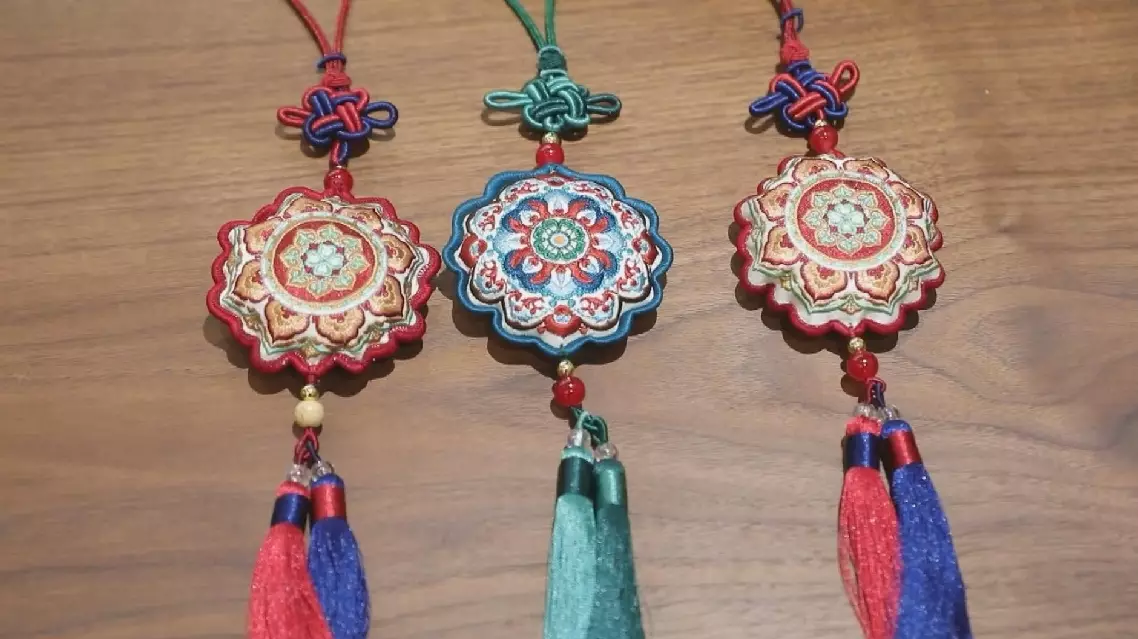
Traditional scented sachets refreshed with creative elements for Dragon Boat Festival