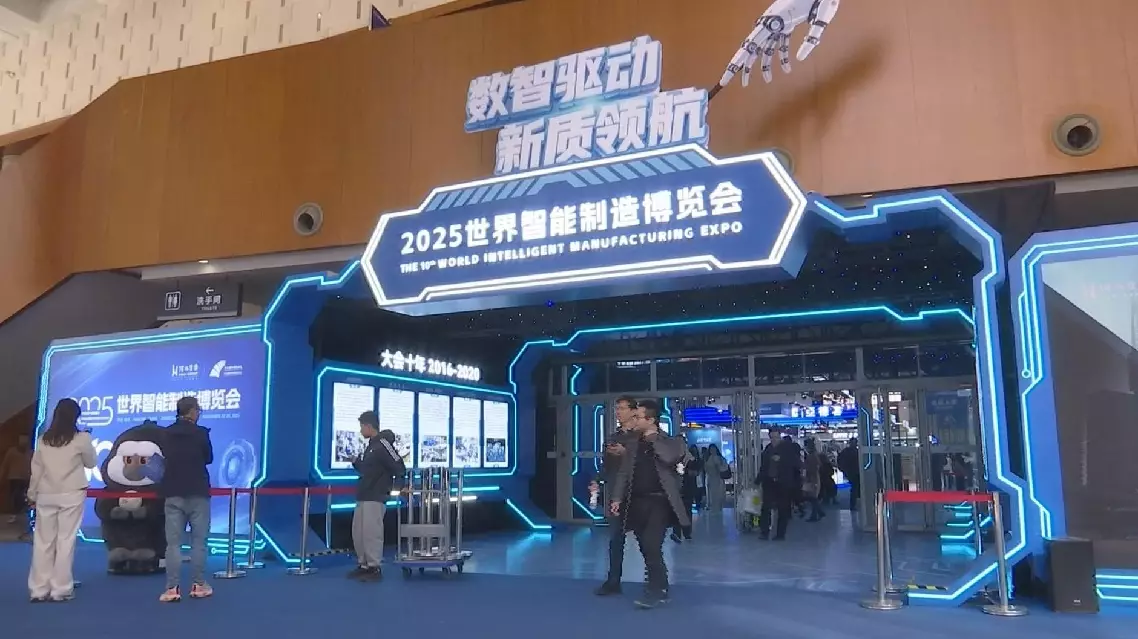
The 2025 World Intelligent Manufacturing Conference Expo opened on Thursday in Nanjing City, east China's Jiangsu Province, staging a futuristic show of cutting-edge technologies and global achievements in intelligent manufacturing.
With four themed exhibition zones displaying robotics, smart factories, industrial software and system solutions, and intelligent equipment in an area of 55,000 square meters, the expo has drawn a total of 456 companies from 21 countries and regions across the world.
In the zone of robotics, a variety of robots are on display from tightening screws and brewing coffee to performing household chores and directing traffic, sketching out a technological future that feels both highly sci-fi and surprisingly close to everyday life.
"This model is called the traffic command robot. We've integrated real-time traffic perception, multimodal intelligent interaction and intelligent decision-making [into the robot]. It can automatically detect traffic light signals at intersections, as well as vehicle and pedestrian flows. We will gradually start exercises on roads in December to test it in real traffic scenarios," said Zhang Tiejian, director of the Driving Safety Technology Research Institute at Duolun Technology.
Across the robotics zone, different types of robots attract crowds by demonstrating their specialized skills. At one booth, a visitor asked a service robot to take a kid's name and compose a personalized poem, which the robot wrote out in calligraphy.
"We gave it our kid's name, and it generated a poem and wrote it out as a gift. It's a pretty fun experience," said a visitor.
"It primarily works in health and senior care companionship settings. Its functions include handwriting, drawing, and playing Chinese chess," said an exhibitor.
The expo is held concurrently with the 10th World Intelligent Manufacturing Conference Expo from Thursday to Saturday.
2025 World Intelligent Manufacturing Conference Expo stages futuristic tech show
The heartbreaking story of 96-year-old Peng Zhuying, one of the last living survivors from the Japanese military's "comfort women" system in the Chinese mainland, has been shared in a moving documentary produced by the China Global Television Network (CGTN).
Peng remains one of only seven registered survivors in the Chinese mainland of the Japanese military's "comfort women" system, a brutal state-enforced regime of sexual slavery during World War II, victimizing over 400,000 women across Asia.
She is also the only living survivor who is officially documented as a victim of both sexual slavery and of Japan's chemical warfare during the Japanese militarists' war of aggression against China.
Eight decades on, Peng has bravely shared the story of her horrifying experiences in the CGTN original documentary "Last Daughters," which reveals the deep scars left by war and captures the quiet strength and warmth that endured, even in the darkest depths of human suffering.
Blinded by mustard gas at age nine and mutilated at 14 before being forced into a military brothel during the war, Peng was able to survive despite facing these unimaginable hardships in her young life.
Nowadays, Peng lives in a narrow alleyway, a humble dwelling with one room and one kitchen in central China's Hunan Province. Her door opens directly in front of a refurbished public toilet.
Born by the Yangtze River, Peng lost her eyesight as a child when Japanese mustard gas bombs fell on her hometown.
"I lost my eyesight when I was nine. The Japanese army struck Yueyang with bombs carrying poison. After I inhaled the mustard gas, I developed a fever, and then lost my eyesight," said Peng.
In the summer of 1938, Peng's mother and infant brother died from the killer gas. Her 13-year-old sister, Peng Renshou, was betrayed to Japanese soldiers while fleeing.
Before she passed away, Peng Renshou said the Japanese soldiers threatened to burn down a house with 50 people inside unless she surrendered. She had no choice. Brutally gang-raped until left unconscious, she survived but became infertile.
Three years later, the then 14-year-old Peng Zhuying suffered the same fate.
"It began with my sister's suffering. She was only 13. When my time came, I was 14, maybe 15. When they came for me, I resisted and refused to go. The Japanese broke two of my toes with sticks. After my toes were broken, I was dragged to the 'comfort women station' in Guozhen Town. I was violated there," said Peng.
After her release, with the help of villagers, when troops marched on Changsha, Peng bled relentlessly from her severe injuries.
"After I returned, I began having gynecological issues. I had persistent bleeding and none of the treatments helped. I was filled with hatred. I thought to myself, I've gotten this illness and it won't get better, so I would rather die. Later on, I received treatment from a doctor named Liu from the Red Cross. The doctor gave me pills and injections, and eventually my bleeding stopped," she said.
A CT scan taken last year revealed a calcified fetus in her womb, which had remained inside Peng Zhuying's body for 80 years.
Survivor of Japan's wartime sexual slavery, chemical attacks bravely shares story in CGTN documentary