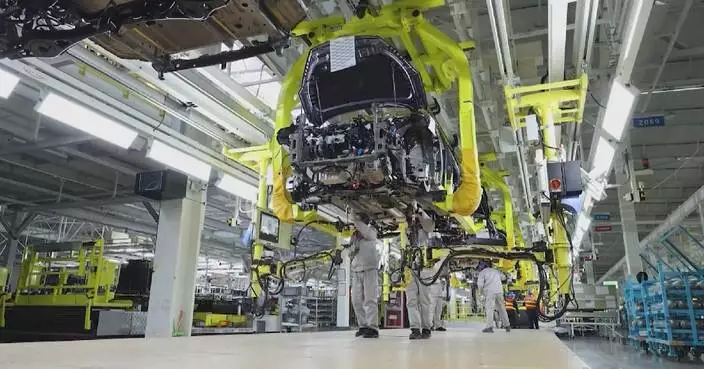
To address the logistical challenges of power grid construction in mountainous areas while protecting the ecological environment, southwest China's Chongqing Municipality has completed its first aerial transportation of transmission tower components using heavy-lift drones.
The operation concluded on Saturday as part of a renovation project on the 35-kilovolt Xitu Line, which involves 15 towers.
In Zhongliang Township of Wuxi County, northeast Chongqing, a heavy-lift drone carrying 289 kilograms of steel tower materials ascended along its planned route and flew straight toward Tower No. 17 of the Xitu Line.
After approximately 20 minutes, the drone hovered above the tower foundation and lowered the payload precisely onto the designated area. With drone assistance, all materials for the entire tower, which stands over 40 meters tall, were completed in just over two hours.
In the project, a total of 125.44 tons of tower materials for the 15 towers located on steep terrain were delivered exclusively by drones.
"The use of heavy-lift drones to transport transmission tower materials has demonstrated multiple significant advantages. Capable of flying directly over mountains, villages and other obstacles, the drones are well suited to complex terrain and eliminate the need to build winding mountain access roads. Compared with traditional mule-and-horse transport, overall costs are greatly reduced. Materials that originally required three days to deliver for a single tower now only take half a day," said Chen Tao, a staff member of the Construction Department, State Grid Chongqing Wuxi Power Supply Company.
Using drone to transport materials minimized the need for temporary road construction and eliminated tree felling, effectively protecting natural forests and preventing damage to mountain vegetation.
By reducing carbon emissions and ecological disturbance, drone transportation has achieved both environmental protection and economic efficiency.

Heavy-lift drone debuts in China's Chongqing to transport transmission tower materials
The surging U.S. immigration crackdown since 2025 has negatively impacted Latino businesses in Los Angeles, home to the country's biggest Hispanic population, where increases in federal arrests of migrants have led to fewer customers and lower sales.
Teodoro Cuevas, a Mariachi musician who has come to the Mariachi Plaza in Boyle Heights -- a cultural hub for Los Angeles' Latino community -- to play music for 25 years, is one of many workers and business owners feeling the effects of a major expansion in immigration enforcement.
"There used to be a lot of people here. The mariachis were here, dressed and ready to work every day. The work isn't the same anymore," he said.
Federal immigration arrests nationwide reached nearly 51,000 in August, a record for a third consecutive month.
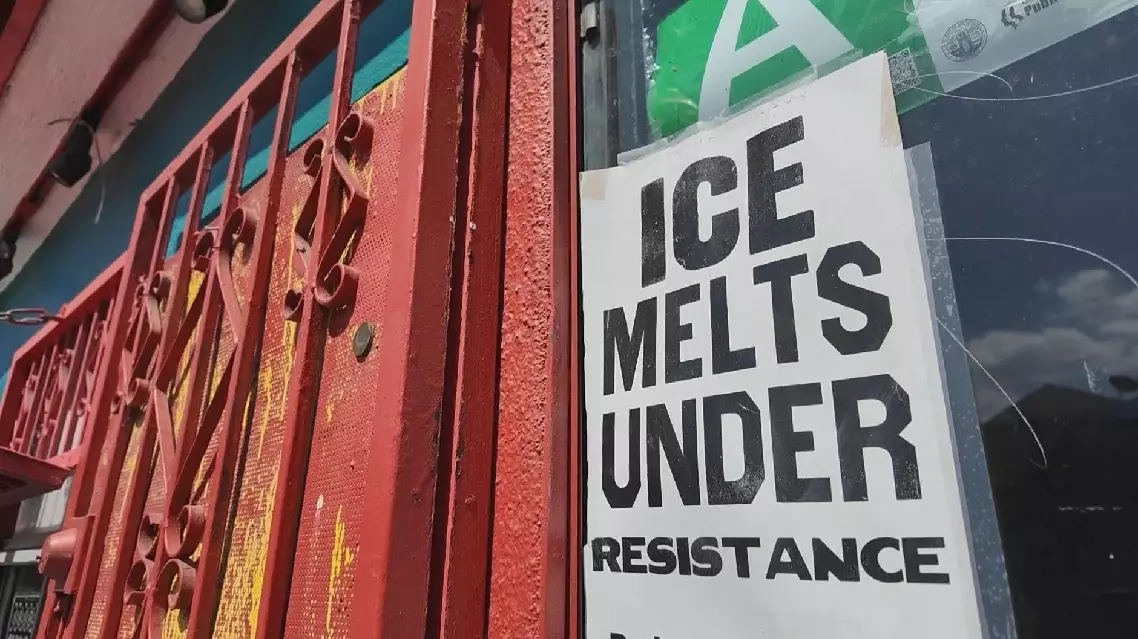
In Los Angeles County, business owners say greater enforcement has spread fear through Latino neighborhoods.
A study by the Latino Policy and Politics Institute at University of California, Los Angeles (UCLA) found the June 2025 Immigration and Customs Enforcement (ICE) raids led to 46,000 fewer customer visits and more than 3 million U.S. dollars in estimated losses near nine immigration enforcement sites in the two weeks after the operations, including the Fashion District, an iconic commercial and cultural landmark of Downtown Los Angeles.
"Before, there were so many people you could barely walk. Now, there's more space and fewer people," said Eric Vaquero, a fabric store worker.
Leonardo Crespo, owner of a restaurant in Boyle Heights, said he used to serve about 100 customers a day, but the figure is now closer to 20 in some days.
"The concern about other people, it's just getting hauled in, because you look a certain way. That's it. It doesn't matter. I had my mother telling me. 'You should carry your birth certificate.' I said I'm not going to do that," he said.
Those concerns are not limited to undocumented immigrants. A ProPublica investigation documented more than 170 U.S. citizens held by immigration agents in the first nine months of 2025.
At least 53 people died in ICE custody between the beginning of President Donald Trump's second term on January 20, 2025 and mid-July 2026, according to a joint report by Human Rights Watch and Physicians for Human Rights.
"So, if you are a Hispanic person that even was born in the U.S., a citizen, you may be scared of going out, because ICE has big pressure to detain people, and they are known for being hostile. So you actually fear for your life or safety or think 'I don't want to be detained.' Right?" said Julio Sevilla, a professor at University of Georgia.
Latino businesses in Los Angeles struggling amid surging federal immigration enforcement