Russia said on Sunday that its armed forces had advanced in Pokrovsk, while Ukraine claimed to have repelled Russian attacks on the same day.
The Russian Ministry of Defense said in its latest report that over the past 24 hours, its forces conducted operations in multiple directions, including Sumy and Kharkiv, striking targets in 143 areas in Ukraine. These targets included Ukrainian military-industrial complexes, fuel depots, and temporary deployment points for Ukrainian troops and foreign mercenaries. The Russian air defense system also shot down 230 fixed-wing drones.
In Pokrovsk, Donetsk region, Russian troops continued to advance into the eastern and northwestern areas of the city, repelling 10 breakout attacks initiated by Ukrainian forces.
Also on Sunday, the General Staff of the Armed Forces of Ukraine reported that 271 battles occurred in the frontline areas, with Ukrainian forces repelling Russian attacks in multiple directions. The Ukrainian Air Force, missile troops, and artillery targeted four areas where Russian troops were gathered and two artillery systems.
Ukrainian President Zelensky on Sunday mentioned on social media that this week, Russian forces have used around 1,400 drones, 1,100 guided aerial bombs, and 66 missiles against Ukrainians.
In another development, Russian Foreign Ministry spokesperson Maria Zakharova on Sunday condemned recent Ukrainian attacks on two oil tankers and a port in the Black Sea, denouncing those who planned and carried out the strikes.
According to a statement released by the ministry, Zakharova said the two tankers sailing under the Gambian flag and en route to the Russian port of Novorossiysk were attacked by unmanned surface vessels on Friday and Saturday. The port of Novorossiysk also came under attack on Saturday.
She added that Ukrainian intelligence services had claimed responsibility for the attacks.
The targeted civilian energy infrastructure plays a vital role in ensuring global energy security and has never been subject to any international restrictions or sanctions, the spokesperson said, adding that these attacks jeopardized the safety of navigation in this vital waterway.
Russia also calls on the international community to condemn these attacks and give a proper assessment of the destructive actions, Zakharova said.

Russia reports advances in Pokrovsk while Ukraine claims to repel Russian attacks
China's box office revenue has exceeded 11 billion yuan (about 1.6 billion U.S. dollars) so far this year, maintaining its position as the world's largest single film market.
The total, including pre-sales, surpassed the mark on Thursday, according to data from Maoyan, one of the country's major online movie ticket platforms.
When the National People's Congress (NPC), China's top legislature, and the National Committee of the Chinese People's Political Consultative Conference, the country's top political advisory body, was in session earlier in March, the strong performance of China's film industry became a widely discussed topic among NPC deputies and national political advisers.
Many said China's leading position in the global box office marks not only a breakthrough but also a new starting point.
Driven by the "Film Economy Promotion Year" initiative, relevant authorities have been promoting cross-sector programs linking films with tourism, gastronomy and intangible cultural heritage, with the emerging "film-plus" consumption model turning box office momentum into broader growth for the real economy.
With support from the China Film Administration, local governments have rolled out a variety of movie ticket subsidy programs since the start of the year, helping reduce average ticket prices by about 6 percent and encouraging more people to go to theaters. Screenings during the nine-day Spring Festival holiday reached a record 4.35 million sessions nationwide.
A single movie ticket can spur spending in sectors ranging from dining and shopping to transportation and cultural merchandise, providing a boost to the offline economy.
Estimates show the total value generated by the film industry has exceeded 150 billion yuan (about 22 billion U.S. dollars) in 2026.
Beyond theaters, the trend of traveling with films is fueling a new wave of consumption. Regions across China are combining local cultural and tourism resources with film-related promotions, creating "film-plus-tourism" experiences that turn cinematic popularity into consumer demand.
Since the start of the year, Chinese films have not only driven the domestic box office but have also continued gaining popularity overseas.
During the Spring Festival holiday, films including "Scare Out" and "Blades of the Guardians" were released simultaneously on the first day of the Chinese New Year in more than a dozen countries and regions, including North America, Europe, Australia, New Zealand and Southeast Asia.
At the same time, overseas promotions for initiatives such as "China Travel with Chinese Films" are attracting more international audiences to visit China so as to experience the country's culture, natural scenery and modern development.
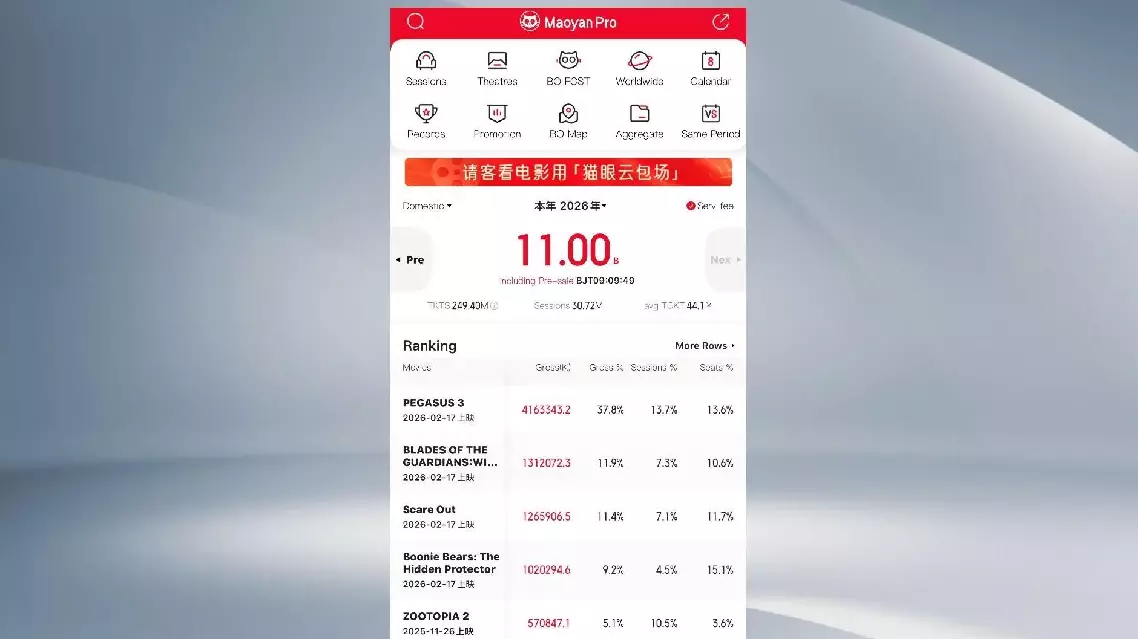
China's box office surpasses 11 bln yuan in 2026