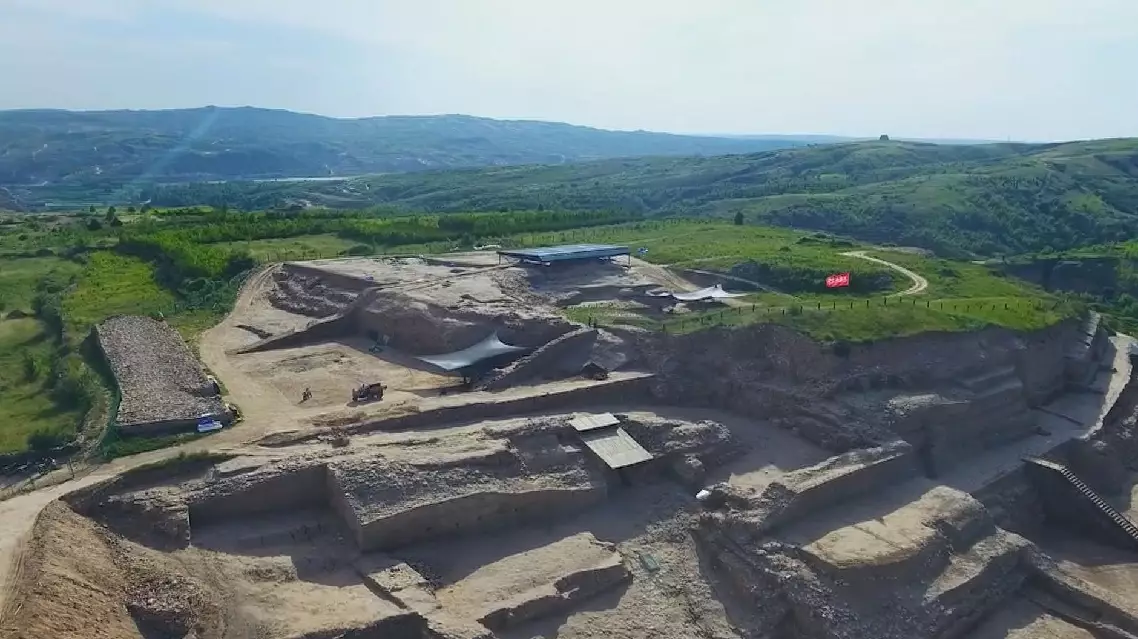
A 13-year study of DNA samples collected from the 4,000-year-old Shimao site, a gigantic complex of prehistoric ruins on the northern edge of the Loess Plateau in northwest China's Shaanxi Province, has unlocked clues that could decode the population structure and kinship systems of the ancient people who inhabited the area.
Dating back about 4,200-3,700 years, the Shimao site is a massive, clearly socially stratified late Neolithic settlement located in northern Shaanxi Province.
"The basic layout of the Shimao site's urban area has been extensively confirmed. Within the Shimao city, numerous high-grade archaeological relics have been discovered, predominantly concentrated around a high ground called Huangchengtai, which is presumed to be the palace city zone of Shimao. During our excavations, we observed tens of thousands of bone artifacts and evidence of bone tool production, indicating that Huangchengtai housed a large-scale bone utensil workshop," said Shao Jing, deputy director of the Shaanxi Provincial Academy of Archaeology.
The research team spent 13 years carrying out large-scale, high-resolution nuclear genome analysis on 169 ancient human samples collected from Shimao and the surrounding sites, as well as the southern Shanxi region neighboring Shaanxi. The new findings were published in the 'Nature' journal on November 27, shedding light on the origins, population structures, and kinship systems of the people of Shimao.
"The Shimao culture predominantly derives from late Yangshao populations in northern Shaanxi, demonstrating clear genetic continuity and confirming the region's deep indigenous roots. In a minority of individuals, Yumin ancestry from the northern grasslands and coastal rice-farming populations from southern regions was detected, objectively illustrating the multicultural and inclusive nature of Chinese civilization from its inception. The study provides the first comprehensive understanding of their social structure, reconstructs early state kinship ties, and reveals complex forms of social organization. Meanwhile, evidence of human sacrifice offers valuable perspectives on early societal frameworks," said Fu Qiaomei, deputy director, the Institute of Vertebrate Paleontology and Paleoanthropology, the Chinese Academy of Sciences.
Furthermore, the study offers the first direct genetic evidence for exploring power inheritance models and the composition of ruling families and social strata in the origins of early East Asian states.
New DNA study unlocks origins, social structure of ancient Shimao people in northwest China