BOSTON (AP) — A Harvard visiting law professor from Brazil who told police he was shooting at rats when he fired a pellet gun near a synagogue during Yom Kippur has left the United States after his visa was revoked, federal officials and his lawyer confirmed on Thursday.
After Immigration and Customs Enforcement arrested Carlos Portugal Gouvêa on Wednesday, officials said he agreed to depart the United States voluntarily instead of being deported. He arrived in Brazil on Thursday, according to a statement from his attorney, Joseph D. Eisenstadt.
Homeland Security officials described the incident in October as antisemitic, but in a social media post days afterward, Temple Beth Zion in the Boston metropolitan area town of Brookline said it did not appear to be motivated by antisemitism. Police initially told the synagogue that “the individual was unaware that he lived next to, and was shooting his BB gun next to, a synagogue or that it was a religious holiday. We were told he said he was shooting rats.”
In a statement, Assistant Secretary Tricia McLaughlin called working and studying in the United States a privilege, “not a right.”
“There is no room in the United States for brazen, violent acts of anti-Semitism like this," she said, calling it an “affront” the the nation's core principles and "an unacceptable threat against law-abiding American citizens.”
According to the Brookline Police's arrest report, law enforcement was called to Temple Beth Zion for a report of a “person with a gun” just after 9 p.m. on Oct. 1 during Yom Kippur, considered the holiest day for Jews who spend it seeking to atone for sins and seek forgiveness.
Private security assigned to guard the temple during holiday services said they'd heard “at least two loud shots fired" and spotted Gouvêa behind a tree holding a pellet rifle, according to the report.
An officer began to approach Gouvêa and the professor set the pellet gun down against the tree before "the two began to get in a brief physical struggle, falling to the ground after Mr. Gouvêa lunged towards the rifle," the arrest report reads.
According to the arrest report, Gouvêa told officers he used the pellet gun to “hunt rats” in his neighborhood.
Gouvêa initially pleaded not guilty to three misdemeanor and one felony charges: illegally discharging a BB/pellet gun, vandalism, disorderly conduct and disturbing the peace.
David Linton, spokesperson for Norfolk District Attorney Michael Morrissey, said all charges against Gouvêa but the misdemeanor illegal BB/pellet gun discharge charge were dismissed last month.
As part of a plea agreement, Gouvêa was placed on pretrial probation for six months on the one charge and was ordered to pay restitution of $386.59 to a person whose car window he broke with a pellet. He did not change his plea from not guilty.
After the six months, if he doesn't break any laws, that final count will be dismissed administratively. Gouvêa will not be required to go before a judge.
DHS said Gouvêa's J-1 visa, a nonimmigrant visas for people participating in exchange visitor programs, was revoked by the State Department on Oct. 16 following “an anti-Semitic shooting incident in October.”
Harvard Law School’s website lists Gouvêa as a visiting professor of law for the fall 2025 semester. He was teaching two courses: Corruption and Inequality Seminar: Unraveling the Vicious Circle and Sustainable Capitalism. The site says Gouvêa is an associate professor at the University of São Paulo Law School and CEO of the Global Law Institute, a think tank on environmental and social justice in Brazil.
Harvard did not have a comment on Gouvêa’s case.
In a statement after Gouvêa’s arrest in October, University of São Paulo’s Law School Director Celso Fernandes Campilongo repudiated “the malicious and distorted insinuations” against Gouvêa, noting his history of advocating for human rights and his affinities, including family ties, to the Jewish community.
__ Brumfield reported from Cockeysville, Maryland. AP journalist Gabriela Sá Pessoa contributed from São Paulo, Brazil.
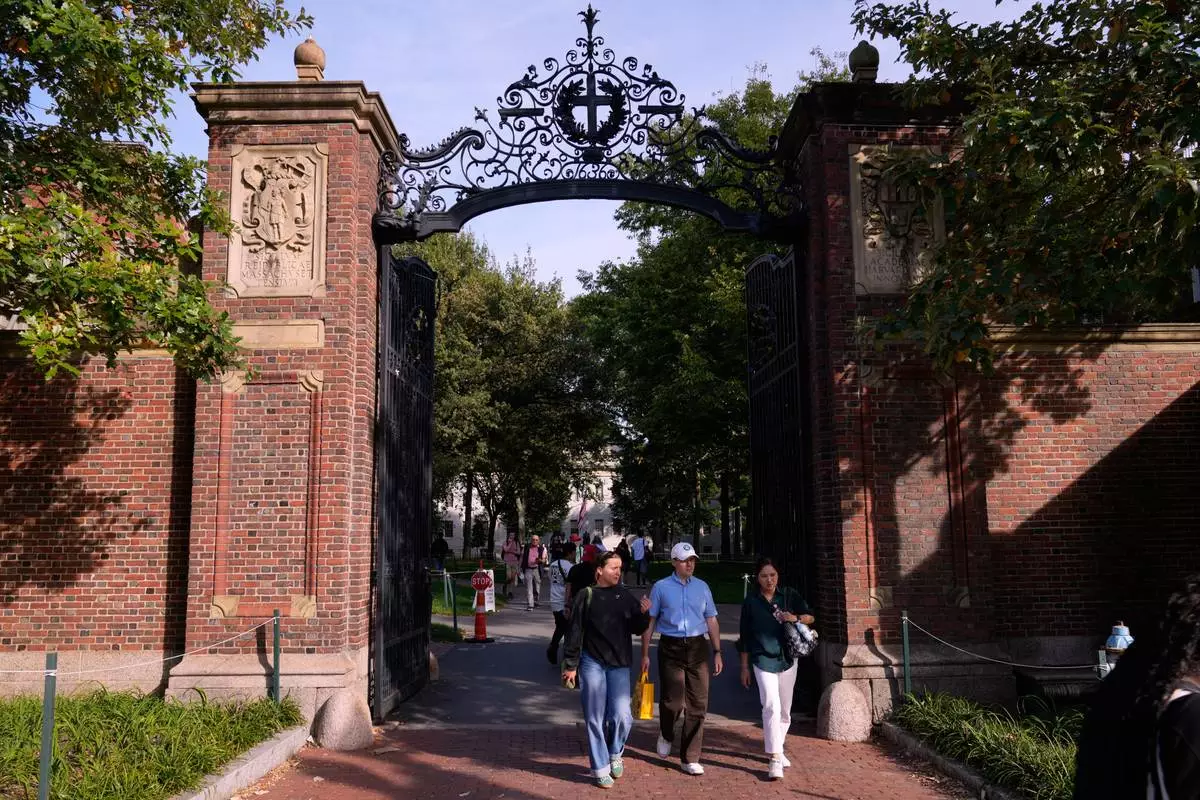
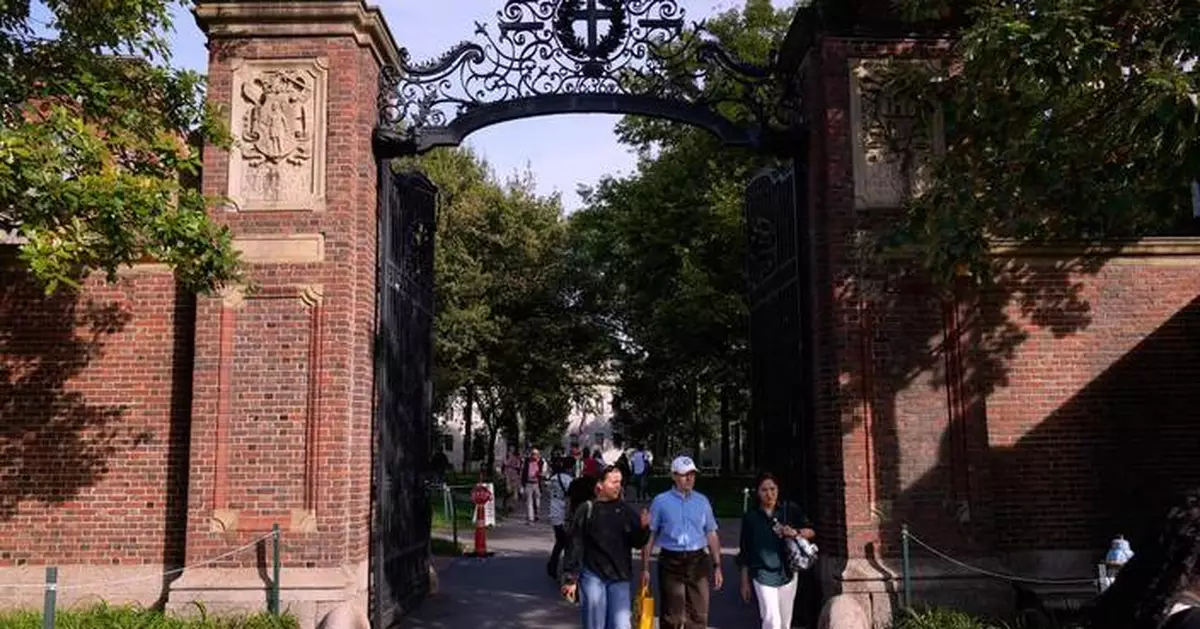
FILE - The gates of Harvard Yard at Harvard University, Tuesday, Sept. 30, 2025, in Cambridge, Mass. (AP Photo/Charles Krupa, File)
WASHINGTON (AP) — President Donald Trump was awarded the new FIFA peace prize on Friday at the 2026 World Cup draw — giving the spectacle to set matchups for the quadrennial soccer tournament even more of a Trumpian flair.
Trump, who had openly campaigned for the Nobel Peace Prize, had been heavily expected to receive the newly created FIFA prize. FIFA president Gianni Infantino, a close ally of Trump, has said he thought Trump should have won the Nobel for his efforts to broker a ceasefire in Gaza.
In awarding the prize, Infantino told Trump it was a “beautiful medal for you that you can wear everywhere you want to go.” Trump promptly placed the medal around his neck. The certificate that Infantino handed Trump recognizes the U.S. president for his actions to “promote peace and unity around the world.”
Infantino also presented Trump with a gold trophy with his name on it that depicts hands holding up the world. “You definitely deserve the first FIFA Peace Prize for your action, for what you have obtained in your way," said Infantino, who spoke after a video was played that showed images of Trump meeting with world leaders from countries whose conflicts he has taken credit for resolving.
Trump thanked his family, including his wife, first lady Melania Trump, and praised the leaders of the other two host nations — Canadian Prime Minister Mark Carney and Mexican President Claudia Sheinbaum — in his brief remarks, saying the coordination with the countries has been “outstanding.”
“This is truly one of the great honors of my life,” Trump said, adding that “most important, I just want to thank everybody. The world is a safer place now.”
Infantino has often spoken about soccer as a unifier for the world, but the prize is a departure from the federation’s traditional focus on sport.
Infantino has been a frequent visitor to the Oval Office, including in November when the administration announced new efforts to expedite visa processing for World Cup visitors. Infantino had a prime seat at Trump’s January inauguration and FIFA has established an office at Trump Tower in Manhattan.
FIFA has given no details about the process for choosing a winner. When Infantino first announced last month that the organization would give out a peace prize, some of its senior officials were caught off guard, learning about it through reports in the media.
The FIFA president was also on hand Thursday at the newly renamed Donald J. Trump Institute of Peace in Washington, where Trump and the leaders of the Democratic Republic of Congo and Rwanda signed a deal aimed at ending the conflict in eastern Congo.
FIFA's award to Trump came during a week in which his administration has been engaged in shuttle diplomacy to try to end the war in Ukraine, while also under scrutiny for lethal strikes on alleged drug boats in the Caribbean and as Trump hardens his rhetoric against immigrants.
The Nobel for peace was awarded this year to Venezuelan opposition leader Maria Corina Machado, who said shortly after the prize was announced that she was dedicating it in part to Trump for “his decisive support of our cause.” Machado will receive the award at the traditional Nobel Peace Prize ceremony in Oslo, Norway, on Dec. 10.
Associated Press sports reporter Graham Dunbar in Geneva contributed to this report.
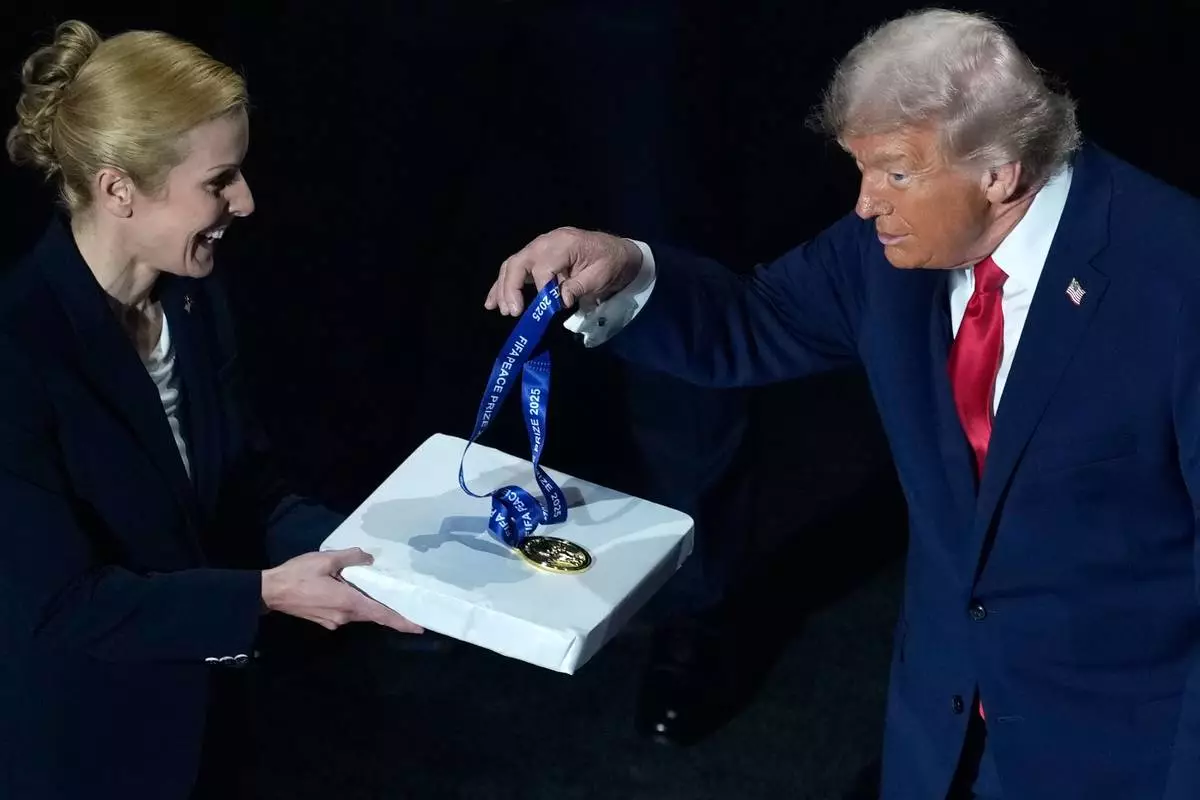
President Donald Trump picks up his FIFA Peace Prize medal, awarded to him by FIFA President Gianni Infantino, before the draw for the 2026 soccer World Cup at the Kennedy Center in Washington, Friday, Dec. 5, 2025. (AP Photo/Julia Demaree Nikhinson)
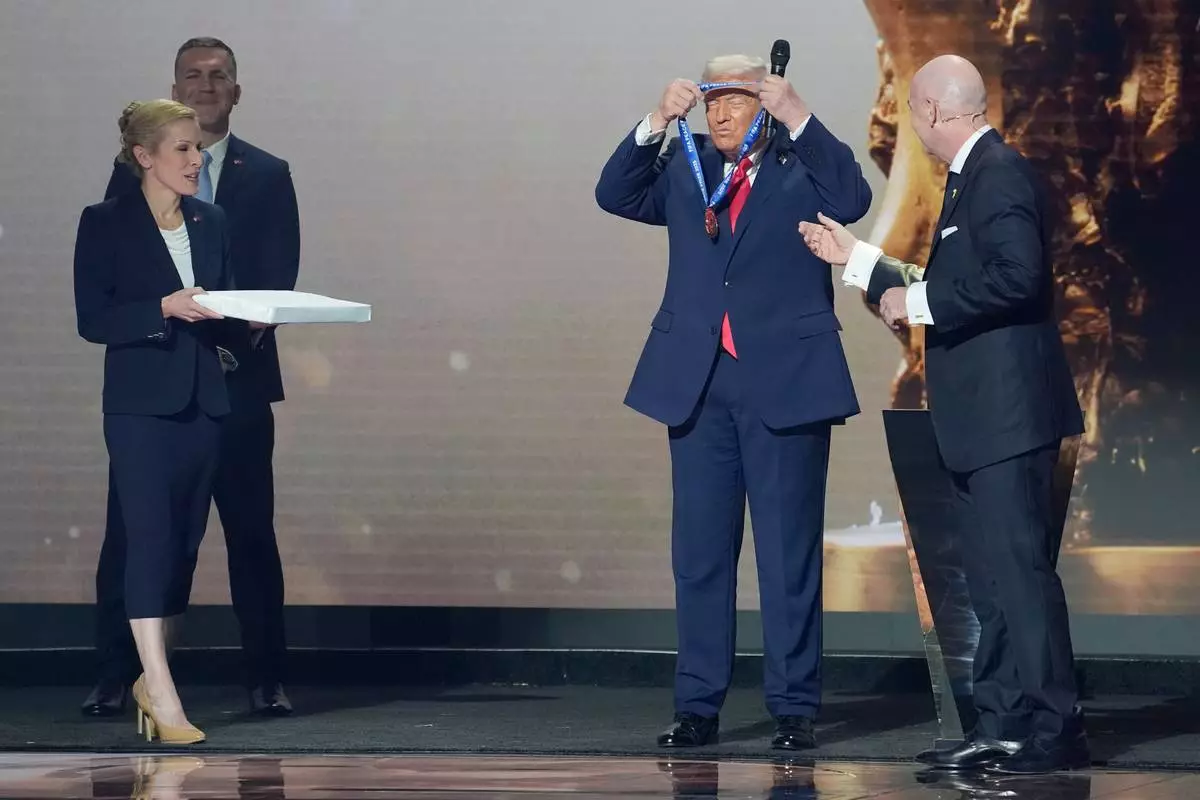
President Donald Trump is presented with the inaugural FIFA Peace Prize by FIFA President Gianni Infantino during the 2026 FIFA World Cup draw at the Kennedy Center, Friday, Dec. 5, 2025, in Washington. (AP Photo/Evan Vucci)
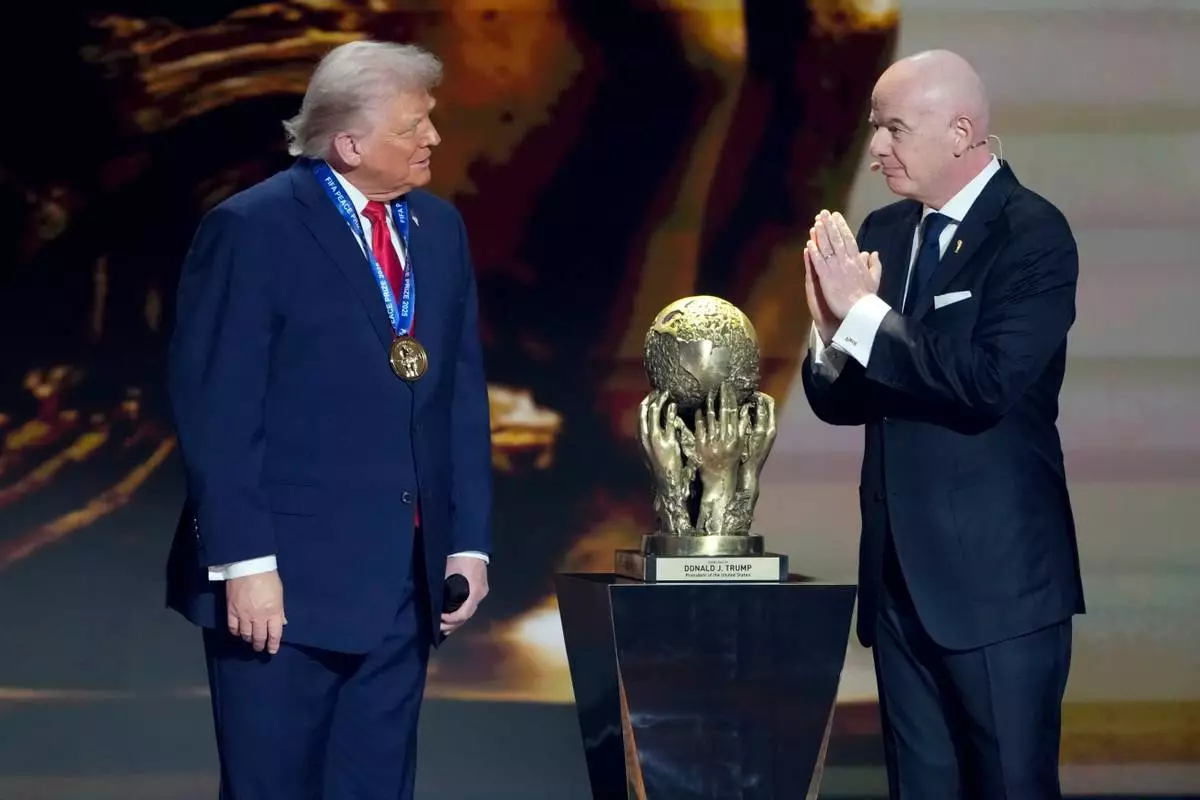
FIFA President Gianni Infantino, right, awards President Donald Trump with the FIFA Peace Prize during the draw for the 2026 soccer World Cup at the Kennedy Center in Washington, Friday, Dec. 5, 2025. (AP Photo/Chris Carlson)
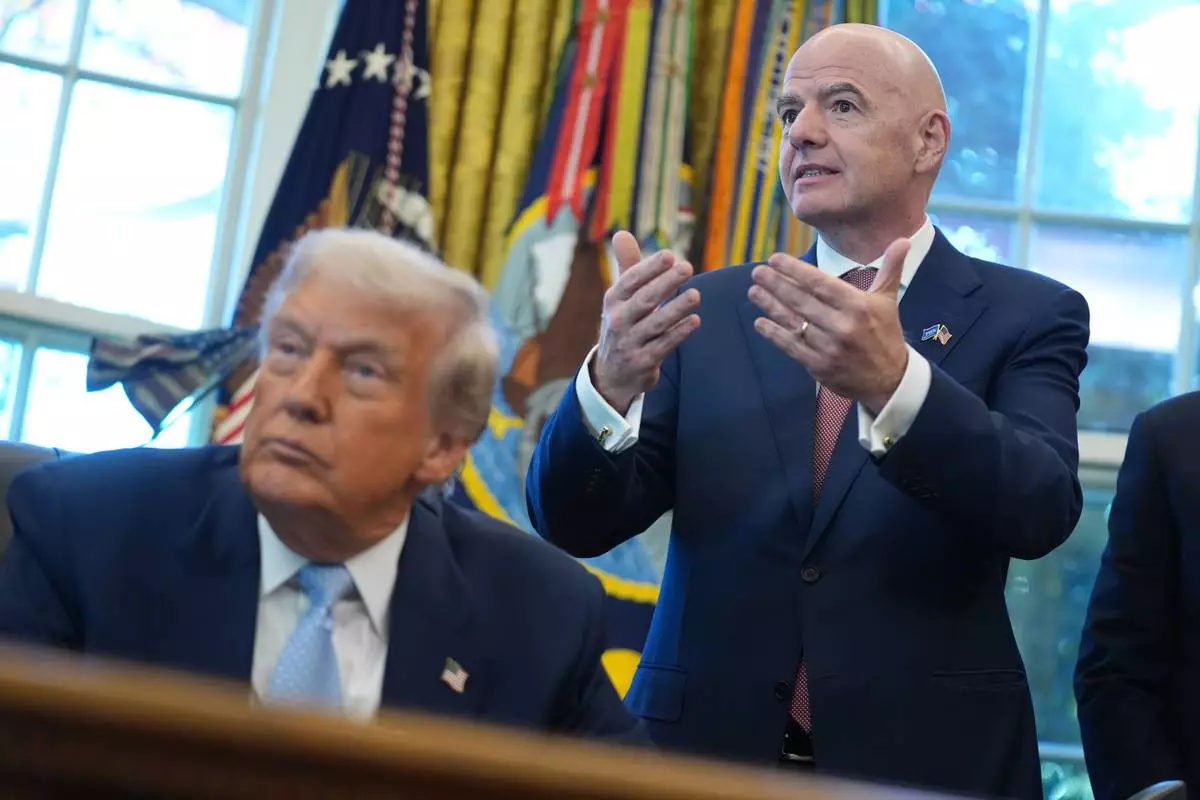
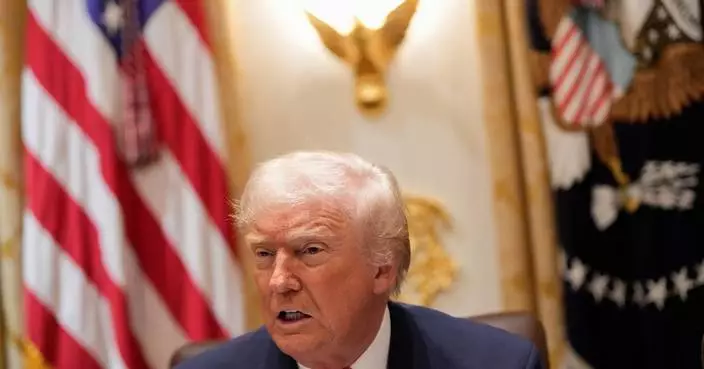
FILE - President Donald Trump listens as FIFA President Gianni Infantino speaks during a meeting with the White House task force on the 2026 FIFA World Cup in the Oval Office of the White House, Nov. 17, 2025, in Washington. (AP Photo/Evan Vucci, File)
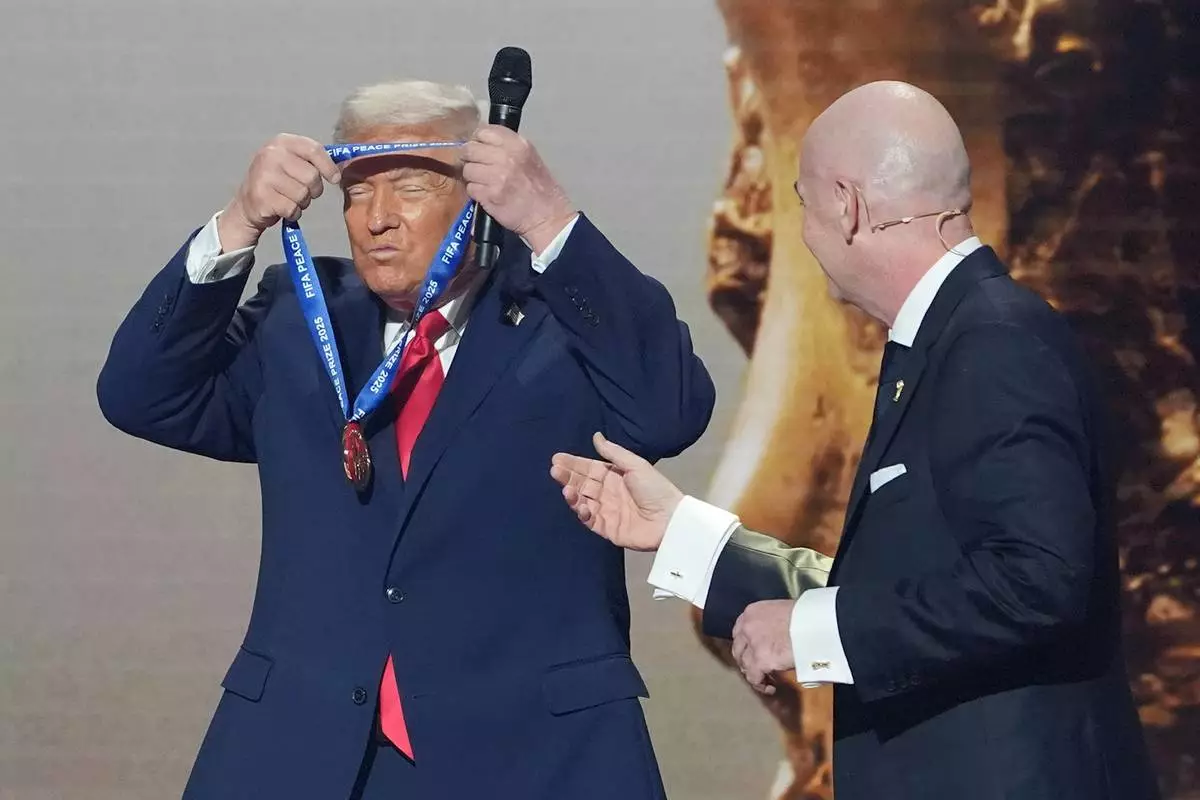
President Donald Trump is presented with the inaugural FIFA Peace Prize by FIFA President Gianni Infantino during the 2026 FIFA World Cup draw at the Kennedy Center, Friday, Dec. 5, 2025, in Washington. (AP Photo/Evan Vucci)
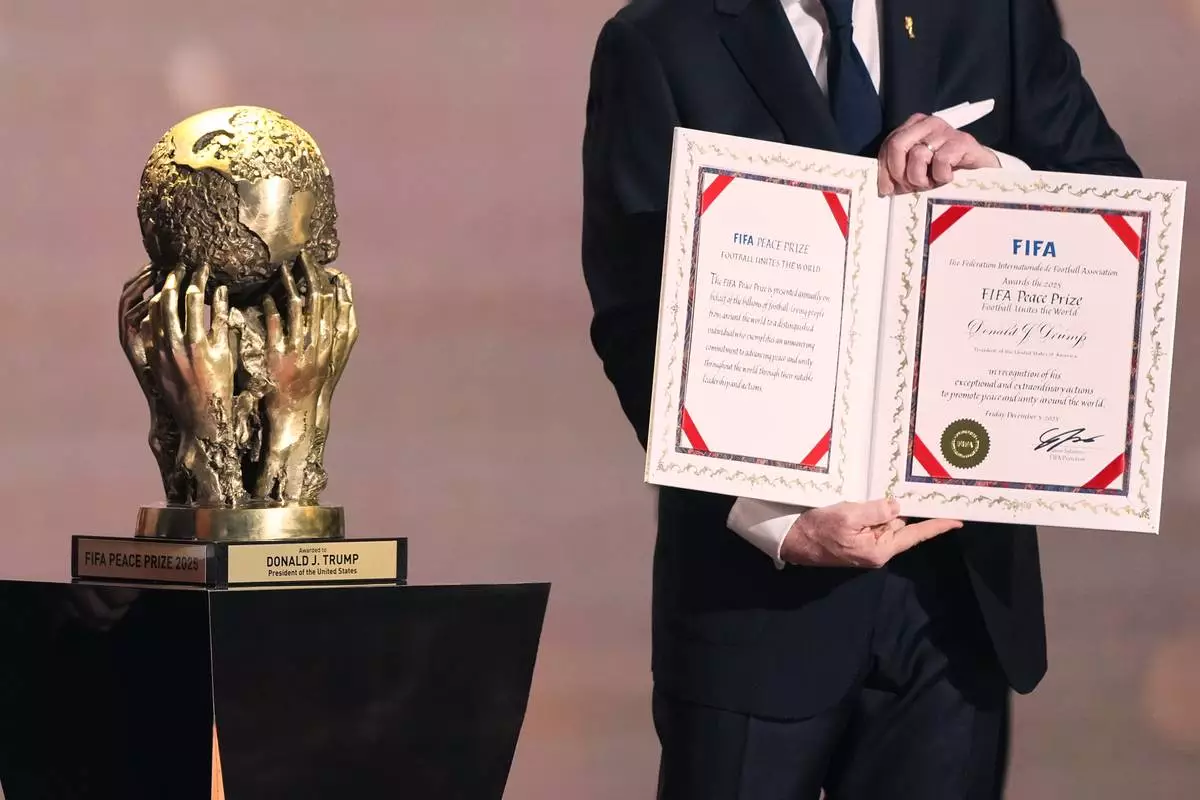
FIFA President Gianni Infantino presents President Donald Trump with the FIFA Peace Prize during the draw for the 2026 soccer World Cup at the Kennedy Center in Washington, Friday, Dec. 5, 2025. (AP Photo/Stephanie Scarbrough, Pool)
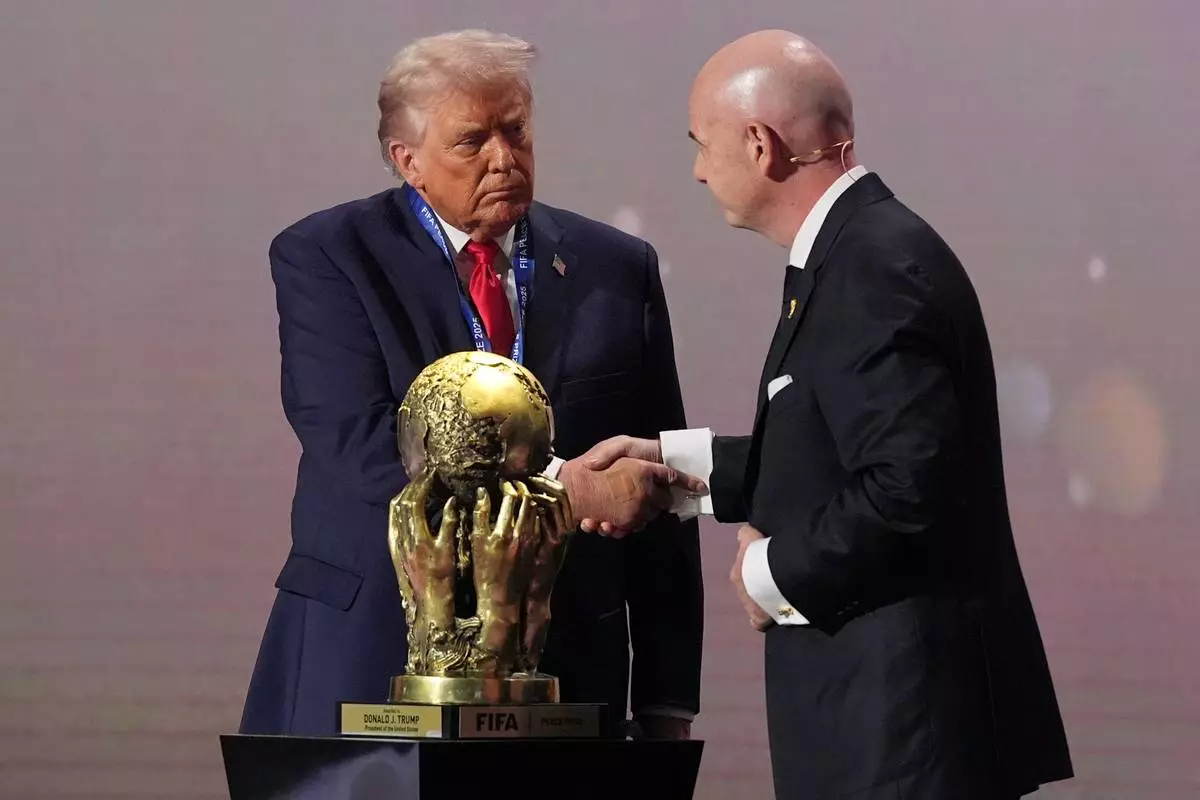
President Donald Trump receives the FIFA Peace Prize from FIFA President Gianni Infantino during the draw for the 2026 soccer World Cup at the Kennedy Center in Washington, Friday, Dec. 5, 2025. (AP Photo/Jacquelyn Martin)