Eric Foster, nephew of U.S. journalist Edgar Snow, said he has spent more than 12 years writing a book to present the real China to the world, following in the footsteps of his uncle who chronicled China's revolutionary in the 1930s and 1940s.
This November, Foster traveled to Yan'an City in northwest China's Shaanxi Province, where Edgar Snow ventured deep into China's revolutionary heartland. Yan'an hosted the headquarters of the Communist Party of China (CPC) and was the center of the Communist revolution from 1935 to 1948.
In 1936, at a time when China was embroiled in internal conflict and external aggression, Snow made his way to the remote headquarters of the CPC in Yan'an. As the first Western journalist to enter the area, he conducted extensive interviews and careful documentation there.
Snow's reporting culminated in "Red Star Over China," in which he painted a picture of a resilient, promising country that the world rarely saw, and challenged the world's misunderstandings and prejudices about China.
Foster visited a former residence of Mao Zedong, where Snow met Mao for the first time.
"My uncle and Mao actually sat down here, and this is where Mao Zedong told my uncle about the Long March, and lots of other very important information," said Foster, who then introduced in detail how Snow took Mao's "public relation picture for the West."
"Mao was standing, he was standing right here. My uncle was getting ready to take a picture of Mao. And it's a very important picture, his public relations picture for the West. And he was going to take a picture, but Mao's hair was quite long. So, my uncle said, 'Hey, does somebody have a pair of scissors?’ And so they got a pair of scissors and they cut Mao's hair. And then he brushed it back, and so he's going to take the picture again. But something still was not right, and then he had the idea. I know, they took his hat off, put it on Mao, and that's the story behind that hat on Mao. It's actually my uncle's hat," said Foster.
"So it is quite remarkable how simple life was, and when you can imagine what came out of this simple room, the percussions that affected history, not only history of China, but the whole world, what came out of this room here," Foster said.
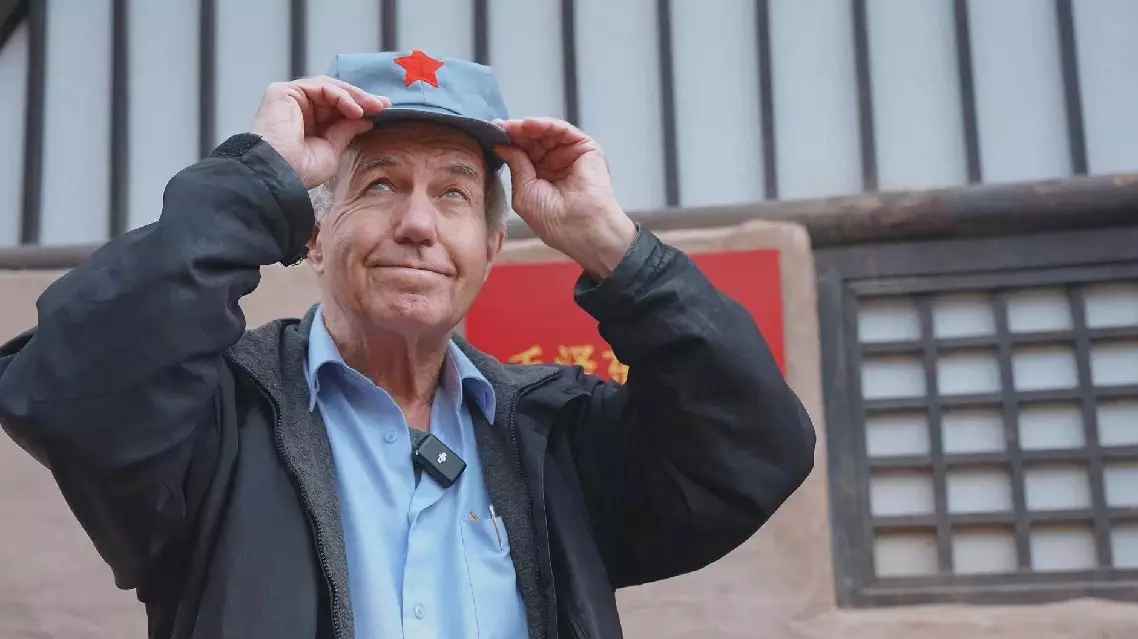
Foster was presented a replica of the octagonal cap given by Snow to Mao Zedong.
"As I put on this cap, I can almost feel the weight it carried in those days. It feels not merely like nostalgia, but more like a form of inheritance. What they (my uncle and my aunt) tried to do with their life, is to try to build a bridge between the two countries. As my aunt said that, the people-to-people between China and America is so important. Because the politics is like the weather, it changes all the time, so the people-to-people is what's really important. We need to build that bridge between the people-to- people. So I want to try to do what my aunt and uncle did, to promote China to the world. And then I thought, oh I need to write a book, that's what I need to do. This is what I've been doing for last 12 years or 13 years. My book tries to tell the true history about China, to help whoever reads it in America or other Western countries to see the real China," said Foster.
After the founding of the People's Republic of China, Snow paid three further visits to the country. He remained interested in China following his visits, and firmly supported the just cause of the Chinese people. He has therefore come to be regarded as a lifelong friend of the Chinese people.
With a notebook in his hand and moral clarity in his heart, Snow constructed an unprecedented bridge of mutual respect and understanding between China and the rest of the world that still stands today.
Edgar Snow's nephew aims to present real China to world