China's Qingzhou cargo spacecraft has completed multiple key technology verifications and entered integrated testing.
Qingzhou, which means "Light Ship" in Chinese, has been designed to be smaller in size and lighter in weight than the existing Tianzhou (Sky Ship) cargo craft.
Developed by the Innovation Academy for Microsatellites of the Chinese Academy of Sciences, the vehicle is expected to provide a low-cost solution for transporting supplies to and from China's space station.
After passing its design review in June, the Qingzhou prototype moved into the initial manufacturing phase, with all research and development work progressing smoothly.
The prototype measures roughly 3.3 meters in diameter, weighs 5 tonnes, and can carry up to 1.8 tonnes of cargo to orbit. Its structure combines a sealed module with an unsealed aft section, allowing taikonauts' supplies and precision instruments to be stored safely in the pressurized area. Meanwhile, external payloads and space-exposure experiments can be mounted on the open section to maximize transport efficiency.
The Innovation Academy for Microsatellites has completed testing the prototype’s software design, safety and reliability design, spacecraft-rocket compatibility verification, medical evaluation and key technology verification.
More targeted testing and verification of the prototype and later versions will be carried out in the future, according to the research team.
"We have now conducted large-scale experiments and are currently loading and verifying the status of the remaining individual machines, as well as conducting final testing. The overall test results are quite good,” said Wu Huiying, deputy chief designer of the Qingzhou cargo spacecraft.
Full engineering model production is scheduled to begin in early 2026, and all construction will be completed by the end of the year, followed by its maiden flight in accordance with the need of the space station, scientists say.
"After the maiden flight of the Qingzhou cargo spacecraft, we will follow the plan for the in-orbit development of the space station. In the future, the space station will be expanded from a T-shape to a structure of a cross with a horizontal bar atop, which requires a large amount of supplies being transported to the space station. Together with the Tianzhou cargo craft and the Haolong space cargo shuttle, we will see a stronger delivery capacity to the Chinese Space Station,” said Chang Liang, chief designer of the Qingzhou cargo spacecraft.
Using a single-module configuration, Qingzhou prioritizes space efficiency and mission economy. Inside, four cargo racks provide 40 storage compartments and a total volume of 27 cubic meters, capable of carrying daily necessities, scientific equipment, and research payloads. The craft also features five 60-liter cold-chain units to store the taikonauts' food and temperature-sensitive biological samples.
The Qingzhou cargo spacecraft will not just function as a cargo ship but will also be equipped with experimental equipment for in-orbit research.
"For instance, this is a test satellite we made for unfolding solar panels. It can be separated in space to conduct different experiments,” said Chang.
"We installed a lot of space experiment equipment on the initial sample. For example, right below us is a laser sintering device, which is used for in-orbit laser research,” Chang said.
Designed for two-way logistics, the Qingzhou spacecraft can deliver supplies from Earth to the space station and bring back around 2 tonnes of waste from orbit.
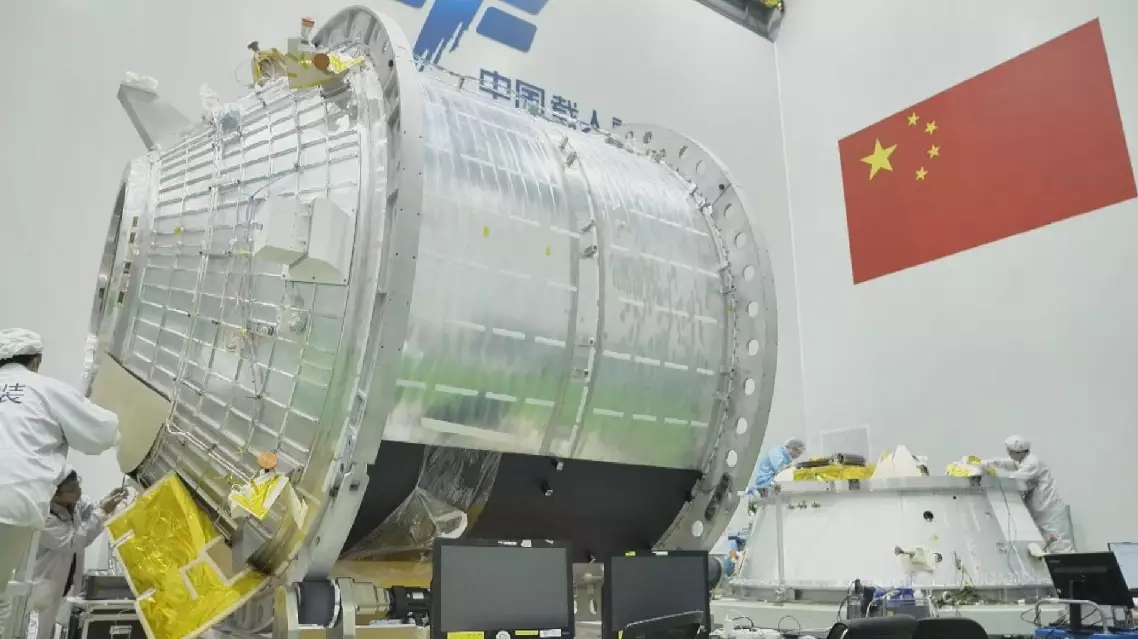
China's new cargo spacecraft completes multiple key technology verifications