Skip to Content Facebook Feature Image

China's astronauts check Shenzhou-20 viewport window during spacewalk

China

China

China

China's astronauts check Shenzhou-20 viewport window during spacewalk

2025-12-10 08:53 Last Updated At:12:37

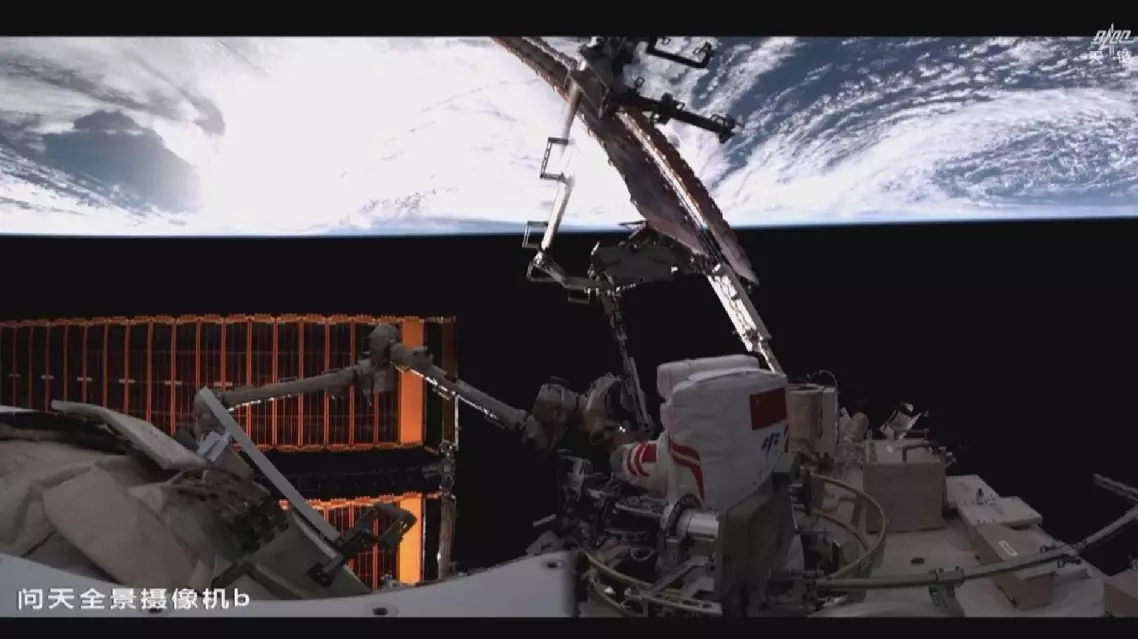
The Shenzhou-21 crew successfully completed their primary objective during their first series of extravehicular activities (EVAs) on Tuesday, which was inspecting and photographing the viewport window of the Shenzhou-20 return capsule, according to the China Manned Space Agency.

Tiny cracks were found in the viewport window, most probably caused by external impacts from space debris. As a result, the Shenzhou-20 spacecraft did not meet the safety requirements for the astronauts' return and has remained in orbit.

The trio crew, consisting of mission commander Zhang Lu and astronauts Wu Fei and Zhang Hongzhang, completed all assigned tasks by 18:42 (Beijing Time) after more than eight hours, with assistance from the space station's robotic arm and ground-based research fellows.

"The astronaut moved outside the module, carrying high-definition camera to take photos, and the ground personnel confirmed the status. The first task was to inspect from the outside of the module whether there were any further anomalies of the viewport window, and the second was to assess the structure surrounding the window to provide technical support for future decisions regarding Shenzhou-20," said Zheng Hao from China Aerospace Science and Technology Corporation.

In addition to inspection, another crucial task was installing debris-shielding components on the Tianhe core module. This installation focused on safeguarding exposed cables and pipelines, enhancing the space station's overall capability to respond to space debris.

Zheng noted a unique technical challenge for this mission: it was the first time EVAs were conducted with two crewed spacecraft docked to the space station. This new layout imposed higher demands on the robotic arm's path planning and motion safety.

"We had to redesign the path while considering constraints related to the spacecraft's equipment and solar panels," Zheng added. The data collected during this activity will provide crucial support for the subsequent unmanned return mission of Shenzhou-20 and the long-term safe operation of the space station.

Since entering the orbiting space station combination on Nov 1, the Shenzhou-21 astronauts have completed various tasks, including a rotation with the Shenzhou-20 crew, maintenance of the space station platform, inspection and organization of emergency supplies, and life and health support activities.

The three astronauts for the Shenzhou-20 mission returned to the Earth aboard the Shenzhou-21 spacecraft on November 14, and the Shenzhou-22 spaceship was launched on November 25 as a return vessel for the Shenzhou-21 astronauts in orbit.
China's astronauts check Shenzhou-20 viewport window during spacewalk

China's astronauts check Shenzhou-20 viewport window during spacewalk

Space-bred cranberry seedlings, carried into space aboard multiple missions and nurtured through two years of greenhouse breeding and acclimatization, have begun field transplantation at a plantation in northeast China.

The seedlings were carried into space aboard China's Shenzhou-14, Shenzhou-16 and Shijian-19 missions. After returning to Earth, they underwent a rigorous two-year period of greenhouse breeding and acclimatization before being transferred to open fields for large-scale management and monitoring. Now, they are being planted in fields in Fuyuan, Heilongjiang Province.

Cheng Zhengxin, a technical engineer at the plantation, explained the meticulous transplantation procedures needed to safeguard the delicate seedlings' superior traits and maximize their survival rates in the open fields.

"Now is the ideal season for transplantation. We are moving the space-bred cranberry seedlings from greenhouses into open fields for large-scale management. During the process, we must keep the original roots and soil intact without damaging the root systems or branches. After transplantation, timely watering is needed to keep the soil moist but without water accumulation," she said.

Regarding the future direction of the breeding program, the plantation's general manager Li Feng explained the vision for domestic cultivation.

"The seedlings we are working with come from our space breeding program and radiation simulation experiments conducted with the Harbin Institute of Technology. In the future, we will continue field observation and variety comparison experiments to cultivate cranberry varieties suitable for growing in China and help fill the gap in domestic cranberry germplasm resources," he said.

Cranberries used to be sourced mainly from North America, but Fuyuan City has made breakthroughs since 2014 in the production of cranberries via cooperation among the government, companies, research institutions and colleges. Once deserted experimental fields in the city have been transformed into the biggest planting base for cranberries in China. Recent years saw Fuyuan further extending the industrial chain of cranberries to enrich the product line ranging from juice and ice cream to beer and cosmetics, which now serves as a major cash cow to the local economy.

Space-bred cranberry seedlings transplanted into fields in northeast China

Space-bred cranberry seedlings transplanted into fields in northeast China

Recommended Articles