Skip to Content Facebook Feature Image

Group of Friends of Global Governance established at UN headquarters

China

China

China

Group of Friends of Global Governance established at UN headquarters

2025-12-10 10:59 Last Updated At:16:37

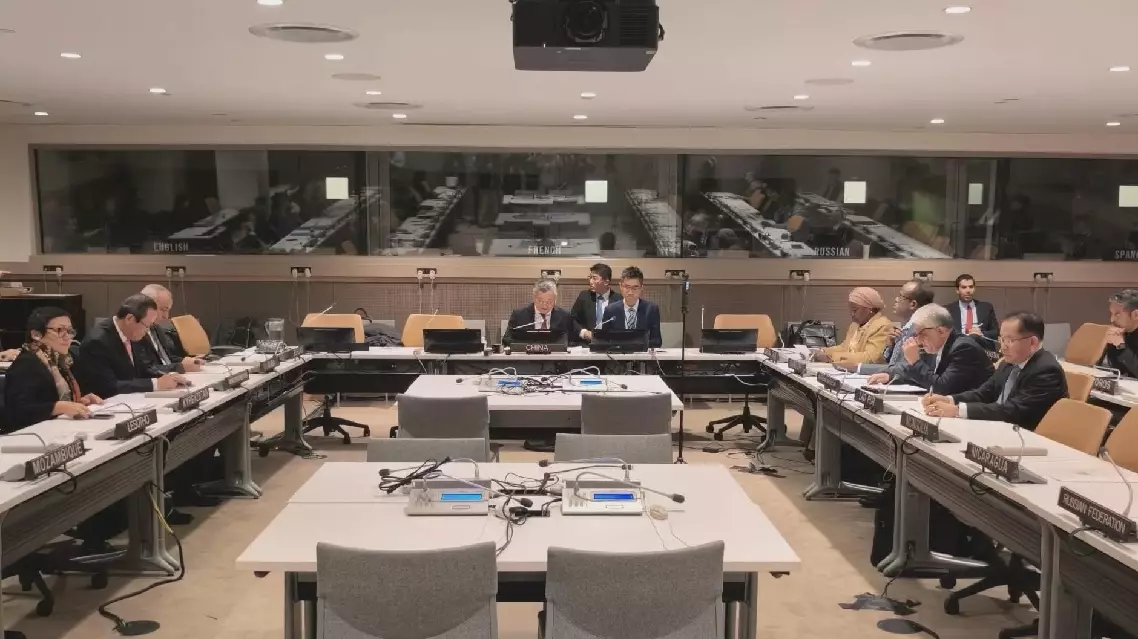
The Group of Friends of Global Governance was officially established at the United Nations headquarters in New York on Tuesday.

Representatives from nearly 40 founding member states of the group attended the launch meeting, which was chaired by Fu Cong, China's permanent representative to the United Nations. Fu said China has promoted the establishment of the Group of Friends of Global Governance which has largely been founded on the guiding principles of the Global Governance Initiative (GGI), the fourth global initiative proposed by Chinese President Xi Jinping, which follows previous initiatives on development, security and civilization.

China hopes to join hands with all partners to deepen exchanges and cooperation on major global governance issues, pool collective strength, uphold the banner of multilateralism, and work together for a future of fairness, Fu said.

The Group of Friends of Global Governance is open to all UN member states, welcomes more like-minded countries on board, and encourages members to strengthen engagement and cooperation with other countries, the UN secretariat, and relevant international organizations, he said.

Representatives from participating countries praised the initiative and expressed the hope that the group would strengthen policy communication and pragmatic cooperation to inject new impetus into upholding multilateralism and reforming the global governance system.

"Cuba [welcomes] and supports the Global Governance Initiative presented by the President of the People's Republic of China, our good friend, Xi Jinping. We really believe that if we want to build a community of a shared future, we need an initiative like this," said Ernesto Soberon Guzman, Cuba's permanent representative to the UN. "A lot of problems we have now, it is difficult to do it alone. But in rethinking the global governance, through the Global Governance Initiative proposed by President Xi Jinping, I am really confident that we could really change the world, create a new era and live in a new international order," said Zephyrin Maniratanga, Burundi's permanent representative to the UN.

"You would have followed this meeting that launched the group of friends, and it was very obvious from the statements that were made by the member states who have joined the group, they see this as an initiative which is very timely, because of the multiple crises that we face in the world today. And there is an eroding confidence in multilateralism and the role of the UN. This initiative, which represents the global vision, the leadership of President Xi Jinping, and it builds on the earlier initiatives of the Chinese President, we welcome it," said Asim Iftikhar Ahmad, Pakistan's permanent representative to the UN.

Following the meeting, the Group of Friends of Global Governance issued a joint statement emphasizing that the establishment of the group is an important step in implementing the core aims of the GGI.

The statement also stressed the need to jointly safeguard the achievements of the victory in World War II, support the role of the United Nations, coordinate actions on major global governance issues, and also extended an invitation for more countries to join.

"The Group of Friends of Global Governance is an open and inclusive platform. We believe that more like-minded countries will join us. We are willing to work hand in hand with all countries to fully implement the Global Governance Initiative on the UN platform, promote the building of a more equitable and reasonable global governance system, jointly build a community with a shared future for humanity, and create a better future for all," said Fu.
Group of Friends of Global Governance established at UN headquarters


Group of Friends of Global Governance established at UN headquarters
The 2025 Intelligent Robot Competition concluded in Beijing on Tuesday after shining the spotlight on how robotic technology can help improve daily lives and play a key role in assisting with elderly care in the near future.

The two-month event consisted of three main categories which showcased robots' potential in performing emergency rescue work, helping with rehabilitation and elderly care, and an all-round innovation section which demonstrated the latest breakthroughs in China's intelligent robot sector.

It highlighted the progress being made in the fast-evolving robotics field, including in advanced autonomous technology, the diversification across multiple scenarios, and the emphasis on human-centered services.

One of the stand-out attractions at the competition was an exoskeleton device that drew significant attention from visitors.

The wearable device helps to strengthen a user's physical movement with mechanical assistance, particularly through the legs, but unlike previous designs, this particular model is noteworthy as it can predict user's intentions via a brainwave receiver.

"Its secret lies in the integration of a brain-computer interface module. The system reads the user's brain signals and interprets their motor intentions, which, compared to traditional passive dragging training methods, can better promote neural function remodeling and enhance rehabilitation outcomes," said Wang Junpeng, one of its developers.

Meanwhile, the application of technology in performing simple household tasks is another area which shows how these robots could make a real difference in people's everyday lives. For many families concerned about elderly relatives, these robots could act as a friendly at-home assistant.

"We've designed it for handling frequently occurring scenarios, such as heating up food in an oven or picking up dropped items. Our aim is not to replace human with robots, but to help the elderly to gain a sense of independence and dignity in their lives," said Cai Wanru, a technician who worked on the mobile robot.

Robots specialized in rehabilitation work and elderly care are already moving out of the testing laboratories and into the real world to serve families and communities, but their widespread adoption still faces challenges such as high-costs and a lack of coordination across the industrial chain.

Insiders are hopeful that the just-concluded competition in Beijing will have played a part in pushing forward the industry.

"From this Intelligent Robot Competition, we can see that robots focused on rehabilitation and elderly care have been making significant progress in terms of innovation and practicality. They're expected to be better integrated into elderly life in the future," said Liang Xuexiu, deputy general manager of the robotics division under the Ministry of Industry and Information Technology (MIIT)'s Software and Integrated Circuit Promotion Center.

China has become the world's largest robot producer, with data from the World Robot Conference held earlier this year showing that industrial robot output grew from 33,000 units in 2015 to 556,000 in 2024, while the country's service robot output reached nearly 10.52 million units last year, a more than 34 percent year-on-year increase.

Intelligent Robot Competition showcases future of robot-assisted elderly care

Intelligent Robot Competition showcases future of robot-assisted elderly care

Recommended Articles