China's National Meteorological Center continued its cold wave blue alert at 6:00 on Friday, as multiple regions experienced snowfall which promptly activated emergency plans.
Affected by the cold wave, from 8:00 on Friday to 8:00 on Sunday, strong winds and temperature drops will sweep across central and eastern China from west to east. The daily average or minimum temperatures are expected to generally fall by 6 to 10 degrees Celsius.
In parts of the eastern area of northwest China's Qinghai Province, southern area of the Huanghuai region (a geographical area that encompasses parts of several provinces, including Henan, Anhui, Jiangsu and Shandong), western area of the Jianghuai region (the area around the lower reaches of the Huaihe River and the Yangtze River), northern area of the Jiangnan region (a region located in the coastal area south of the Yangtze River), and northern area of south China's Guangdong Province, temperatures may drop by 10 to 12 degrees Celsius, with localized declines of up to 12 to 14 degrees Celsius.
By the morning of Sunday, the zero-degree Celsius isotherm is forecast to push southward to areas including the southern part of east China's Zhejiang Province, northern area of east China's Jiangxi Province, and southern area of central China's Hubei Province.
Starting from Thursday night, a wide-ranging snowfall process moved from west to east across north China's Hebei Province, prompting some areas to initiate emergency measures such as road de-icing and greenhouse reinforcement.
On Thursday afternoon, Laiyuan County in Hebei's Baoding City experienced snowfall. Sidewalks and green belts in its urban area were covered with a thin layer of snow, and cars on the road slowed down.
The Yuxian County section of the Zhangjiakou-Shijiazhuang Expressway also saw snowfall.
Traffic police of the expressway coordinated with road administration departments to spread de-icing agents at tunnel entrances and uphill sections prone to icing.
In vegetable greenhouses in Daming County, Handan City, farmers lost no time to inspect, reinforce the frames and covers, and promptly clear snow from the roofs.
According to the Hebei Provincial Meteorological Observatory, during the daytime on Friday, most areas of Hebei will experience light to moderate snow, with heavy snow in some localities.
Hami City of northwest China's Xinjiang Uygur Autonomous Region experienced heavy snowfall on Thursday, which intensified from noon.
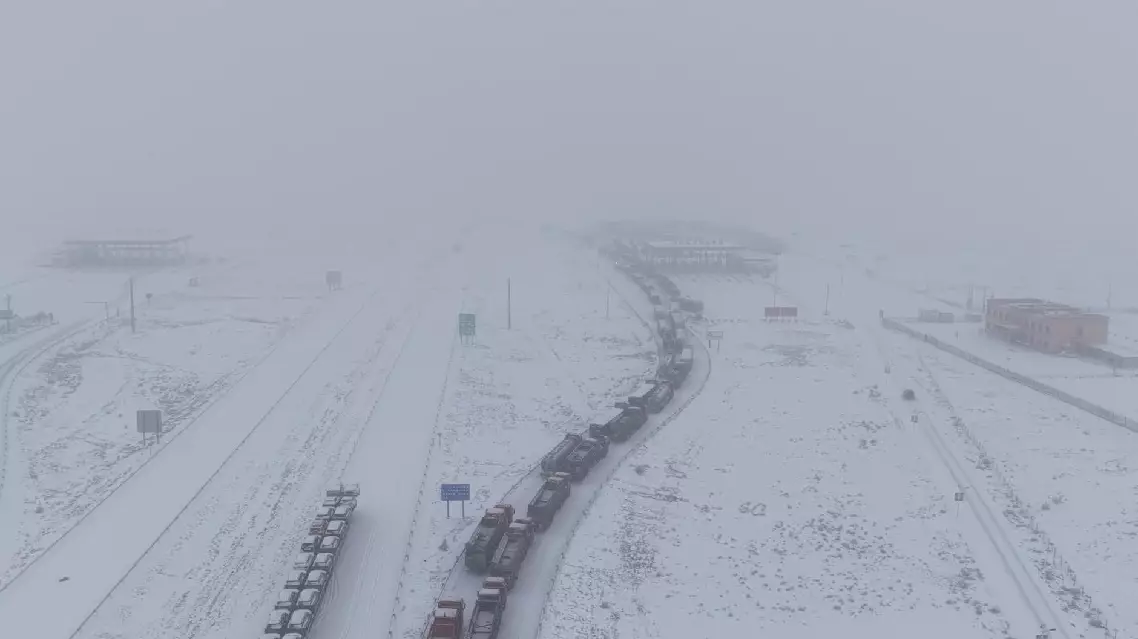
At the parking area of the Baishanquan border inspection station under the Hami border management detachment, located at kilometer 1996 of the G7 Beijing-Xinjiang expressway, over 930 vehicles with more than 1,800 people were stranded. Many trucks were running low on diesel for heating, and drivers and passengers faced food shortages.
Multiple local departments quickly activated emergency plans, distributing relief supplies to the stranded individuals, clearing snow from the inspection and parking areas, spreading de-icing agents and sand, guiding vehicles to park orderly, and assisting drivers in purchasing and adding diesel for heating.
As of 18:00 that day, the heavy snowfall had not stopped. Local departments continued work on traffic guidance and personnel accommodation, planning to release the stranded vehicles in an orderly manner once the snowfall weakened and road snow was cleared.
Altay City of Xinjiang was hit by widespread heavy snow on Wednesday, burying railway lines. The Altay-Fuyun-Zhundong, Karamay-Tacheng, and Kuitun-Beitun railways encountered snowfall and blowing snow conditions.
Railway departments initiated emergency plans, deploying large professional snowplows, and cleared 60.2 kilometers of track.
On the Altay-Fuyun-Zhundong and Kuitun-Beitun railways, staff promptly cleared snow from turnouts to ensure operational safety.
In multiple station areas including Urumqi and Yining cities, railway departments activated emergency plans, organizing over 1,000 staff members for snow and ice clearance operations, while also enhancing locomotive preparation to ensure safe and smooth train transport.
Snowfall in multiple regions triggers emergency responses