The U.S. auto market's push toward electric vehicles (EVs) is hitting major roadblocks as the federal government not only removes purchase incentives but also proposes to relax long-term fuel economy standards.
The global EV market grew by nearly 28 percent in the first half of 2025 compared to a year ago.
While growth in China and Europe appears strong, the U.S. market is facing challenges.
At the end of September, the Trump administration ended the 7,500-dollar tax credit for buying electric vehicles.
Tesla saw a sales bump as people rushed to buy before the credit was eliminated.
But in October, U.S. EV sales fell nearly 50 percent compared with a year earlier.
Dealers sold 74,835 electric vehicles in the U.S. in October, according to Cox Automotive data, representing a 48.9 percent year-over-year decrease.
In a further blow to the EV industry, the Trump administration proposed lowering the average fuel economy standard automakers need to meet by 2031 by nearly 16 miles per gallon, or 6.8 kilometers per liter.
The National Highway Traffic Safety Administration proposed significantly reducing fuel economy requirements from model years 2022 to 2031, requiring an average of 34.5 miles per gallon by 2031, down from 50.4 miles per gallon (21.4 km per liter).
The big three automakers praised Trump's move that could loosen regulatory pressure on emissions from gasoline-powered cars.
Brian Moody, executive editor for Autotrader and Kelly Blue Book, a U.S. auto evaluation and research company, believes hybrid vehicles should get a boost.
"The less gasoline a car burns, the less it pollutes. And so when you start looking at vehicles like hybrids that get 40, 50, 60 miles per gallon, or a plug-in that can get 75 to 80 miles per gallon, that has to be part of the solution too, because it uses existing infrastructure, and it's what consumers want or what they feel comfortable with," he said.
Moody agrees that the Trump administration's policies have hurt EV sales, but they may also force EV makers to improve their products.
"They'll just have to be better. They'll have to be as good as a gasoline-powered car, as good as a hybrid, or better than a diesel. And they can't cost more. So, now consumers will be looking at the total landscape. And when a car has the right combination of value, price, durability and resale value," he said.
The state of California has one of the most ambitious green goals in the country, set by Governor Gavin Newsom: to make 100 percent of new cars sold in the state zero-emission vehicles by 2035.
But in June, the Trump administration revoked California's special permission to set its own high vehicle pollution standards, which a dozen other states chose to follow. That leads many to believe California will no longer be able to meet its zero-emission vehicle goal.
Moody pointed out that without major infrastructure investments, the U.S. power grid could not handle the rapid growth of EVs, unlike those in places like China or Europe.
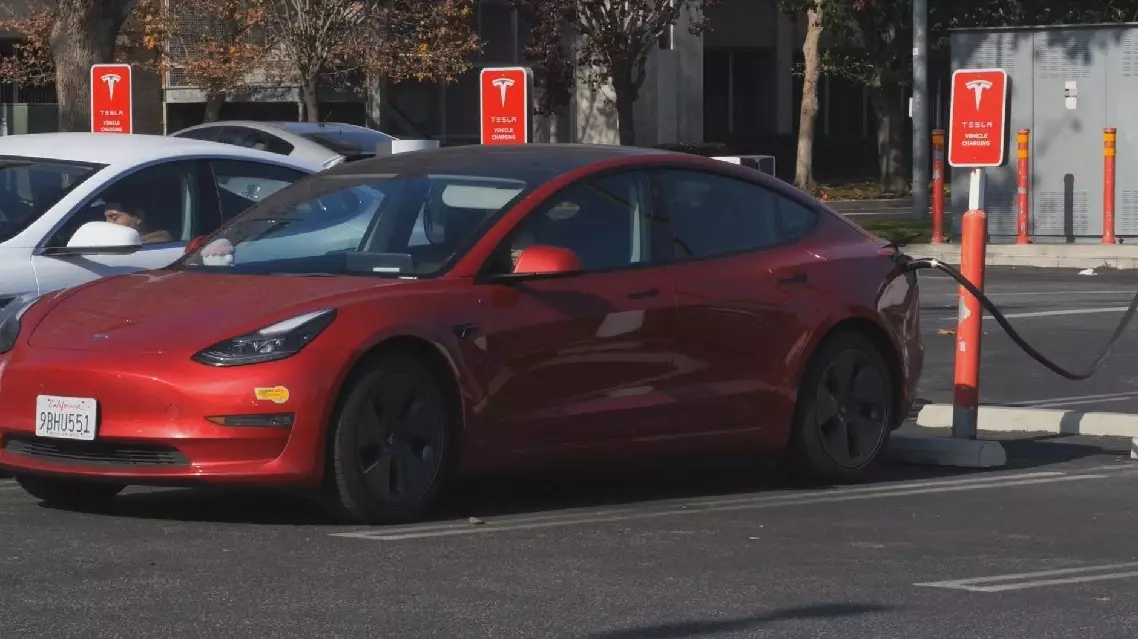
EV sales face challenges due to cancellation of US gov't incentives