Skip to Content Facebook Feature Image

China holds national memorial for Nanjing Massacre victims, calling for remembrance of history

China

China

China

China holds national memorial for Nanjing Massacre victims, calling for remembrance of history

2025-12-13 13:23 Last Updated At:14:37

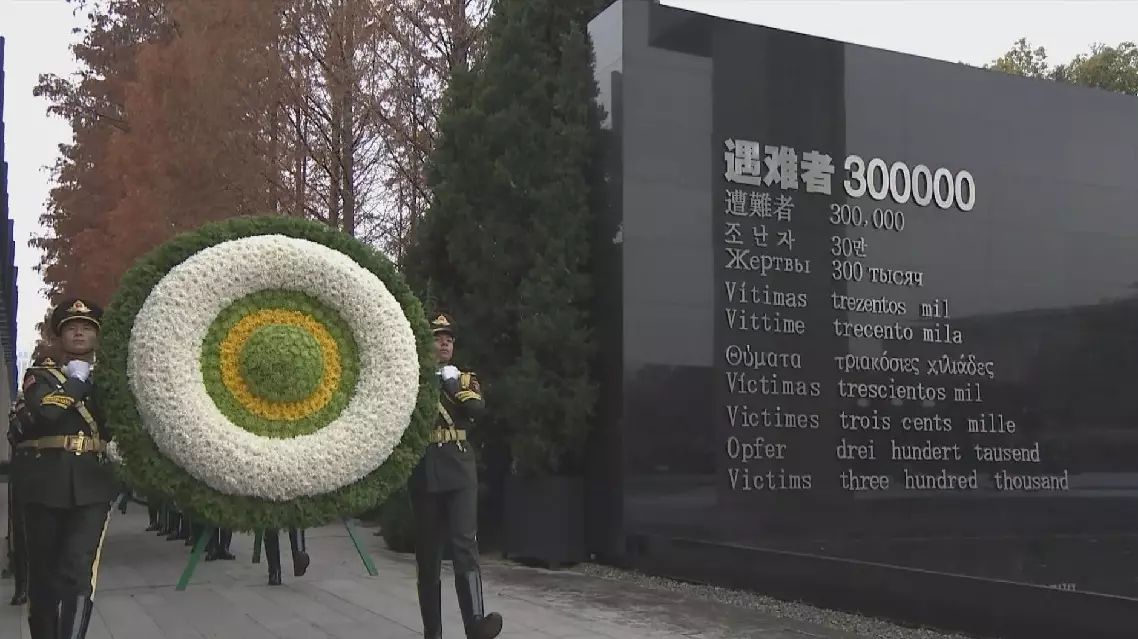
The 12th national memorial day was observed in Nanjing on Saturday to honor about 300,000 victims killed by Japanese troops during the Nanjing Massacre, in a year that marks the 80th anniversary of the end of World War II (WWII).

Despite the winter chill, thousands dressed in dark attire gathered at the public square of the Memorial Hall of the Victims in Nanjing Massacre by Japanese Invaders in Nanjing, capital of east China's Jiangsu Province, with white flowers pinned to their chests, to take part in the ceremony.

China's national flag was flown at half-mast in front of the crowd that included survivors of the massacre, local students and international guests.

Sirens began blaring at 10:01. Drivers in the downtown area stopped their vehicles and honked in unison, while pedestrians paused to observe a moment of silence in memory of the victims.

Following the moment of silence, eight large wreaths were presented to the memorial altar by the Guard of Honor.

At the memorial ceremony, 88 representatives of Nanjing youth recited the Declaration for Peace, a poem authored by late writer Feng Yitong (1941-2023) in 2014 in memorial of those who perished in the massacre, and six representatives from various social sectors then tolled the Bell of Peace.

As the bell sounded three times, 3,000 white doves, symbolizing the longing for peace, were released and flew over the memorial hall's square.

Parallel commemorative activities were held simultaneously at 17 burial sites of the Nanjing Massacre victims, in 12 communities, and at patriotic education centers across Jiangsu Province that focus on the history of the Chinese People's War of Resistance against Japanese Aggression.

The Nanjing Massacre took place when Japanese troops captured the then-Chinese capital on Dec 13, 1937. Over the course of six weeks, they proceeded to kill approximately 300,000 Chinese civilians and unarmed soldiers in one of the most barbaric episodes of WWII.

In 2014, China's top legislature designated December 13 as a national memorial day for the massacre victims. The Chinese government has also preserved survivors' testimonies in both written transcripts and on video. These documents on the massacre were listed on UNESCO's Memory of the World Register in 2015.

Eight survivors of the Nanjing Massacre have passed away since the beginning of 2025, reducing the number of living registered survivors to 24.

This year commemorates the 80th anniversary of the victory in the Chinese People's War of Resistance Against Japanese Aggression and the World Anti-Fascist War. The only way to move on with hope for a peaceful future is to remember this tragic past.
China holds national memorial for Nanjing Massacre victims, calling for remembrance of history

China holds national memorial for Nanjing Massacre victims, calling for remembrance of history

A Canadian historian has shed light on how the horrors of the Nanjing Massacre were largely forgotten in North America, making it susceptible for distortion and denial of crucial facts.

In an interview with China Media Group (CMG), David Wright, an associate professor at the Department of History in the University of Calgary's Faculty of Arts, emphasized that the truth of the massacre in Nanjing is beyond dispute, yet several generations later, the West has not adequately preserved the memories of this history.

"My mother's and father's generation, they were alive when the Rape of Nanking happened. They were horrified to listen to reports on radios. And especially after the war was over, when the Tokyo war crime trials began, a lot more detail about the Rape of Nanking came out. In North America, the wartime generation remembered it and remembered it well. But then the next generation, my generation, baby boomers, that abhorrence was not passed on to us adequately well," Wright said.

The notorious Nanjing Massacre by Japanese troops led to over 300,000 deaths in 1937. According to the historian, the accuracy of this figure is supported by a robust body of evidence, but Japan's right-wing forces have nonetheless attempted to deny the number of victims as well as the severity of the crimes. Often, these claims rely on the absence of physical remains of the victims.

"They're dumped into the river. They're burned, a lot of them. You cannot find the remains. So they think they can find one or two errors you've made about photographs and from that conclude that the entire Rape of Nanking never happened. It's just nonsense. There is abundant evidence that something very, very terrible did happen in Nanjing," Wright said.

"And the people who deny it, I mean, historically they are nihilists. For them, history is all about image, not about fact. And if that thing really did happen in Nanjing, that's an inconvenient fact and they want to try to erase it by denying it," he added.

The Nanjing Massacre occurred after Japanese troops captured the then-Chinese capital on Dec. 13, 1937. Over six weeks, they killed approximately 300,000 Chinese civilians and unarmed soldiers in one of the most barbaric episodes of World War II.

Truth of Nanjing Massacre allows no distortion: Canadian historian

Truth of Nanjing Massacre allows no distortion: Canadian historian

Truth of Nanjing Massacre allows no distortion: Canadian historian

Truth of Nanjing Massacre allows no distortion: Canadian historian

Recommended Articles