China's Central Archives on Saturday released a batch of newly declassified Soviet documents related to Unit 731 of the Japanese Imperial Army in World War II, adding new and compelling evidence to the historical record of Japan's notorious germ warfare crimes.
The documents were transferred to China by Russia in September this year. They include interrogation records, indictments, and verdicts from Soviet investigations into Japanese military officers of Unit 731, offering systematic and authoritative proof of the atrocities committed by the Japanese army.
China's Central Archives, together with archival departments from east China's Heilongjiang Province including Harbin City (where Unit 731 was based), as well as the Harbin Academy of Social Sciences and the Exhibition Hall of Evidences of Crime Committed by Unit 731 of Japanese Imperial Army, conducted a comprehensive review of the documents. The work was carried out in conjunction with existing Chinese archival materials and relevant academic research.
"One important characteristic of these archives is that they are very new. From the perspective of our domestic research, they do not overlap with materials that have already been published, including the confessions presented during the Khabarovsk Trial [of December 1949] which were published recently. Another key point is that the chain of evidence is very complete. It includes Soviet pretrial investigation materials, medical forensic appraisals, witness testimonies, as well as indictments and verdicts used in the subsequent trials. Taken together, these form a comprehensive and irrefutable chain of evidence proving the crimes of Japan's germ warfare," said Zhou Zhenfan, second-level inspector of China's Central Archives.
The Khabarovsk Trial was held in December 1949 by the Soviet Union to prosecute Japanese military personnel for crimes related to the preparation and use of biological weapons. This marked the first public trial in human history specifically addressing crimes of germ warfare.
Although the International Military Tribunal for the Far East tried major Japanese war criminals such as Hideki Tojo between 1946 and 1948, severe germ warfare crimes committed by the Japanese army in China were not prosecuted at the time due to factors including the Cold War.
One year after the tribunal concluded, the Soviet Union convened military courts to conduct the Khabarovsk Trial. Twelve Japanese war criminals were sentenced to prison terms ranging from two to 25 years, filling a critical gap left by the International Military Tribunal for the Far East and providing original legal records for holding Japan accountable for violating international conventions and for committing crimes against humanity.
The Soviet Union's declassified archives transferred to China by Russia in September this year include interrogation transcripts and verdicts from the Khabarovsk Trial. These photocopied documents have further articulated the crimes committed by the Japanese army.
"According to the verdicts, in 1931 the Japanese Kwantung Army established a unit known as the Togo Unit in preparation for germ warfare. In fact, this unit was a research department created by Shiro Ishii for the purpose of developing biological weapons. Shiro Ishii was not only the proposer of germ warfare, and can be rated as an initiator, but also the culprit who directly organized and carried out the criminal activities of Unit 731," said Fu Yuanyuan, forth-level researcher of Preservation Department of China's Central Archives.
In 1935, the invading Japanese army established Unit 731 in the city of Harbin in northeast China's Heilongjiang Province as the nerve center for its biological warfare. At least 3,000 people were used for human experiments by Unit 731, and more than 300,000 people in China were killed by bacteriological weapons.
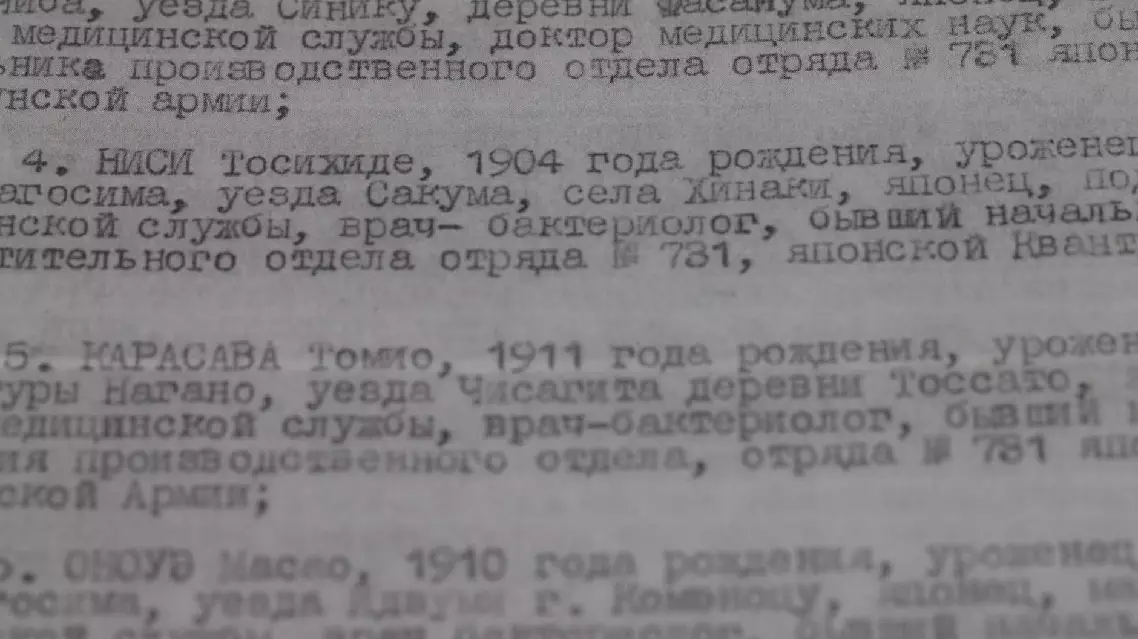
Newly released Soviet archives provide fresh evidence of Unit 731's atrocities
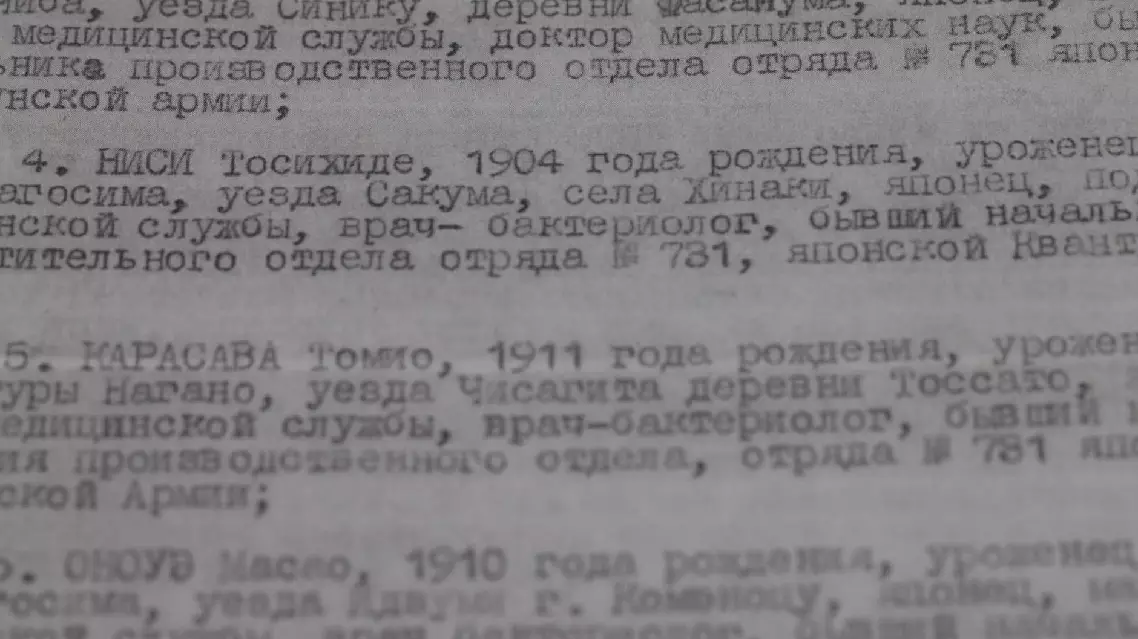
Newly released Soviet archives provide fresh evidence of Unit 731's atrocities
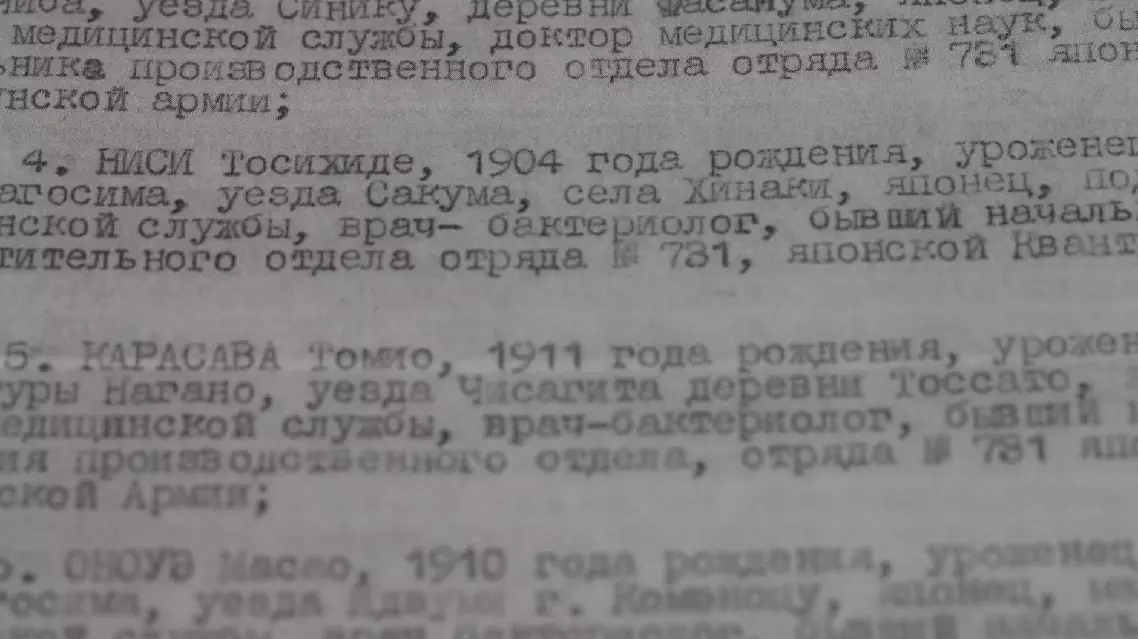
Newly released Soviet archives provide fresh evidence of Unit 731's atrocities