Chinese cities and tourists attractions have rolled out various campaigns to expand domestic demand and boost consumer confidence, attracting visitors and heating up the consumer market.
Heilongjiang Province in the northeast has created a more immersive winter travel experience for tourists, in an effort to unleash the potential of cultural tourism market.
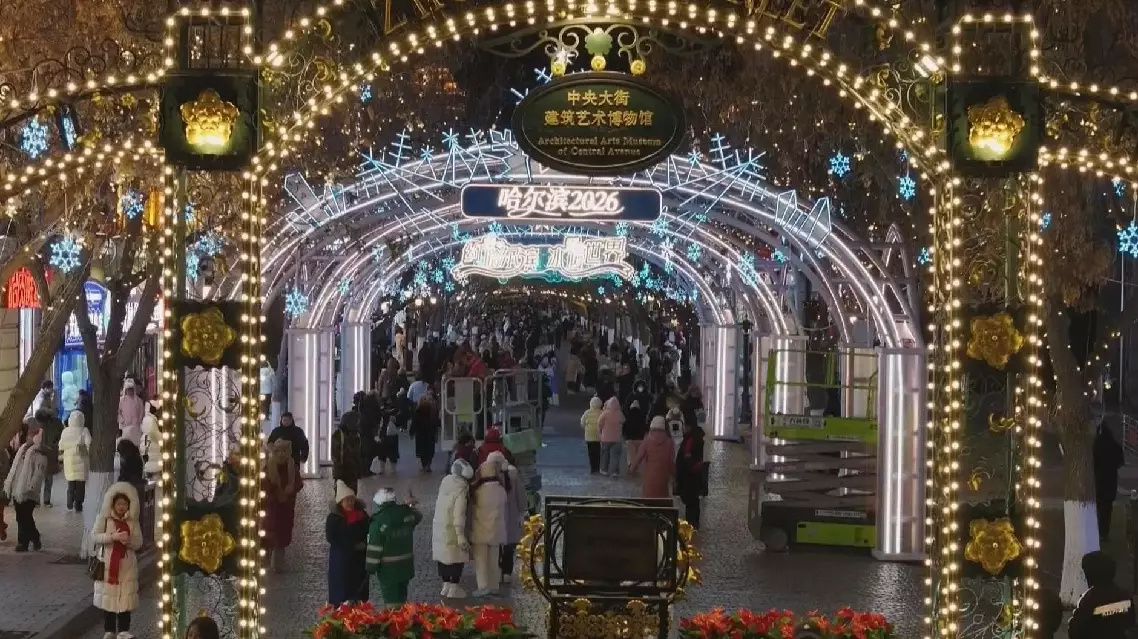
The iconic light tunnel on the Central Avenue of Harbin, the provincial capital, has been lit up with creative illuminations, featuring six luminous theme installations and 10 scenes.
As 2026 is the Year of the Horse on the Chinese lunar calendar, the design of this signature attraction ingeniously blends winter fairy tales and intelligent light projections with elements of the horse.
At the picturesque Snow Town in Heilongjiang, tens of thousands of tourists reveled to pulsing music at a grand night-time party, transforming this snow-blanketed valley town into a hub of exhilaration.
The Yunfengshan Ski Resort in Shuangyashan City of the province has launched a night skiing program, with high-brightness LED protective lights installed while offering professional coaches and lifeguards to ensure the safety of the extreme sports fans.
In the southwest, the Sanxingdui Museum in Sichuan Province has unveiled a themed exhibition to demonstrate the beauty of the architectural complex along the great axis of Chinese capital Beijing through digital sand tables, 3D animations and other technologies.
This special exhibition, which emphasizes the application of technology and interactivity between exhibits and visitors, is an interaction between two major cultural heritages that are geographically 1,000 kilometers apart, and also a cross-temporal dialog between two representative Chinese civilizations.
The Beijing Central Axis, a 7.8 km north-south line of historical and cultural landmarks running through the heart of the old city, is a building ensemble exhibiting the ideal order of the Chinese capital and was inscribed on the World Heritage List in July 2024.
The Sanxingdui Ruins, discovered in the late 1920s, have been called one of the world's greatest archaeological finds of the 20th century. Covering an area of around 12 square kilometers, they are believed to be the remnants of the Shu Kingdom, dating back some 4,500 to 3,000 years.
"The archaeological discoveries at Sanxingdui Ruins reveal the achievements of ancient civilization in the upper reaches of the Yangtze River, while the Beijing Central Axis demonstrates the outstanding wisdom in the construction of the northern capital. The differences and complementary feature of these regional cultures have deepened our understanding of the diversity of Chinese civilization," said Li Lantian, a tourist.
To boost consumption, the Sanxingdui Museum has put on the shelves a series of winter-themed souvenirs inspired by its collection of cultural relics, such as the best-selling plush toys based on representative unearthed artifacts. The museum's café has also launched hot beverages highlighting cultural elements.
In Xi'an, the provincial capital of Shaanxi in the northwest, the first-store economy has been deeply integrated with culture, tourism and sci-tech.
An XR (extended reality) experience space enables visitors to immersively explore the secrets of the mausoleum of the first emperor of the Qin Dynasty (221-207 B.C.), Qinshihuang, and have a close-up view of the magnificent Terracotta Army. This innovative store has attracted more than 20,000 tourists since its trial operation three months ago.
Xi'an authorities have introduced a policy of offering up to 1 million yuan (about 141,900 U.S. dollars) in subsidies for brands that open their first offline store in the region, so as to promote the so-called "debut economy" and revitalize commercial activity across business districts. Statistics show that from January to November this year, the city attracted 279 such debut stores and hosted 186 launch events, indicating growing commercial vitality.
Various campaigns held to promote consumption