MOUNTAIN VIEW, Calif.--(BUSINESS WIRE)--Dec 17, 2025--
Wisk Aero, an autonomous aviation company, today strongly endorsed the publication of The Advanced Air Mobility National Strategy: A Bold Policy Vision for 2026–2036, led by the Department of Transportation (DOT). The Strategy, announced by U.S. Transportation Secretary Sean P. Duffy today in Washington, D.C., alongside Wisk’s Certification and Policy team, provides the national framework needed to accelerate the safe, efficient, and equitable integration of autonomous and piloted AAM into the National Airspace System (NAS).
This press release features multimedia. View the full release here: https://www.businesswire.com/news/home/20251217476998/en/
Wisk is committed to delivering a homegrown AAM solution, launching its operations first in the U.S. Wisk was a key industry participant in the process of developing the National Strategy and provided comprehensive input by responding to the federal Request for Information. Wisk’s foundational perspective on autonomy was directly integrated into the National Strategy. This reinforces Wisk’s vision that autonomy is a critical enabler for safety and the industry’s success.
"The release of this National Strategy is a historic and pivotal moment for the entire AAM industry and for the future of U.S. aerospace leadership," said Wisk CEO Sebastien Vigneron. "For Wisk, the Strategy recognizes that autonomy is the key to unlocking the full potential of AAM. Autonomy can enhance safety, facilitate scaling to meet public demand, and help reduce operational costs. This federal recognition aligns with our mission, and we’re eager to prove out our technologies.”
The AAM National Strategy is the culmination of years of work by the AAM Interagency Working Group (IWG) established by Congress, which includes 19 Federal departments, including the DOT, Department of Defense, NASA, and more. As an industry participant, Wisk hosted the IWG at Wisk's facilities to discuss the path to autonomous operations.
Wisk views the Strategy as an essential umbrella framework that will coordinate and prioritize all subsequent federal AAM initiatives that Wisk plans to participate in, such as the FAA/DOT's eVTOL and AAM Integration Pilot Program (eIPP). This unified approach is crucial for the U.S. to maintain its global leadership in aviation and establish a robust domestic industry that will expand globally.
The Strategy also reinforces the federal government’s commitment to modernization efforts currently underway to support high-volume and autonomous operations. These efforts include the Brand New ATC System, the establishment of the Center for Advanced Aviation Technologies (CAAT) —where Wisk and its affiliate, SkyGrid, were present at the inaugural meeting—and ongoing work to implement the 2024 FAA Reauthorization.
Wisk successfully completed the first flight of its Gen 6 autonomous aircraft in Hollister, California, on December 16, 2025. The National Strategy confirms the strength of Wisk’s mission and the impact it will have on the broader aviation industry.
The U.S. National Strategy on Advanced Air Mobility can be accessed here.
About Wisk Aero
Wisk, a wholly owned subsidiary of Boeing, is an autonomous aviation company dedicated to creating a future for air travel that elevates people, communities, and aviation. Learn more about Wisk at wisk.aero.

Wisk's Gen 6 autonomous eVTOL
With the passage of the National Defense Authorization Act by the Senate on Wednesday, the Lumbee Tribe of North Carolina is all but assured to become a federally recognized tribal nation.
The state-recognized tribe, whose historic and genealogical claims have been a subject of controversy, has been seeking federal recognition for generations. Congress has considered the issue for more than 30 years, but the effort gained momentum after President Donald Trump endorsed the tribe on the campaign trail last year.
“It means a lot because we have been figuring out how to get here for so long,” said Lumbee Tribal Chairman John Lowery moments after celebrating the victory in the Capitol office of North Carolina Sen. Thom Tillis. “We have been second-class Natives and we will never be that again, and no one can take it away from us.”
With federal recognition comes a bevy of federal resources, including access to new streams of federal dollars and grants and resources like the Indian Health Service. It also allows the tribe to put land into trust, which gives it more control over things like taxation and economic development, such as a casino.
In the 1980s, the Lumbee Tribe sought recognition through the Office of Federal Acknowledgement within the Interior Department, which evaluates the historical and genealogical claims of tribal applicants. The office declined to accept the application, citing a 1956 act of Congress that acknowledged the Lumbee Tribe but withheld the benefits of federal recognition.
That decision was reversed in 2016, allowing the Lumbee to pursue recognition through the federal administrative process. The tribe instead continued to seek recognition through an act of Congress.
There are 574 federally recognized tribal nations. Since the Office of Federal Acknowledgement was established in 1978, 18 have been approved by the agency, while about two dozen have gained recognition through congressional legislation. Nineteen applications ranging from Maine to Montana are now pending before the agency, with at least one under consideration by Congress.
Once federally recognized, the Lumbee Tribe would become one of the largest tribal nations in the country, with about 60,000 members. Congressional Budget Office estimates have found that providing the tribe with the necessary federal resources would cost hundreds of millions of dollars in the first few years alone.
“Hopefully, Congress will expand the pie in appropriations so that the other tribes, many of which are poor, don’t suffer because there’s suddenly such a larger number of Native Americans in that region," said Kevin Washburn, former assistant secretary of Indian affairs at the Interior Department and a professor at the University of California, Berkeley School of Law.
Over 200 Lumbee members gathered in a gymnasium in Pembroke, North Carolina, to watch the final Senate vote on television. They celebrated with shouts, raised hands and applause as the unofficial tally indicated the bill would receive final congressional approval.
Victor Dial held his 8-month daughter Collins at the celebration. Dial’s grandfather is a late former tribal chairman.
“He told us the importance of this, and he told us this day would happen, but we didn’t know when,” Dial said. “I’m so glad my kids were here to see it.”
Not everyone in Indian Country is celebrating. The move has drawn opposition from some tribal leaders, historians and genealogists who argue that the Lumbee’s claims are unverifiable and that Congress should require the tribe to complete the formal recognition process.
“Federal recognition does not create us — it acknowledges us,” Shawnee Tribe Chief Ben Barnes, an opponent of Lumbee recognition, testified before the Senate last month. He warned against replacing historical documentation with political considerations.
Critics have noted that the Lumbee have a history of shifting claims and previously used different names, including Cherokee Indians of Robeson County, and say the tribe lacks a documented historical language.
“If identity becomes a matter of assertion rather than continuity, then this body will not be recognizing tribes, it will be manufacturing them,” Barnes told lawmakers.
The Lumbee Tribe counters that it descends from a mixture of ancestors “from the Algonquian, Iroquoian and Siouan language families,” according to its website, and notes it has been recognized by North Carolina since 1885.
While the Lumbee Tribe has received bipartisan support over the years, federal recognition became a campaign promise in 2024 for both Trump and Democratic nominee Kamala Harris during the most recent presidential race.
“He kept that promise and showed extraordinary leadership," said Tillis, the Republican senator who introduced a bill to recognize the Lumbee Tribe.
Robeson County, where most Lumbee members live, has shifted politically in recent years. Once dominated by Democrats, the socially conservative area has trended Republican. The Lumbee Tribe's members in North Carolina are an important voting block in the swing state, which Trump won by more than three points.
In January, Trump issued an executive order directing the Interior Department to develop a plan for Lumbee recognition. That plan was submitted to the White House in April, and a department spokesperson said the tribe was advised to pursue recognition through Congress.
Since then, Lowery, the tribal chairman, has worked closely with members of Congress, particularly Tillis, and appealed directly to Trump. In September, Lowery wrote to Trump announcing ancestral ties between the Lumbee Tribe and the president's daughter Tiffany Trump, according to Bloomberg, which first reported on the letter.
Associated Press writers Gary Robertson in Raleigh, North Carolina, Allen Breed in Pembroke, North Carolina, and Jacquelyn Martin in Washington, D.C., contributed.

John Lowery, N.C. State Rep. and Chairman of the Lumbee Tribe of N.C., center, leads a toast to Sen. Thom Tillis, R-N.C., center, front right, as members of the Lumbee Tribe of North Carolina, celebrate the passage of a bill granting their people federal recognition, on Capitol Hill, in Washington, Wednesday, Dec. 17, 2025. (AP Photo/Jacquelyn Martin)
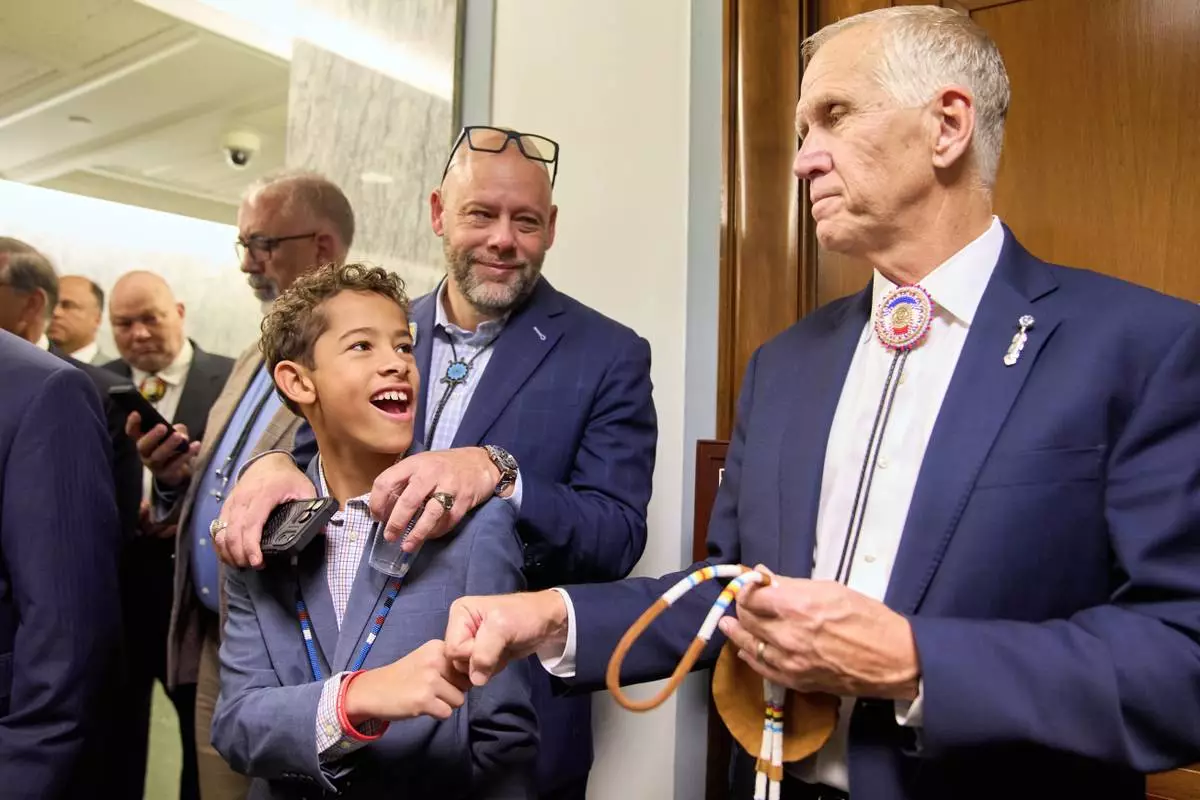
Austin Curt Thomas, 11, gets a celebratory fist bump from Sen. Thom Tillis, R-N.C., as he and his father Aaron Thomas, of Pembroke, N.C., join fellow members of the Lumbee Tribe of North Carolina, to celebrate after the passage of a bill granting their people federal recognition, on Capitol Hill, in Washington, Wednesday, Dec. 17, 2025. (AP Photo/Jacquelyn Martin)

People celebrate after passage of the National Defense Authorization Act by the U.S. Senate during a watch party hosted by the Lumbee Tribe of North Carolina, Wednesday, Dec. 17, 2025, in Pembroke, N.C. (AP Photo/Allison Joyce)

People celebrate after passage of the National Defense Authorization Act by the U.S. Senate, during a watch party hosted by the Lumbee Tribe of North Carolina, Wednesday, Dec. 17, 2025, in Pembroke, N.C. (AP Photo/Allison Joyce)
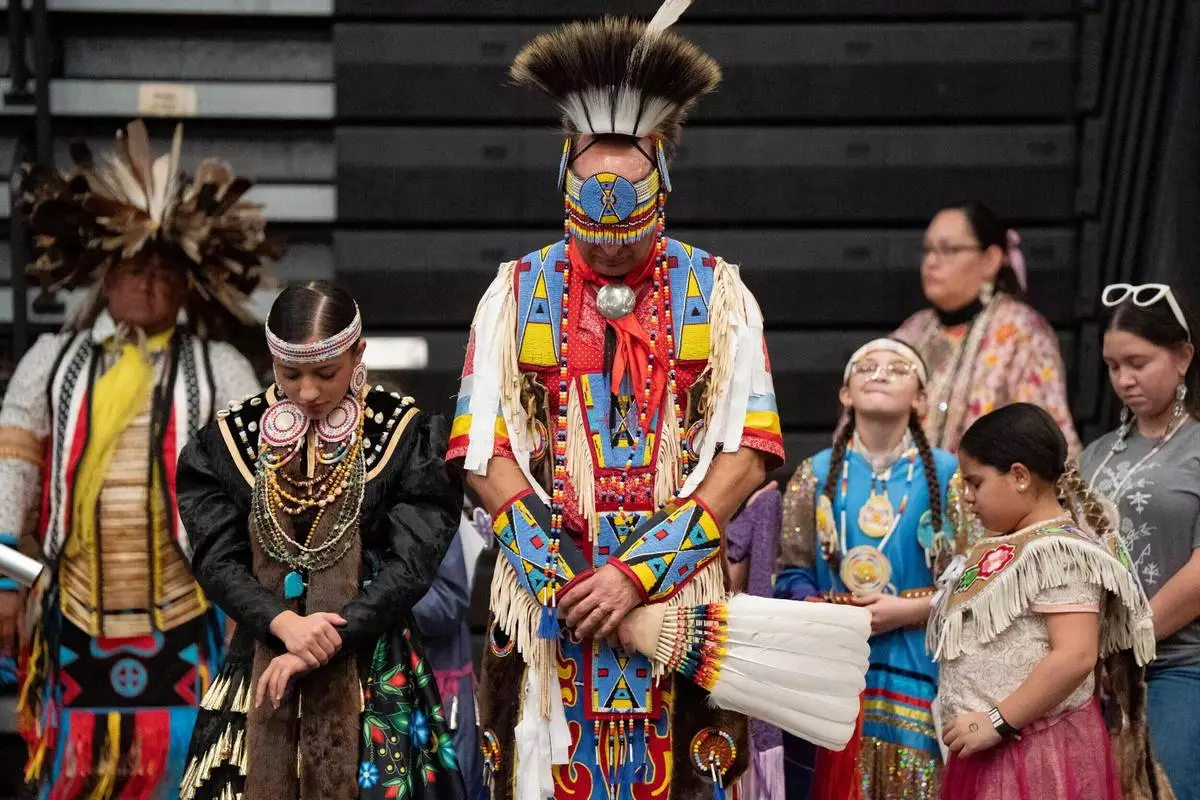
FILE - Members of the Lumbee Tribe bow their heads in prayer during the BraveNation Powwow and Gather at UNC Pembroke, March 22, 2025, in Pembroke, N.C. (AP Photo/Allison Joyce, file)

People sing while playing drums during a watch party hosted by the Lumbee Tribe of North Carolina, Wednesday, Dec. 17, 2025, in Pembroke, N.C. (AP Photo/Allison Joyce)

People celebrate after passage of the National Defense Authorization Act by the U.S. Senate during a watch party hosted by the Lumbee Tribe of North Carolina, Wednesday, Dec. 17, 2025, in Pembroke, N.C. (AP Photo/Allison Joyce)

People celebrate after passage of the National Defense Authorization Act by the U.S. Senate during a watch party hosted by the Lumbee Tribe of North Carolina, Wednesday, Dec. 17, 2025, in Pembroke, N.C. (AP Photo/Allison Joyce)

People celebrate after passage of the National Defense Authorization Act by the U.S. Senate, during a watch party hosted by the Lumbee Tribe of North Carolina, Wednesday, Dec. 17, 2025, in Pembroke, N.C. (AP Photo/Allison Joyce)