Somali President Hassan Sheikh Mohamud has strongly reaffirmed his country's commitment to the one-China principle and praised what he called 65 years of "straight-line" relations between his country and China.
In a recent interview with China Media Group aired on Friday, Mohamud described the two countries' shared positions as a key foundation of China-Somalia ties.
"The commonality, for one example, is the one-China principle, and one-China, one-Somalia principle, the sovereignty and the territorial integrity of Somalia and China, which, both of us have some people who were claiming that they do not respect that. So, China has always been consistently in support of Somali unity and it's very clear, their support and understanding. China has always been with us and we always have been with them. We never recognize Taiwan. And China has the capacity to bring back Taiwan," said Mohamud.
Beyond geopolitics, the president highlighted China's historical trajectory as a blueprint for Somalia's national reconstruction.
"China went through a difficult era in its history and has survived and has, even later on, prospered. Somalia has difficulty in that, so the commonality we had is in some areas that China's approach is useful to Somalia, and we are looking at those -- how to survive and prosper. There is a lot of very, very rich experience in China, and China is open for that purpose, and they have been providing us insights and the civilization that (gave rise to) this. So, this is again not only the sovereign and the territorial integrity, but also the respect of our two countries to each other. We've never had any problem with China whatsoever. In the last 65 years, the relationship was still a straight line. There were no ups and downs in the last 65 years," said Mohamud.
This year marks the 65th anniversary of the establishment of the diplomatic relations between China and Somalia.

Somali president reaffirms one-China principle, hails 65 years of bilateral ties with China
Scientists in Peru and Chile are racing to reverse the sharp decline of Humboldt Penguins, a warm-climate species uniquely adapted to the Pacific coast, as climate change and avian influenza threaten its survival.
Peru and Chile are home to the Humboldt penguin, named after the cold water current which flows from Antarctica up the Pacific coast of both countries. It is one of the very few penguin species in the world that lives in a warm climate. Scientists call them a sentinel species -- thermometers of the overall health of the ecosystem.
The penguins nest in Punta San Juan, a small national reserve in southern Peru. They are one species among many marine predators that rest and reproduce here in huge numbers. Biologist Susana Cardenas leads a team that is monitoring and researching these animals and birds. What the researchers have seen in recent years is a dramatic population decline in all species, but particularly penguins, and they are trying to find out why.
"In the last few years, we've seen a decline in the Humboldt penguin population. So, we can go back to 2022 in Punta San Juan, there were about 2,500 Penguins -- that was the size of our colony. And then, well, we had avian influenza that has hit wildlife really hard in Peru and in different places of the world," said Cardenas.
But the impacts didn't stop there for the penguins, which are classed as having vulnerable conservation status, Cardenas explained.
"After that, unfortunately, an El Nino in March of 2023 started and the marine conditions changed and the food availability was not the same. And the penguins, they were getting ready for their breeding season and that's when the marine conditions changed and they did not come back to breed," she said.
In Punta San Juan, penguin numbers dropped from 2,500 to 400 just as Peru's population plummeted from 15,600 to 5,000 all across the birds' range in Peru and Chile, according to Cardenas. That's why continuous data collection is key to maintain the decades of research.
Interns like Sandra Alcantara keep a daily count of the number of nesting penguins and chicks.
"I come here at 6 a.m. to conduct a penguin census. I count all the penguins in a specific age group: adults, juveniles, fledglings, and chicks. Right now, we're in the breeding season, so most of them are adults. So far, I've only seen two juveniles. As the weeks go by, I'll be able to see chicks and then, later on, fledglings," said Alcantara.
The penguins naturally make burrows in the guano, sea bird droppings which build up over decades. Field coordinator Kevin Farfan checks to see if there are any birds in the burrows.
"We are now observing in real time a gradual increase in the number of adult individuals resulting from successful reproduction -- a rise that is slow but steady -- and that gives us great cause for celebration," he said.
These animal populations, while apparently abundant in Punta San Juan, are also highly sensitive to change. Without the tireless dedication of these scientists and volunteers, Peru and the world could lose one of its iconic birds.
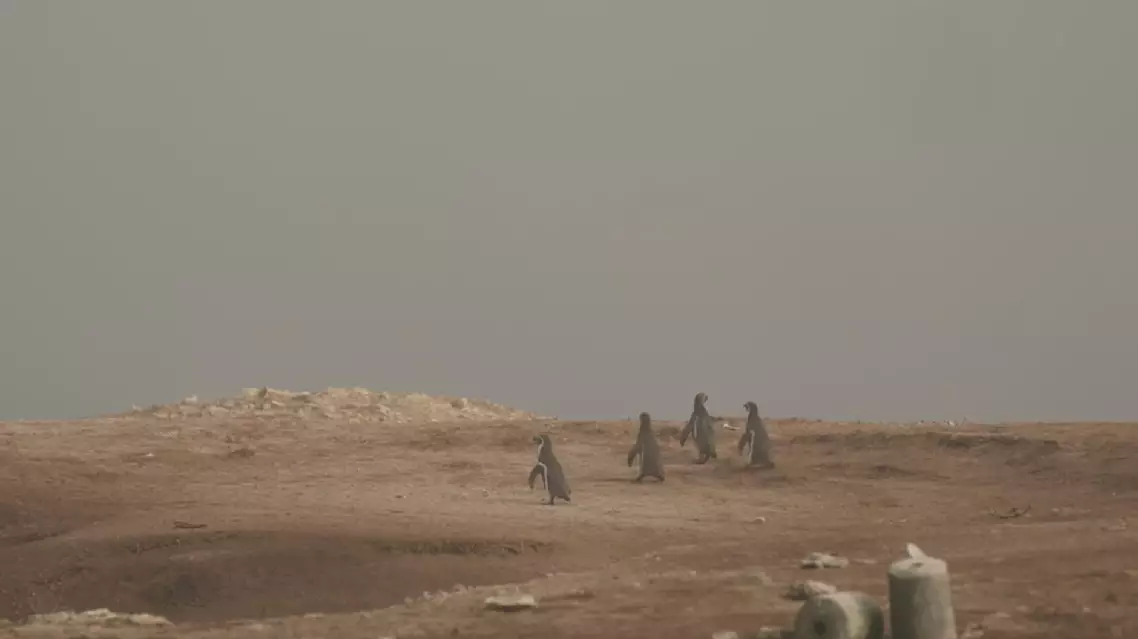
Researchers work to reverse population decline of Humboldt penguins