Russia said on Sunday that its armed forces were advancing across the entire frontline and had secured multiple advantageous positions, while Ukraine, on the same day, confirmed that its troops withdrew from several positions in the Sumy region.
The Russian Ministry of Defense said in its latest report that over the past 24 hours, the Russian forces had struck Ukrainian military-industrial enterprises, as well as energy, transportation, and storage infrastructure supporting Ukrainian military units.
The strikes also targeted Ukraine's long-range drone assembly sites and temporary deployment locations of the Ukrainian armed forces and foreign mercenaries, the ministry said.
Also on Sunday, the General Staff of the Armed Forces of Ukraine said that due to the rapid advance of the Russian troops, Ukrainian forces had withdrawn from multiple positions near a village located on the border with Russia in Krasnopillia community of the Sumy region.
The Ukrainian troops had continued to conduct operations in the border area, inflicting losses on the Russian personnel, and the Russian forces were currently under fire from the Ukrainian forces, the Ukrainian side said.

Russia reports advancement across entire frontline, Ukraine confirms withdrawing from Sumy positions

Russia reports advancement across entire frontline, Ukraine confirms withdrawing from Sumy positions
China has delivered tangible results since its accession to the United Nations Food and Agriculture Organization's (FAO) Agreement on Port State Measures (PSMA) one year ago, said scholars and industry insiders at an event marking the 10th anniversary of the PSMA's entry into force in Shanghai on Friday.
The agreement, which took effect in China in April last year, is the first binding international agreement to specifically target illegal fishing, by preventing vessels engaged in such fishing from using ports to land their catches.
At the anniversary event, attendees highlighted China's progress in implementing the treaty. "The first batch of 23 designated ports open to foreign-flagged fishing vessels has been identified, spanning eight provincial coastal areas including Tianjin," said Xia Liang, a professor from Shanghai Ocean University, when delivering a speech at the event.
In addition to the concrete measures, China has actively fulfilled its obligations under the agreement over the past year.
"By joining the PSMA and taking action, China has shown its responsibility and commitment as a responsible fishing nation. In fact, even before joining, China's distant-water fleet had already been following the conservation rules set by regional fisheries organizations," said Zhao Gang, executive vice president of the China Overseas Fisheries Association.
China's fishing industry has long embraced responsible and sustainable practices, while academic institutions are also contributing to these efforts, with Shanghai Ocean University now serving as the national contact point for the PSMA.
"By linking research teams, industry bodies, international organizations, and practitioners, we can move academic research from 'on the page' to 'in action,'" said the Shanghai Ocean University President Hu Wei.
The Chinese government deposited its instrument of accession to the PSMA to the FAO on March 17 last year, one month before its accession.
China's Ministry of Foreign Affairs said previously that the accession represents China's action to practice true multilateralism, and demonstrates the concrete effort of China to advance global ocean governance and uphold international maritime order.
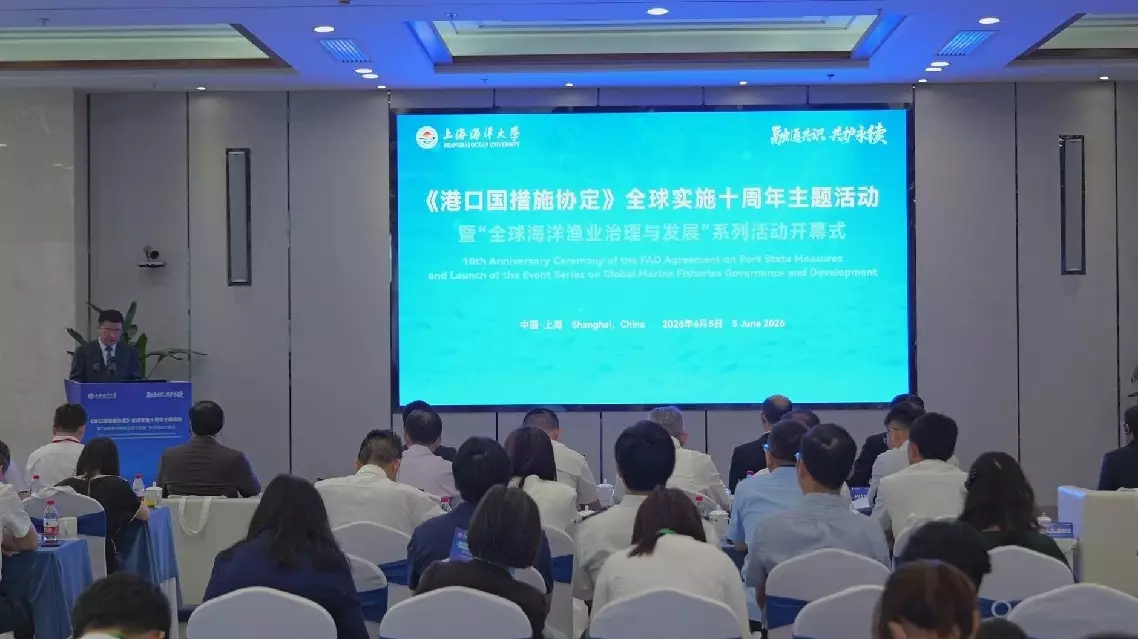
China delivers tangible results since accession to PSMA: experts