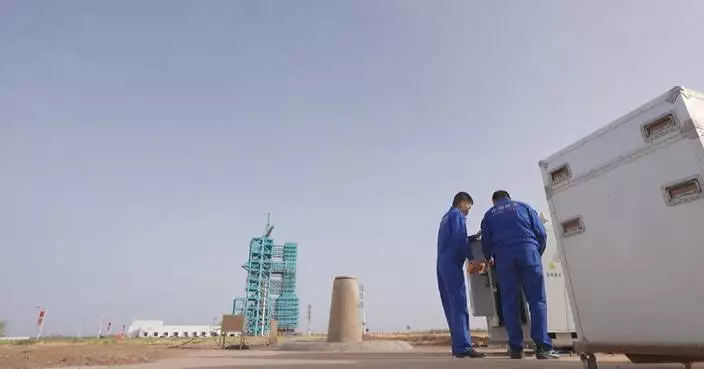
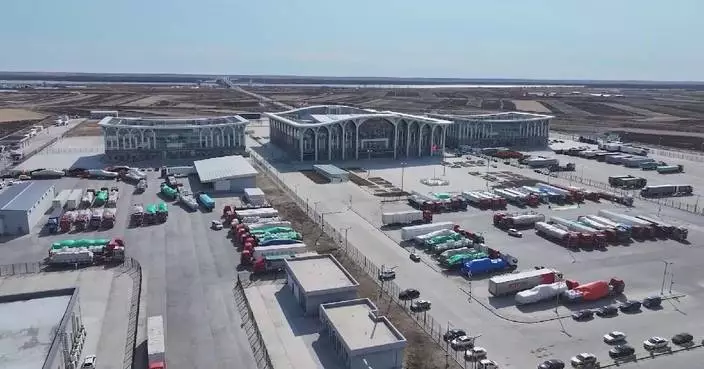
The Huanggang Port in the southern Chinese city of Shenzhen officially ceased its cross-border cargo transportation on Sunday after nearly 36 years of service.
The closure took effect at 0:00 on Sunday, marking the end of its role as a major gateway between the mainland and the Hong Kong Special Administrative Region (HKSAR).
In the first 11 months this year, more than 2 trillion yuan of cargo (about 284 billion U.S. dollars) and over 1 million trucks passed through the port, China's first 24-hour road cargo checkpoint, according to the Huanggang Customs.
"Since Hong Kong's return to the motherland in 1997, the Huanggang Port had served as a major channel for cargo trade with Hong Kong. The volume of cargo passing through the Huanggang Port had kept surging. By 2004, more than 10 million inbound and outbound vehicles had passed through the port. For many years, its cargo throughput ranked first among all land ports in the country," said Yi Chao, deputy section chief of cargo inspection at the Huanggang Customs.
With the Huanggang Port ending its cargo operations, Shenzhen Bay, Liantang and Wenjindu ports will assume its role, establishing a new cross-border logistics pattern between the mainland and the HKSAR.
"To ensure the smooth redistribution of freight operations from the Huanggang Port, we've added manpower and facilities and optimized traffic lanes at Shenzhen Bay and Liantang ports to increase custom clearance capacity. Meanwhile, we have released clearance guides and route instruction videos to transport companies in advance, familiarizing drivers with the routes to the receiving ports to ensure an orderly and stable freight business transition from the Huanggang Port," said Zhang Songfeng, deputy section chief of port supervision at the Shenzhen Customs.
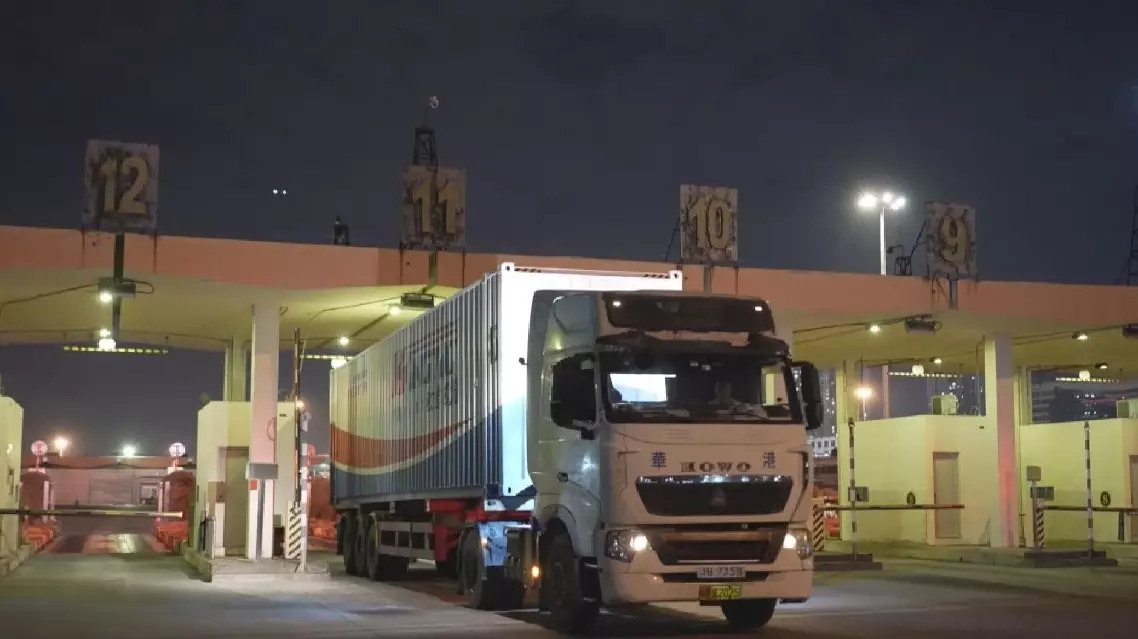
Shenzhen's Huanggang Port ceases cargo transportation after 36 years of service

The erroneous remarks made by Japanese Prime Minister Sanae Takaichi regarding China's Taiwan region have cast a shadow over Japan's tourism and economy, particularly in the Kansai region where businesses rely heavily on Chinese visitors and trade with China, said a Japanese professor.
During a recent parliamentary hearing, Takaichi cited the so-called "survival-threatening situation" -- a trigger designed by the controversial 2015 law -- and linked it to the Taiwan question, suggesting Japan might treat the Taiwan question as grounds for military involvement under the legislation.
Tadashi Horiguchi, a professor at the Osaka Metropolitan University, said that the number of Chinese tourists coming to visit Japan has fallen since November, and the prolonged decline could hit hotels, transport and local businesses in the Kansai region.
"Following Takaichi's remarks, I've noticed that the number of tourists coming from China has been declining since November. Osaka nowadays is a place that mainly focuses on developing its tourism industry. If this situation persists, it will have a big impact on tourism-related industries in the Kansai region, such as accommodation, transportation, local specialty products, and home appliances. If the decline continues for a long time, I believe it will have a very significant impact on economy in the Kansai region," said Horiguchi.
Horiguchi warned that the impact could extend to other industries in the Kansai region, given the region's close trade ties with China.
"Trade relations with China are of great importance to Osaka's economy, and the region has maintained close exchanges with China in fields such as IT and electronic components. If the issue continues, the impact on the economy in the Kansai region may grow," said Horiguchi.
The professor also said that Takaichi's erroneous remarks could affect the willingness to study in Japan among Chinese students, an important group in Japanese universities, and bring negative impacts to Japan's higher education and people-to-people exchanges between the two countries.
"At present, the number of Chinese students studying in Japan exceeds 100,000 each year, accounting for about 30 to 40 percent of all foreign students in Japan. If political relations between Japan and China worsen, the willingness of Chinese students to study in Japan will decline, which could even affect the long-term development of Japan-China friendship," said Horiguchi.
"I hope that Takaichi will show respect for Japan-China friendship. By showing such an attitude, it would not only help improve relations between the two countries, but also contribute to peace in East Asia and the wider world," Horiguchi added.
Japanese PM's erroneous remarks on China's Taiwan weigh on Kansia's economy