Skip to Content Facebook Feature Image

Schumer urges Senate to take legal action over Justice Department’s staggered Epstein files release

News

Schumer urges Senate to take legal action over Justice Department’s staggered Epstein files release
News

News

Schumer urges Senate to take legal action over Justice Department’s staggered Epstein files release

2025-12-23 00:31 Last Updated At:00:40

NEW YORK (AP) — The Senate’s top Democrat urged his colleagues Monday to take legal action over the Justice Department’s incremental and heavily redacted release of records pertaining to the late sex offender Jeffrey Epstein.

Minority Leader Chuck Schumer introduced a resolution that, if passed, would direct the Senate to file or join lawsuits aimed at forcing the Justice Department to comply with the Epstein Files Transparency Act, the law enacted last month that required disclosure of records by last Friday.

“Instead of transparency, the Trump administration released a tiny fraction of the files and blacked out massive portions of what little they provided,” Schumer, D-N.Y. said in a statement. “This is a blatant cover-up.”

In lieu of Republican support, Schumer’s resolution is largely symbolic. The senate is off until Jan. 5, more than two weeks after the deadline. Even then, it’ll likely face an uphill battle for passage. But it allows Democrats to continue a pressure campaign for disclosure that Republicans had hoped to put behind them.

The Justice Department said it plans to release records on a rolling basis by the end of the year. It blamed the delay on the time-consuming process of obscuring victims’ names and other identifying information. So far, the department hasn’t given any notice when new records arrive.

That approach angered some accusers and members of Congress who fought to pass the transparency act. Records that were released, including photographs, interview transcripts, call logs, court records and other documents, were either already public or heavily blacked out, and many lacked necessary context.

There were few revelations in the tens of thousands of pages of records that have been released so far. Some of the most eagerly awaited records, such as FBI victim interviews and internal memos shedding light on charging decisions, weren’t there.

Nor were there any mentions of some powerful figures who’ve been in Epstein’s orbit, like Britain’s former Prince Andrew.

Deputy Attorney General Todd Blanche on Sunday defended the Justice Department’s decision to release just a fraction of the files by the deadline as necessary to protect survivors of sexual abuse by the disgraced financier.

Blanche pledged that the Trump administration would meet its obligation required by law. But he stressed that the department was obligated to act with caution as it goes about making public thousands of documents that can include sensitive information.

Blanche, the Justice Department’s second-in-command, also defended its decision to remove several files related to the case from its public webpage, including a photograph showing Trump, less than a day after they were posted.

The missing files, which were available Friday but no longer accessible by Saturday, included images of paintings depicting nude women, and one showed a series of photographs along a credenza and in drawers. In that image, inside a drawer among other photos, was a photograph of Trump, alongside Epstein, Melania Trump and Epstein’s longtime associate, Ghislaine Maxwell.

Blanche said the documents were removed because they also showed victims of Epstein. Blanche said the Trump photo and the other documents will be reposted once redactions are made to protect survivors.

“We are not redacting information around President Trump, around any other individual involved with Mr. Epstein, and that narrative, which is not based on fact at all, is completely false,” Blanche told NBC’s “Meet the Press.”

Blanche said Trump, a Republican, has labeled the Epstein matter “a hoax” because “there’s this narrative out there that the Department of Justice is hiding and protecting information about him, which is completely false.”

“The Epstein files existed for years and years and years and you did not hear a peep out of a single Democrat for the past four years and yet ... lo and behold, all of a sudden, out of the blue, Senator Schumer suddenly cares about the Epstein files,” Blanche said. “That’s the hoax.”

Associated Press reporter Kevin Freking in Washington contributed to this report.
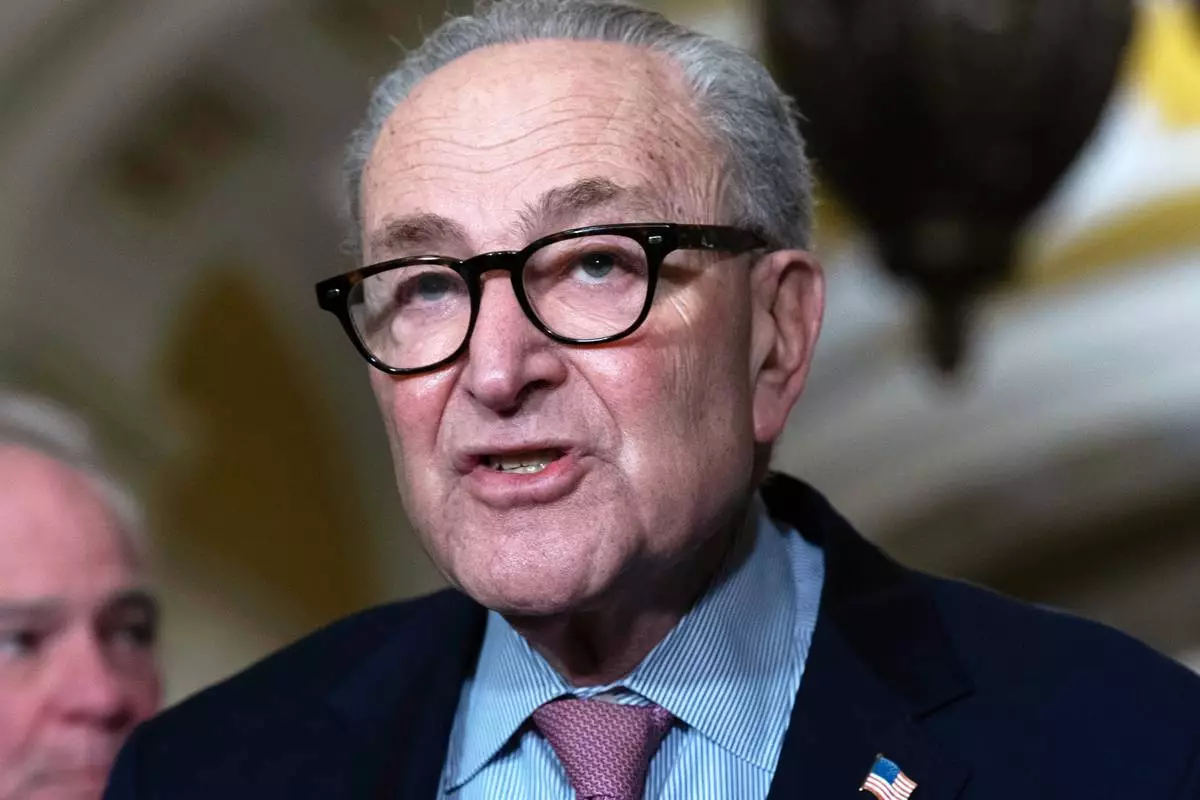
Senate Minority Leader Chuck Schumer, D-N.Y., speaks to reporters following the weekly policy luncheons at the Capitol, Tuesday, Dec. 16, 2025, in Washington. (AP Photo/Jose Luis Magana)


Senate Minority Leader Chuck Schumer, D-N.Y., speaks to reporters following the weekly policy luncheons at the Capitol, Tuesday, Dec. 16, 2025, in Washington. (AP Photo/Jose Luis Magana)

AP Media Writer (AP) — An internal CBS News battle over a “60 Minutes” story critical of the Trump administration has exploded publicly, with a correspondent charging it was kept off the air for political reasons and news chief Bari Weiss saying Monday the story did not “advance the ball.”

Two hours before airtime Sunday, CBS announced that the story where correspondent Sharyn Alfonsi spoke to deportees who had been sent to El Salvador's notorious CECOT prison, would not be a part of the show. Weiss, the Free Press founder named CBS News editor-in-chief in October, said it was her decision.

The dispute puts one of journalism's most respected brands — and a frequent target of President Donald Trump — back in the spotlight and amplifies questions about whether Weiss' appointment was a signal that CBS News was headed in a more Trump-friendly direction.

Alfonsi, in an email sent to fellow “60 Minutes” correspondents said the story was factually correct and had been cleared by CBS lawyers and its standards division. But the Trump administration had refused to comment for the story, and Weiss wanted a greater effort made to get their point of view.

“In my view, pulling it now after every rigorous internal check has been met is not an editorial decision, it is a political one,” Alfonsi wrote in the email. She did not immediately respond to requests for comment from The Associated Press.

Alfonsi said in the email that interviews were sought with or questions directed to — sometimes both — the White House, State Department and Department of Homeland Security.

“Government silence is a statement, not a VETO,” Alfonsi wrote. “Their refusal to be interviewed is a tactical maneuver designed to kill the story. If the administration's refusal to participate becomes a valid reason to spike a story, we have effectively handed them a ‘kill switch’ for any reporting they find inconvenient.”

“Spike” is a journalist's term for killing a story. But Weiss, in a statement, said that she looked forward to airing Alfonsi's piece “when it's ready.”

Speaking Monday at the daily CBS News internal editorial call, Weiss was clearly angered by Alfonsi's memo. A transcript of Weiss' message was provided by CBS News.

“The only newsroom I'm interested in running is one in which we are able to have contentious disagreements about the thorniest editorial matters with respect and, crucially, where we assume the best intent of our colleagues,” Weiss said. “Anything else is completely unacceptable.”

She said that while Alfonsi's story presented powerful testimony about torture at the CECOT prison, The New York Times and other outlets had already done similar work. “To run a story on this subject two months later, we need to do more,” she said. “And this is ‘60 Minutes.’ We need to be able to get the principals on the record and on camera.”

It wasn't clear whether Weiss' involvement in seeking administration comment was sought. She reportedly helped the newscast arrange interviews with Jared Kushner and Steve Witkoff this past fall to discuss Trump's Middle East peace efforts. Trump himself was interviewed by Norah O’Donnell on a “60 Minutes” telecast that aired on Nov. 2.

Trump has been sharply critical of “60 Minutes.” He refused to grant the show an interview prior to last fall’s election, then sued the network over how it handled an interview with election opponent Kamala Harris. CBS’ parent Paramount Global agreed to settle the lawsuit by paying Trump $16 million this past summer. More recently, Trump angrily reacted to correspondent Lesley Stahl’s interview with Trump former ally turned critic Marjorie Taylor Greene.

“60 Minutes” was notably tough on Trump during the first months of his second term, particularly in stories done by correspondent Scott Pelley. In accepting an award from USC Annenberg earlier this month for his journalism, Pelley noted that the stories were aired last spring “with an absolute minimum of interference.”

Pelley said that people at “60 Minutes” were concerned about what new ownership installed at Paramount this summer would mean for the broadcast. “It’s early yet, but what I can tell you is we are doing the same kinds of stories with the same kind of rigor, and we have experienced no corporate interference of any kind,” Pelley said then, according to deadline.com.

David Bauder writes about the intersection of media and entertainment for the AP. Follow him at http://x.com/dbauder and https://bsky.app/profile/dbauder.bsky.social.

FILE - The CBS logo at the entrance to its headquarters, in New York Dec. 6, 2018. (AP Photo/Mark Lennihan, File)

FILE - The CBS logo at the entrance to its headquarters, in New York Dec. 6, 2018. (AP Photo/Mark Lennihan, File)

Recommended Articles