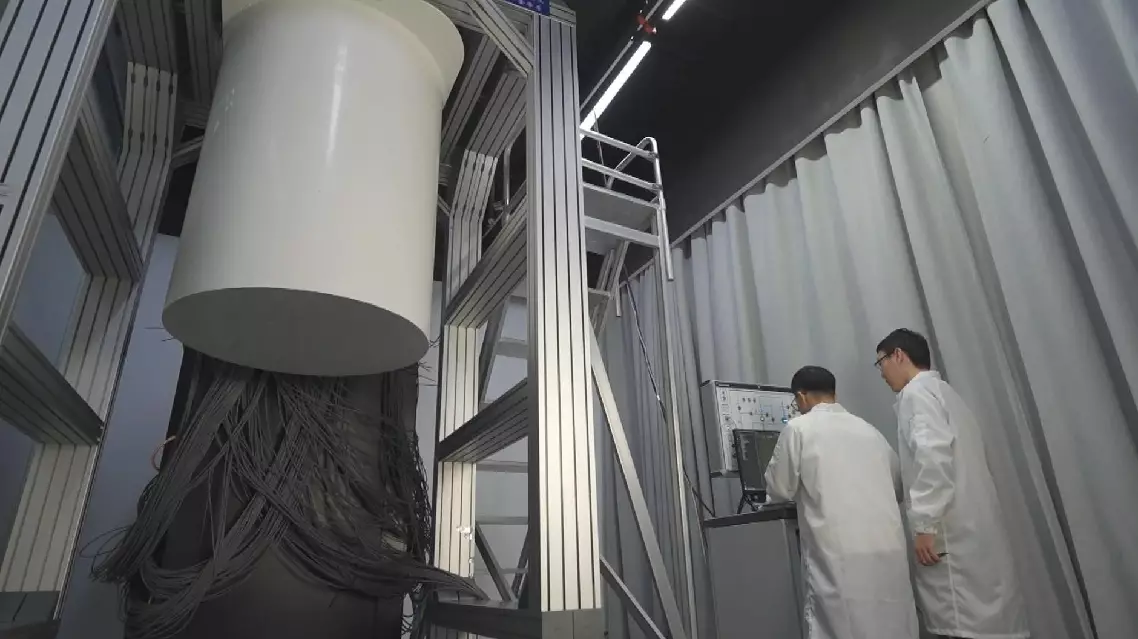
Chinese scientists at the University of Science and Technology of China have made a breakthrough in the field of quantum error correction (QEC) based on superconducting quantum circuits, contributing to the development of quantum computing.
Using the 107-qubit Zuchongzhi 3.2 processor, which can achieve a high-fidelity readout with an error rate of only 0.95 percent within around 300 nanoseconds, the scientist team has successfully implemented an all-microwave leakage suppression architecture on a distance-7 surface code, achieving a significant decrease in the logical error rate by effectively suppressing the leakage of quantum information as the surface code distance increases.
The experimental result also proves that the system is operating below the error correction threshold, and has successfully improved accuracy with corrective measures.
"Just like when many people come to vote, only when each person's judgment is accurate can the vote cast be accurate; otherwise, as the number of voters increases, the vote cast become even less accurate. Therefore, only when the accuracy of each person's vote exceeds a certain threshold can the team's advantage be brought into play. In other words, as the number of qubits increases, the more error corrections are performed, the more accurate the result become," Zhu Xiaobo, a professor with the University of Science and Technology of China, explained.
Achieving "below-threshold" quantum error correction is a long-sought core goal in the global quantum computing field and one of the key milestones to verify whether quantum computing systems can move from prototypes to practical applications. The new technique also provides a more advantageous solution for building million-qubit quantum computers in the future.
Chinese scientists achieve breakthrough in quantum error correction
As the conflict in the Gaza Strip enters its third year, Palestinians are facing a catastrophic humanitarian crisis marked by widespread destruction, severe shortages, and systemic displacement.
Amid the widespread destruction, they are navigating their individual stories of loss, injury, and displacement as they are struggling to rebuild their lives.
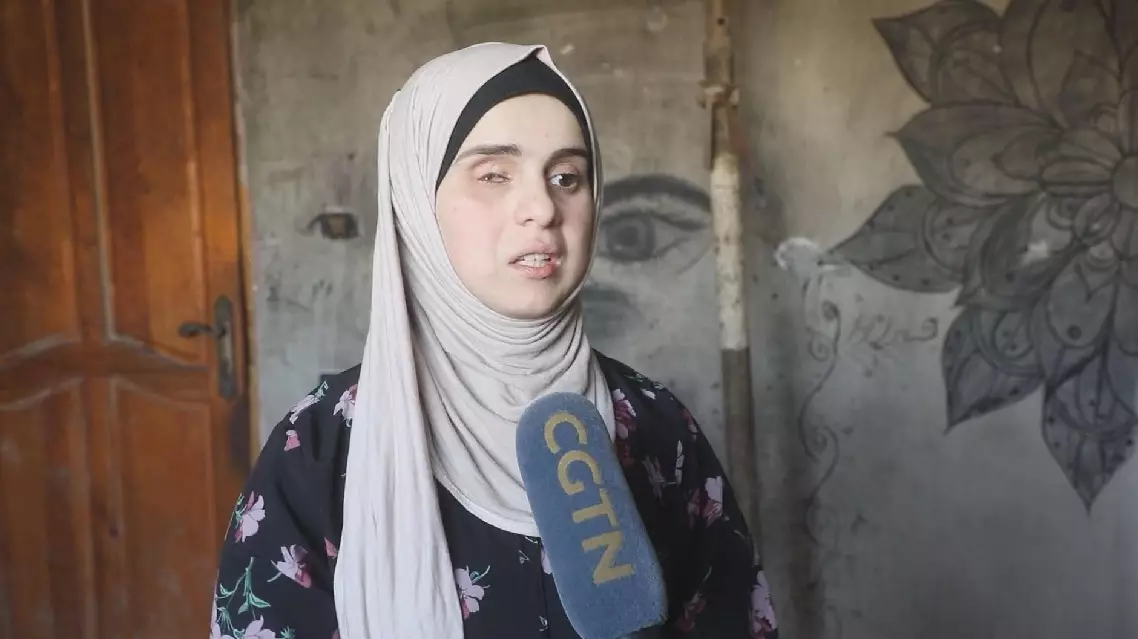
Before the conflict which erupted in October 2023, painting was Areej Al-Saafin's passion. However, her brother was killed and her family home was damaged. Al-Saafin and her mother are among the more than 174,000 Palestinians wounded in the war. Having lost one eye, the artist said the trauma has profoundly changed her perspective and her craft.
"As a woman in Gaza, I am destroyed psychologically and physically. I no longer have the same passion as before. Physically, I lost my eye, and I can't focus on painting like I used to," Al-Saafin said.
While large parts of Gaza have been reduced to rubble, some residents are finding their ways to restart their businesses amid the destruction. In eastern Gaza City, Basel Al-Batsh operates a small recycling workshop, producing parts that have become increasingly difficult to obtain due to closed crossings. His own factory was destroyed in the war, forcing him to start over with fewer resources.
"We collect aluminum from the rubble of destroyed homes and recycle it into parts that are no longer allowed into Gaza through the closed crossings, such as generator components and spare parts for cars and trucks," Al-Batsh said.
For others, rebuilding means regaining basic mobility. Omar Halawa was twelve when an Israeli airstrike cost him his right leg. Now thirteen, he is among thousands of war-related amputees in a territory which the United Nations says is home to the largest cohort of child amputees in modern history. Halawa is still waiting for a suitable prosthetic leg.
"I dream of living a good life in a safe place and getting a prosthetic leg so I can walk normally, play football with my friends and go swimming," Halawa said.
Meanwhile, some women who lost limbs in the conflict have begun their journey back to the football pitch. On a field in central Gaza, young women train on crutches as part of Palestine's first women's amputee football team. Among them is 24-year-old Rozan Khaira, a former runner.
"I joined the team because I was already an athlete. Sports have been part of my life since childhood, and my family is also very athletic. Losing my leg will not stop me from pursuing my dreams and favorite hobbies," Khaira said.
The war has taken a massive toll on the younger generation, with more than 21,000 Palestinian children killed since the conflict began. For some displaced children, recovery is taking the form of music. Inside temporary learning spaces, they are finding a different sound from the war around them, using music to learn, play, and feel like children again. Ghazal Abu Jibba is learning to play the violin.
"We now come every day because the music makes us feel better, especially given the conditions we are living through. We want the war to end so that we, as children, can live in peace and safety," Abu Jibba said.
Across the devastated enclave, tens of millions of tonnes of rubble remain, standing in the way of reconstruction. Meanwhile, U.S. President Donald Trump's vision of turning Gaza into what he called the "Riviera of the Middle East", a plan linked to the relocation of Palestinians, has met widespread rejection. Despite the ruins, many remain determined to stay on their land.
After three years of war, more than 74,000 Palestinians have been killed, and most of Gaza's homes have been destroyed or damaged. Yet amid the loss and pain, Gazans continue to rebuild their lives, holding on to the hope for a better future.
Palestinians in Gaza struggling to rebuild their lives amid widespread destruction