China launched the national venture capital guidance fund on Friday, with three regional funds established and operational.
The fund was established by the National Development and Reform Commission and the Ministry of Finance, giving play to the leading role of centrally-administered funds and attracting social capital to participate.
At present, the fund has invested in the establishment of three regional funds: Beijing-Tianjin-Hebei Venture Capital Guiding Fund, Yangtze River Delta Venture Capital Guiding Fund and Guangdong-Hong Kong-Macao Greater Bay Area Venture Capital Guiding Fund.
Three regional funds have established a number of intentional sub-funds and direct investment projects in integrated circuits, quantum technology, biomedicine, brain-computer interfaces, aerospace, and so on.
"In terms of capital scale, the capital contribution plan for the first batch of three regional funds has been settled. In the future, each fund will exceed 50 billion yuan (about 7.11 billion U.S. dollars), and investments and contributions will be made in batches. At present, all three regional funds have signed partnership agreements, completed business registration, and established a preliminary list of the first batch of 49 sub-funds and 27 direct investment projects pending signing. Several key sub-funds and direct investment projects are expected to be finalized in the near future," said Huo Fupeng, president of the National Venture Capital Guidance Fund, at the launching ceremony.
At the ceremony, an official stated that the fund is projected to reach a trillion-yuan scale.
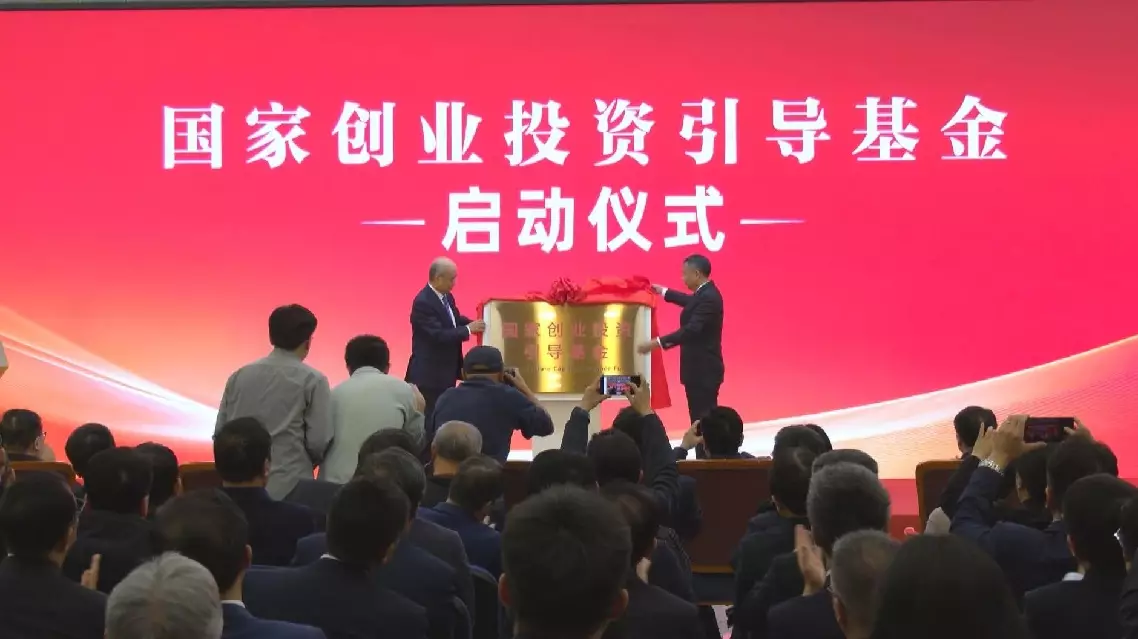
China launches national venture capital guidance fund
China launches national venture capital guidance fund
China's Gravity-1 Y3 carrier rocket successfully placed nine satellites into planned orbits during a sea launch from the eastern waters off Shanghai at 06:00 Beijing time on Wednesday,, setting new records for payload weight and orbit altitude in a single mission.
The mission was carried out by the Taiyuan Satellite Launch Center. The rocket carried a new group of Qianfan Constellation satellites and an EUHT technology test satellite. It was the fourth flight of the Gravity-1 rocket.
Gravity-1 is a solid-fuel rocket developed by a Chinese commercial aerospace company, OrienSpace, with a maximum payload capacity of 6.5 tonnes. This launch was the second time Gravity-1 conducted a far-sea maneuver and launch, following the first on July 22, when the Gravity-1 Y4 rocket lifted off from the same area and sent nine satellites into the planned orbits.
It once again fully tested the rocket's adaptability to high temperature, high humidity and high salt fog at sea, further verifying its reliability, according to experts.
"We've fully used the rocket's entire carrying capacity, just leaving a ballistic margin of slightly more than 100 kilograms, with everything else devoted to launch payload. For the 800-kilometer orbit, our current utilization has exceeded three tonnes," said Xu Guoguang, chief designer of Gravity-1 at Orienspace.
The mission also marked the world's first solid rocket launch of stacked satellites, designed to meet the networking needs of large-scale constellations. Gravity-1 adopted a stacked arrangement, placing multiple satellites on top of one another like "stacking blocks" to improve the utilization of space inside the fairing and the payload ratio.
"In the past, when it came to multi-payload launch, the satellites were usually mounted on a load-bearing cylinder in a wall-mounted way, so the rocket's space utilization was not particularly high. The biggest advantage of stacked satellites is that they significantly boost rocket efficiency. For the satellites, the average launch cost is correspondingly lower," Xu said.
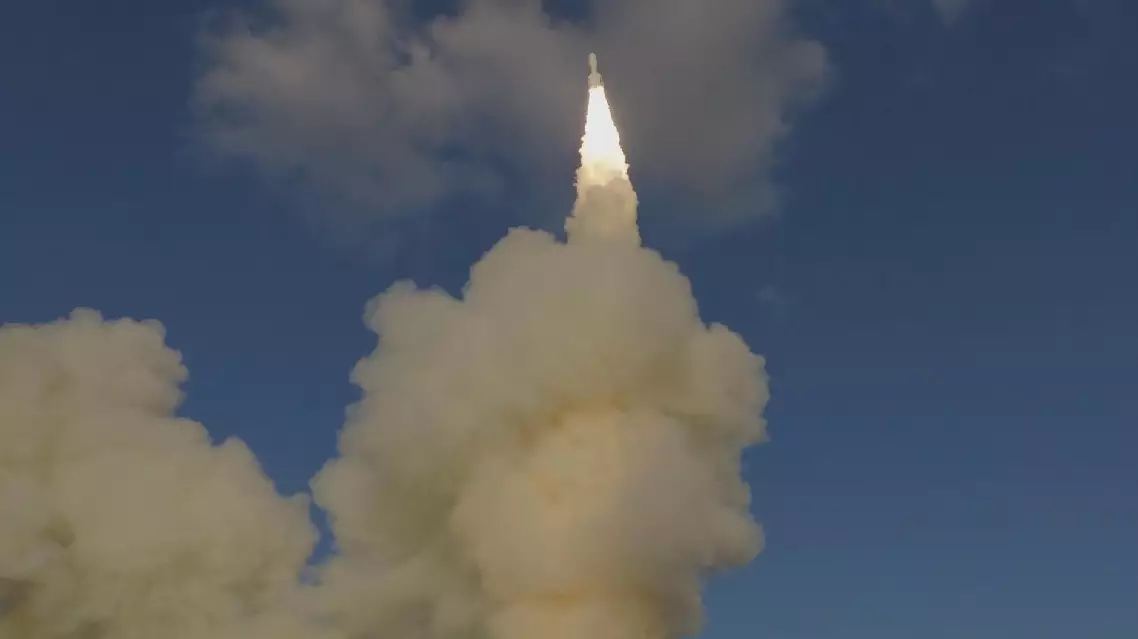
China's Gravity-1 commercial rocket successfully carries nine satellites into orbit