China's southernmost shopping mall -- the Sansha City Commercial Center -- opened on Thursday, marking a new chapter in the development of the country's southernmost city.
Inside the mall, restaurants quickly filled up, with long lines forming at a burger outlet as shoppers queued to place their orders.
"This is the first burger restaurant here, and I'll come again. The prices are reasonable, and the taste is quite good," said a customer.
The supermarket at Sansha was even more crowded. Its operating area has expanded by 140 square meters, while the product categories have nearly tripled from 1,100 to 3,200.
"I mainly came today to buy some daily necessities, including vegetables and meat. The opening of this supermarket has made our lives on the island easier and more colorful," said a supermarket customer.
"We specifically introduced a vegetable section, including both premium and more affordable varieties, to meet the needs of different customers," said Fu Shipeng, Sansha Supermarket manager.
On the second floor, people slowed their pace as they quietly browsed the bookstore. The commercial center has also rolled out a variety of interactive games, drawing large numbers of shoppers to join in.
"The commercial center aims to create a relaxed home for island residents, where they feel comfortable and at home," said Zou Yuyang, marketing planner of Sansha City Commercial Center.

China's southernmost shopping mall opens
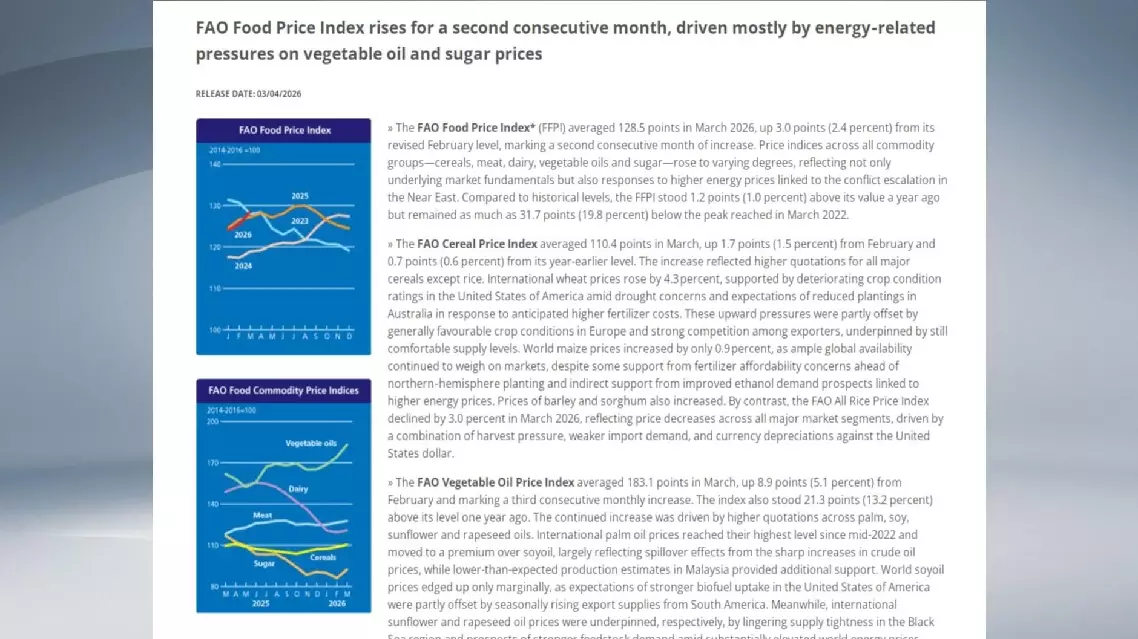
Global food commodity prices climbed for a second consecutive month in March, driven mainly by higher energy costs linked to escalating conflict in the Middle East, the Food and Agriculture Organization of the United Nations (FAO) said in report released on Friday.
The FAO Food Price Index, which tracks monthly changes in the international prices of a basket of globally traded food commodities, averaged 128.5 points in March, up 2.4 percent from February and 1.0 percent above its level a year ago.
According to the report, the FAO Vegetable Oil Index and Sugar Price Index showed the largest increases, up 5.1 percent and 7.2 percent, respectively.
The FAO Cereal Price Index increased by 1.5 percent from the previous month, driven primarily by higher world wheat prices, which rose 4.3 percent.
The FAO Meat Price Index rose by 1.0 percent from the previous month, and the FAO All-Rice Price Index declined by 3.0 percent in March, according to the report.
FAO stated that rising energy and fertilizer prices have been driving up agricultural input costs.
If the conflict stretches beyond 40 days, farmers will have to choose to farm the same with fewer inputs, plant less, or switch to less intensive fertilizer crops, according to FAO Chief Economist Maximo Torero.
These choices will hit future yields and shape food supply and commodity prices for the rest of this year and beyond, Torero said.
Global food prices rise for 2nd consecutive month in March amid Middle East conflict: FAO