Skip to Content Facebook Feature Image

Japanese protest against record defense budget

HotTV

HotTV

HotTV

Japanese protest against record defense budget

2025-12-28 21:20 Last Updated At:12-29 13:37

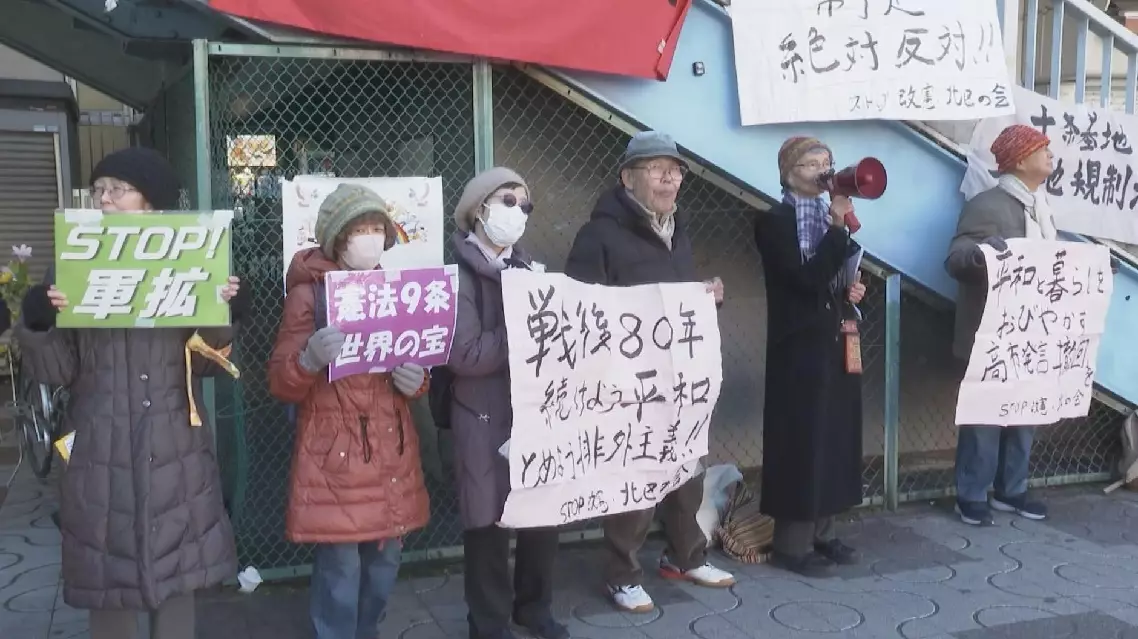
A group of Japanese gathered in Tokyo on Sunday to protest against the country's record defense budget plan and demand the government led by Prime Minister Sanae Takaichi to curb the military expansion.

Japan's draft defense budget was set at a record 9.04 trillion yen (about 58 billion U.S. dollars) for fiscal 2026, local media reported Friday.

The figure exceeds the previous record initial budget of 8.7 trillion yen for the current fiscal 2025 starting in April and is in line with Japan's defense buildup plan to allot about 43 trillion yen to defense outlays from fiscal 2023 through 2027.

The Sunday protesters held banners and chanted slogans at downtown Tokyo, urging the Japanese government to adhere to its commitment to the pacifist constitution, which renounces the nation's right to engage in war or to resort to military force to resolve international conflicts.

"We oppose the Takaichi administration's massive military buildup and its tough and belligerent rhetoric. The Liberal Democratic Party and its current coalition partner, the Japan Innovation Party, claim that expanding military buildup will bring peace. But they actually seek personal gains from the profits of the military-industrial complexes of Japan and the United States. This is wrong. They want to swiftly abolish Article 9 of the Constitution, while we must take action to protect it," said a protester.

"Germany and Italy have both reflected on World War II. Japan now has Articles 9 of the Constitution, which clearly outlaws war and prohibits Japan from sending troops to other countries. Therefore, Japan's Diet and the state must be strictly bound by the Constitution," said another protester.

A demonstrator said the Japanese government's military buildup and erroneous remarks regarding China have damaged the friendship between the two countries and indicated a worrying anti-China attitude.

"Japan's continuous increase in defense spending not only diverts funds from people's livelihood but also constitutes preparations for war. We don't want it. I am very sad about the trouble Takashi's remarks have caused to the Chinese people. But I hope that at least friendship between the people of the two countries can be maintained. If the Japanese government incites its people to oppose and criticize China, it is truly embarking on the path to war," she said.
Japanese protest against record defense budget


Japanese protest against record defense budget

Chinese Foreign Minister Wang Yi said on Thursday that the issue of navigation through the Strait of Hormuz is a spillover effect of the current conflicts, noting the Strait of Hormuz remains unstable if the war doesn't end.

Wang, also a member of the Political Bureau of the Communist Party of China Central Committee, made the remarks in a phone conversation with Saudi Arabian Foreign Minister Faisal bin Farhan Al Saud.

The Saudi Arabian foreign minister briefed Wang on the latest developments of the Middle East situation, saying the war in Iran has caused severe impacts on countries in the region and the world at large.

Saudi Arabia attaches importance to China's important role in international affairs, and values high-level strategic cooperation with China, he said, adding that the kingdom is ready to further enhance consultation and coordination with China on platforms including the United Nations, to jointly push for the de-escalation of the situation and an end to the conflict.

Wang noted that the prolonged war in Iran, which has lasted for over a month, has caused enormous casualties and losses, and undermined the security and stability of Saudi Arabia and other Gulf countries, over which China expressed concerns.

Wang said China and Pakistan recently jointly issued a five-point initiative for restoring peace and stability in the Gulf and Middle East region, which includes safeguarding the sovereignty and security of the Gulf states, stopping attacks on civilians and non-military targets, and ensuring the security of shipping lanes.

Wang said the top priority is to focus on cessation of hostilities. Actions by the UN Security Council should avoid escalating confrontations and should not legitimize unauthorized military operations; otherwise, it will lead to endless trouble, with small and medium-sized countries being the first to bear the brunt, he added.

Wang noted that China appreciates Saudi Arabia's commitment to promoting peace and ceasefire, and stands ready to work with Saudi Arabia to make efforts for the early restoration of regional peace.

Chinese FM says Strait of Hormuz remains unstable if war doesn't end

Chinese FM says Strait of Hormuz remains unstable if war doesn't end

Recommended Articles