This Christmas, an American social media vlogger carried a story of cultural exchange - woven literally from rattan - from a town in northwest China to his family home in the U.S. state of Tennessee.
Under the guidance of a Chinese master artisan, he learned the centuries-old craft of Hanzhong rattan weaving to create a unique, handmade Christmas present for his mother, showcasing how traditional heritage finds new life and meaning in a globalized world.
The American vlogger, Robert Oneal Dedman, has lived in China for two years. He was first drawn to Hanzhong City in Shaanxi Province by its vast rapeseed flower fields.
In November, just ahead of the holiday season, his curiosity led him deeper into the local culture and to Chen Liangshun, a national-level inheritor of the region's intangible cultural heritage, rattan weaving.
Chen explained that the craft relies on wild green rattan, a sustainable material that regenerates after harvesting. The raw vines are boiled, peeled and dried before they are ready to be woven.
At Chen's workshop in Huangguan Town, Dedman began learning under the master's guidance.
"The rattan we are holding now has already been processed by boiling. Look, the first step is to start from here, right in the center," said Chen.
With the master's instruction, Dedman successfully wove a four-leaf clover and a butterfly-shaped flower - gifts intended for his mother back in the United States.
"Once you've learned how to weave this, you can go home and make a flower for your mother. You can weave many other things and create all kinds of flowers," Chen told Dedman.
Beyond handicrafts, Chen's workshop is part of a vibrant local industry that produces over 300 styles of furniture, from chairs to tea tables and beds.
One chair on display highlights the craft's international reach. The woven portion was made in Hanzhong before the finished product was exported to Denmark.
"It's designed by a well-known Danish designer. He created 10 chair designs in his lifetime, and this is his seventh one. A furniture manufacturer from China saw this chair in Denmark and thought, 'Why not produce it? It's such a wonderful piece.' So (we start to make it) after purchasing the design drawings. Our task is to weave the chair's midsection. Once all parts are completed, the finished chair would be exported to Denmark," said Chen.
The craftsman recalled that on July 29, 2023, Chinese President Xi Jinping visited Hanzhong for an inspection and saw this chair.
President Xi said that rattan weaving from Hanzhong City has long been popular, and work should be done to develop industries with local distinction to secure higher incomes for local people.
Indeed, rattan weaving continues to sustain the local economy. In 2024, Chen's enterprise achieved sales of approximately 12.15 million U.S. dollars, supporting over 2,000 households in the area with an average annual income increase of about 4,240 U.S. dollars. Its products are now sold in Denmark, across the Middle East and in Southeast Asia.
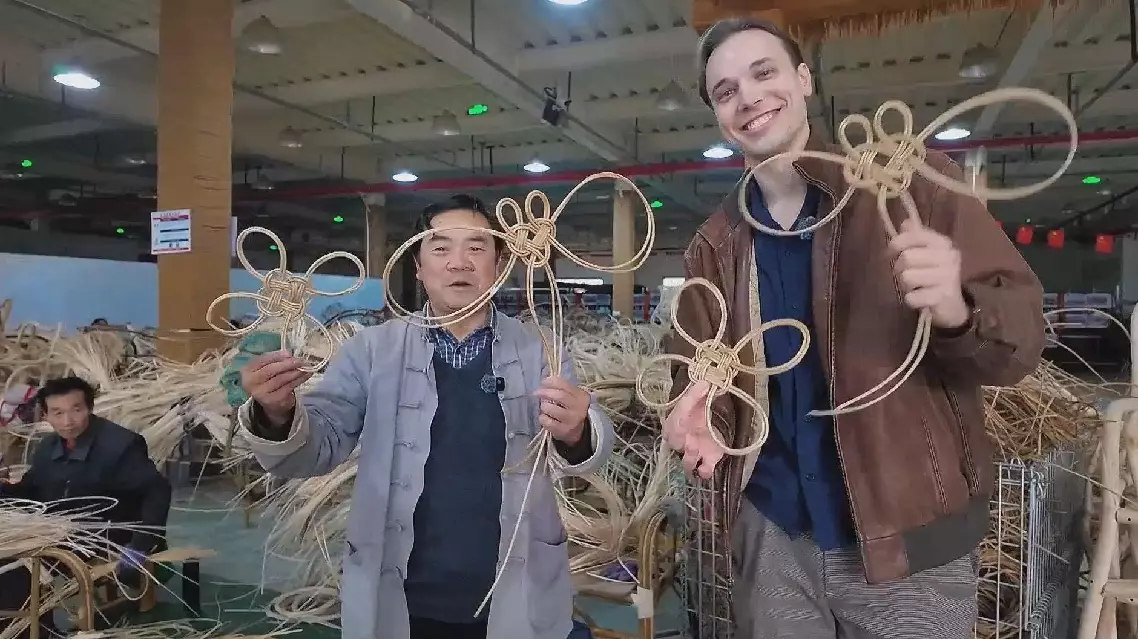
American vlogger weaves cultural bridge with ancient Chinese craft