China's expanded visa-free policies are reshaping inbound tourism and consumption, with new arrivals surging at major gateways.
Over the past year, China has steadily widened the list of visa‑free countries, while extending its existing 72-hour and 144-hour transit visa-free schemes to a unified 240 hours. The upgraded transit policy now covers 24 provincial-level regions and 65 ports of entry.
In southwest China's Sichuan Province, one of the major habitats of giant pandas, the "Panda House," a cultural and creative store in Chengdu's Kuanzhai Alley, has become a hotspot. Foreign tourists are flocking to buy from over 3,000 panda-themed items.
"I bought this 'hat' because it's fun and it's warm," said a tourist from Russia, showing off her new panda-themed item -- a combined hat and scarf.
"We saw many pandas. It's convenient for shopping and transportation. We bought a lot of panda bags to give to all our friends," said a tourist from Singapore.
The store manager noted that cultural and creative items combining pandas with Shu brocade, an ancient textile art recognized as part of China's intangible cultural heritage, are the bestsellers.
"This bag is quite popular among tourists. It is [a product] with an element of intangible cultural heritage. This bag is a collaboration with a heritage master and our Panda House. And it is a limited edition," said the manager.
Nearby, a leaf carving shop is also drawing crowds with customized laser-engraved leaves for highly personalized souvenirs.
"Generally, customers like designs featuring Chengdu landmarks and scenic spots, giant pandas, and Sichuan Opera face-changing masks," a shop assistant said.
According to the Chengdu tax bureau, there are now over 600 tax refund stores in the city. From January to November 2025, tax refunds for foreign tourists exceeded 130 million yuan (about 18.6 million U.S. dollars), with refunds in cultural and creative products accounting for over 40 percent of the total.
In Suzhou City, east China's Jiangsu Province, tourists are opting for a slower pace, taking boat rides through ancient water alleys.
"Here in Suzhou, in the Nest Master Garden, they have the tea house that you can see [to] enjoy the nature, enjoy the harmony in that place, enjoy the tea and some beautiful music," said a visitor from Poland.
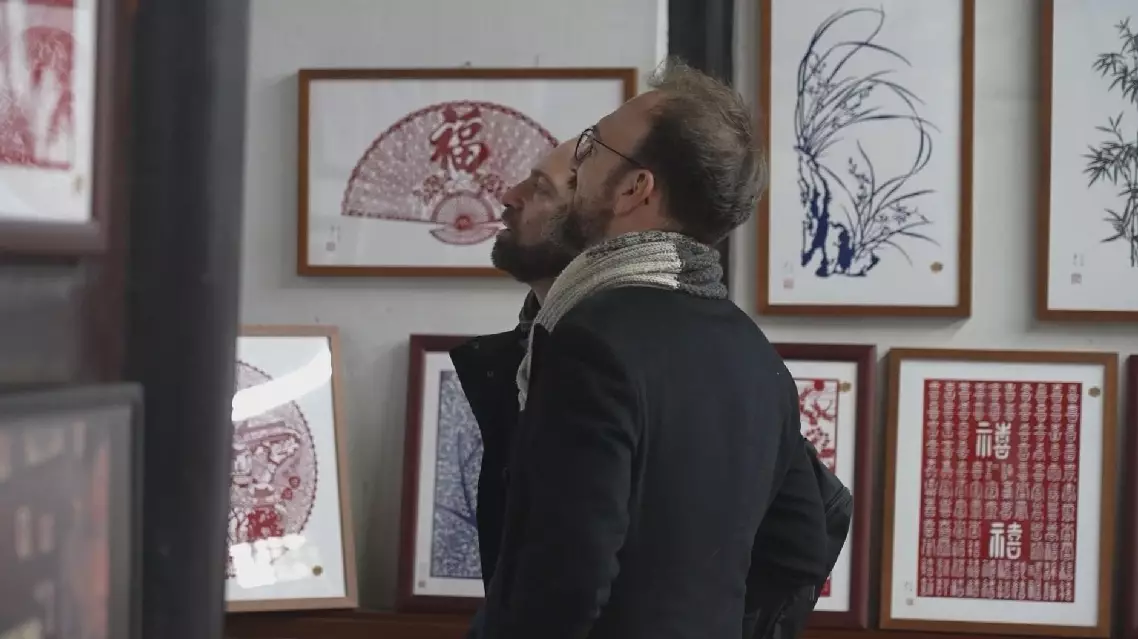
Beyond sightseeing, paper-cutting stores are popular in Suzhou's ancient towns like Zhouzhuang and Tongli, offering insights into Chinese culture and aesthetics.
"Those things interest us, because it shows that there's a lot of effort and technique put into it (paper-cutting). It shows a long history of mastery, so we like it," said a tourist from Singapore.
Ji Jianming, an inheritor of the art of paper-cutting in Tongli, said that around 50 to 60 foreign tourists visit his shop every day.
"We explain to them that this isn't painting inside the frame. It's paper cut. We demonstrate it, and if they are interested, they can try it themselves," said Ji.
In the northeast China's Helongjiang Province, the implementation of a visa-free policy for Russian tourists in September last year has revitalized the border cities of Suifenhe and Heihe.
"It's my first day [traveling in China]. And I want to walk around and buy something," said a tourist from Russia.
"From September 15, 2025, to now, nearly 35,000 foreign travelers have entered China via the Suifenhe port, up 24.7 percent period on period," said Ren Lei, deputy director of the Suifenhe Municipal Bureau of Commerce.
At the Heihe border checkpoint, daily inbound passenger numbers have also climbed significantly.
"This is my first time coming to China. I want to visit your country and know about your traditional culture," said another tourist from Russia.
"We've recently seen a clear increase in inbound tourists. Previously, we handled about 500 to 600 inbound travelers per day. Now the daily figure has exceeded 1,000, roughly double the pre‑holiday level," said Dai Chen, a border officer at the Heihe Entry-Exit Border Inspection Station.
China's visa-free policy fuels surge in foreign entries