Skip to Content Facebook Feature Image

Freight train departures herald promising start to China's 2026 foreign trade

China

China

China

Freight train departures herald promising start to China's 2026 foreign trade

2026-01-02 15:40 Last Updated At:17:07

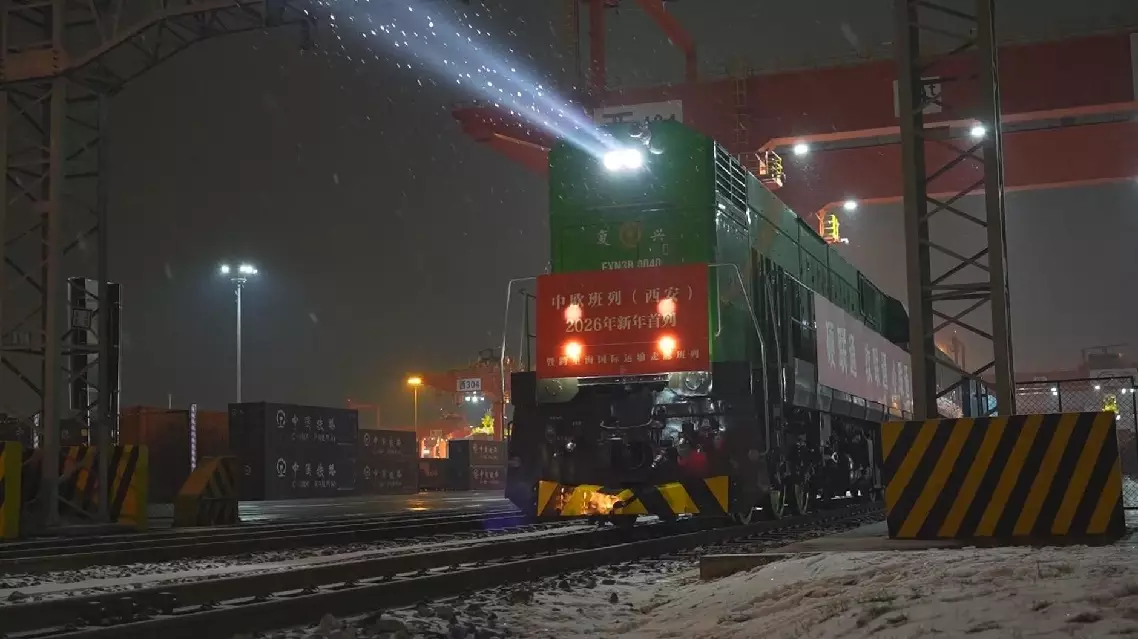
Three international freight trains departed on Thursday, the first day of the new year, from east China's Zhejiang Province, northwest China's Shaanxi Province and Xinjiang Uygur Autonomous Region, marking a strong start for China's foreign trade in 2026.

The one left from Zhejiang became the 1,060th maritime-rail intermodal train handled by Yiwu (Suxi) International Hub Port.

Equipped with a digital intelligent control system, the port efficiently decoded and issued operational commands in real time, ensuring seamless coordination across all units and enabling the continuous export of Chinese goods to markets worldwide.

Known as the "world's supermarket", Yiwu is a global hub for small commodities.

In Shaanxi, a China-Europe freight train loaded with 45 containers of photovoltaic modules departed from the Xi'an International Port Station.

The train is scheduled to exit China via the Horgos Port in Xinjiang, traverse Kazakhstan, and ultimately arrive in Baku, the capital of Azerbaijan.

China-Europe freight trains, dubbed "the modern steel camel caravans", have established a vast logistics network across Eurasia. This initiative embodies both the legacy of the ancient Silk Road and the Belt and Road Initiative's (BRI) vision of enhancing infrastructure connectivity and trade facilitation.

Another China-Europe freight train, carrying 110 standard containers of auto parts, mechanical and electrical products, and daily consumer goods, departed from the Alashankou railway port in Xinjiang.

This train, the first to pass through Xinjiang's rail ports in the new year, is bound for Malaszewicze, Poland, a major logistics hub in Central Europe.

Official data showed that China's total goods imports and exports in yuan-denominated terms rose to 41.21 trillion yuan (about 5.89 trillion U.S. dollars) in the first 11 months of 2025, up 3.6 percent year on year.

In November alone, China's goods imports and exports edged up 4.1 percent to 3.9 trillion yuan.
Freight train departures herald promising start to China's 2026 foreign trade

Freight train departures herald promising start to China's 2026 foreign trade

Coffee estates in Pu'er City, southwest China's Yunnan Province, are offering a new kind of holiday experience, combining farming, tourism and China's growing coffee culture.

As the New Year holiday spurs travel, visitors are arriving at coffee estates in Pu'er, looking for a slower, calmer way to welcome the year ahead.

"The air here is great, and the overall vibe is very relaxing. We can also learn a lot about coffee, and it's especially fun for kids," said Zhang Boai, a tourist from Beijing.

"I'm really, really excited. Coming here today and seeing such a large coffee plantation, with different kinds of cherries -- red, green, deep red -- has given me a completely new and deeper understanding of coffee as a crop," said Zhang Lei, a tourist from Hangzhou.

With abundant sunlight, a mild climate and rich soil, Pu'er offers ideal conditions for growing high-quality Arabica coffee.

In recent years, a growing number of coffee estates have emerged across the city. Combining cultivation, processing and accommodation, they represent a new way of exploring how a single crop can generate more value.

"Our project officially opened in January 2025. Since then, we've welcomed about 300,000 visitors, mostly from big cities like Beijing, Shanghai and Guangzhou," said Dai Xiaoyan, general manager of Beautiful Star Village, Windy Coffee Valley.

Picking fresh cherries is just the first step. Here, visitors slow down to experience every stage of coffee making -- from drying and roasting to tasting and cupping -- and even create small souvenirs from coffee beans, making the journey as memorable as the drink itself.

"I've been drinking coffee for a long time, but I've never really understood how it's made, so this experience is really interesting," said Wang Han, a tourist from Shanghai

China is becoming one of the world's major coffee-consuming markets. That rising appetite is fueling the development of the domestic industry.

In producing regions like Pu'er, coffee harvests are shifting -- from supplying raw materials for global coffee brands to producing higher-quality, premium beans.

Now, by integrating coffee production with tourism, new opportunities are being created for local farmers.

"Before, we only grew a little coffee, some corn, and raised a few pigs, so our income was limited. Now, my wife works on the project and also runs a tie-dye business with them," said Huang Yubing, a local farmer.

Huang has also been experimenting with what he calls "Bao Bao Coffee," roasting beans in a popcorn machine for a unique flavor. He said his sources of income have become far more diversified.

From the hills of Pu'er to the first cup of the year, coffee is changing how people travel, unwind, and reconnect with the land, while quietly transforming the lives of those who grow it.

Coffee tourism booms in southwest China during New Year holiday

Coffee tourism booms in southwest China during New Year holiday

Recommended Articles