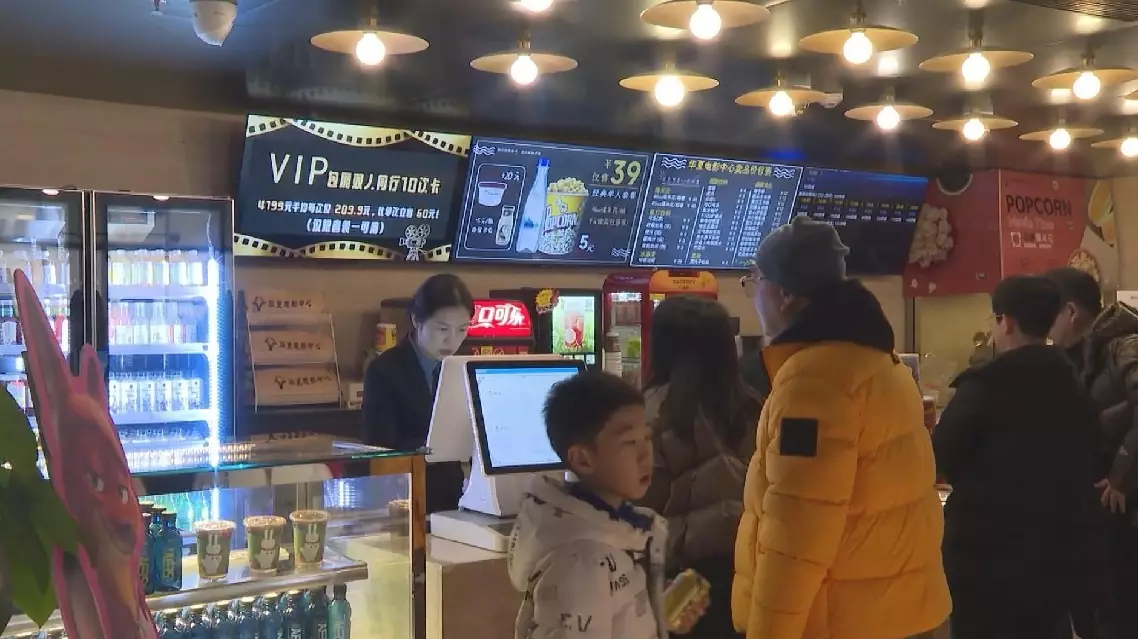
China's New Year holiday box office has surpassed 680 million yuan as of 14:30 on Saturday, the final day of the three-day break, according to data from online ticketing platform Maoyan.
In Beijing, Huaxia Film Center, China's first high frame rate LED multiplex, has emerged as a top destination for film enthusiasts. Featuring high dynamic range, brightness, and contrast, the cinema supports screenings at up to 120 frames per second, delivering a premium viewing experience for high-frame-rate productions.
The cinema reflects broader upgrades underway in China's film exhibition industry. Since the China Film Administration rolled out policies in June 2025 to encourage the development of LED theaters, more than 240 LED screening halls have been installed and put into operation nationwide, the highest number globally.
Enhanced screening quality has translated directly into box office performance. After the release of Avatar 3, China Film CINITY LED theater topped national rankings, recording an average of 87 viewers per screening and an occupancy rate of 26.59 percent, with tickets for prime-time showings rapidly sold out.
"We are seeking to expand the role of cinemas, and staged diverse alternative activities, including sports broadcasts, stage performances, and concert screenings. These efforts have boosted non-ticket revenue to 32 percent of box office income and turned cinemas into shared cultural spaces that bring people together," said Shen Ying, general manager of Huaxia Film Center.
China is also advancing the integration of virtual reality (VR) technology with film. In March last year, the China Film Administration introduced policies for VR films, becoming the first globally to bring VR productions under formal regulation and support. Since then, nearly 140 VR films have been registered, with 28 approved for public release.
In Guiyang City of southwest China's Guizhou Province, a local cinema operates the country's largest Extended Reality (XR) screening hall. Unlike conventional moviegoing, XR films allow audiences to move freely within virtual environments, transforming the experience from passive viewing to active exploration.
"It allows more interactions, which is nice. And it really feels like you are inside the story, something that I've never tried before. I chose to watch the Night Banquet in Tang Dynasty Palace, where the children can experience traditional culture," said Chen Kun, a local resident.
China's New Year holiday box office tops 680 mln yuan