The three astronauts aboard China's Shenzhou-21 mission have completed a diverse range of scientific experiments and routine station maintenance tasks during their second month on the Tiangong Space Station.
China launched the Shenzhou-21 crewed spaceship on Oct 31, 2025, sending the three astronauts to its orbiting space station on a six-month mission.
The Shenzhou-21 crew consists of mission commander Zhang Lu, along with astronauts Wu Fei and Zhang Hongzhang. The trio serve respectively as space pilot, flight engineer and payload specialist, representing the three categories of Chinese astronauts currently employed in the country's space program.
In the field of space medicine, ongoing research focuses on the kinematic characteristics of astronauts during long-term missions in orbit. By capturing three-dimensional structured light video of the astronauts in specific work scenarios, researchers obtain data on their kinematic properties and changes during on-orbit operations and activities, providing support for ergonomic design and evaluation, as well as optimization of mission planning.
In the footage, astronauts are conducting studies related to musculoskeletal loading forces. Using equipment for muscle structure and function measurement, plantar pressure collection, and patch-based ultrasound, they gather data on plantar pressure, joint kinematics, motion images, and muscle parameters during running and resistance exercises under different load conditions in flight, aiming to understand the relationship between different exercise parameters and physical stress.
Neuroscience research has also progressed. The crew has performed multiple electroencephalogram (EEG) tests for studies on visual field perception and executive function training. Using near-infrared brain imaging equipment, they investigate how long-term spaceflight affects astronauts' brain functional networks and the brain's adaptive mechanisms to the space environment.
Studies on psychological and behavioral capacity, including assessments of emergency decision-making and emotional states, are also underway. The crew has conducted microgravity experiments on intuitive physical behavior, investigating how long-term spaceflight affects and reshapes these innate responses.
In microgravity physical science, the astronauts have completed scheduled tasks including sample replacements in the colloid experiments unit of the fluid physics rack and maintenance work on the electrode mechanisms of the containerless experimental facility. Ongoing research includes an in-situ optical study of lithium-ion battery electrochemistry for space applications.
For routine operations, the crew have conducted regular maintenance on key equipment such as the space treadmill and the environmental control and life support system, alongside general cabin cleaning. They have also performed environmental monitoring, measuring parameters like acoustic levels, airflow, and temperature.
To ensure their own health, the astronauts have undergone standard medical examinations, including non-invasive cardiac function tests, hearing assessments, and comprehensive vision checks. They have also used a Traditional Chinese Medicine diagnostic instrument to collect physiological data, supporting long-term health monitoring for the mission.
As the new year begins, the Shenzhou-21 crew plans to conduct additional extravehicular activities with both astronauts and experimental payloads, along with a series of scientific experiments and technical tests.
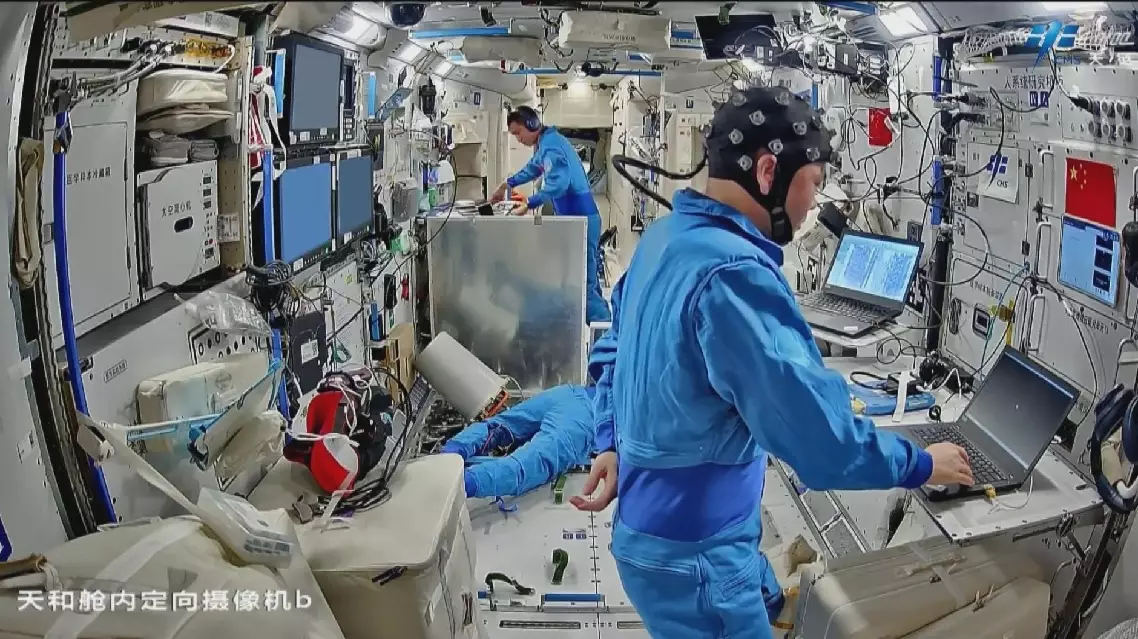
Shenzhou-21 crew busy with scientific experiments two months into space mission
Shenzhou-21 crew busy with scientific experiments two months into space mission
Shenzhou-21 crew busy with scientific experiments two months into space mission