China has made important progress in the conservation of the Chinese sturgeon, one of the world's most critically endangered species that is native to the country, since the government launched in 2016 a major initiative for the Yangtze River Economic Belt, a region covering 11 provinces and municipalities along the river.
The Chinese sturgeon is an anadromous species that spends most of its life at sea and migrates to spawn in the 6,300 km-long Yangtze River, the country's longest river. It is known as the "panda of the water" and is the most emblematic species of aquatic life in the Yangtze.
China launched the Yangtze River Economic Belt initiative in early 2016, aiming to transform the region into a vibrant economic belt featuring more beautiful ecology, smoother transport networks, a more coordinated economy, a better-integrated market, and a greater quantity of scientific mechanisms.
To implement the initiative in protecting the Yangtze's unique ecosystem, China has intensified efforts for the conservation and management of the Chinese sturgeon, by banning illegal fishing, creating reproductive areas, conducting artificial propagation programs, and organizing releases of captive-bred fish fry.
In June 2020, Shanghai, a leading city of the Yangtze River Economic Belt, officially put into effect a set of regulations on the conservation and management of the Chinese sturgeon, which was the first local rules of its kind dedicated for a specific species nationwide.
At a marine ranch located at the mouth of the Yangtze River in late December last year, researchers from the Shanghai Aquatic Wildlife Conservation and Research Center recorded multiple species under national top- and second-class protection, such as the Chinese sturgeon, the Yangtze finless porpoise, and the Chinese sucker fish.
"In 2025, we have monitored a total of 25 Chinese sturgeons in the waters of the Yangtze River estuary, which is a relative high number compared with previous years. They were all released from the upper reaches of the Yangtze," Wang Ting, a researcher told China Central Television during the aquatic wildlife tracking mission on Dec 22.
She was referring to the large-scale releases of captive-bred Chinese sturgeons into the wild, efforts that the Ministry of Agriculture and Rural Affairs has stepped up since 2024 to protect the rare species and boost the biodiversity of the Yangtze.
According to official data, these scientific restocking efforts saw more than 970,000 Chinese sturgeons being released into the Yangtze River in 2025.
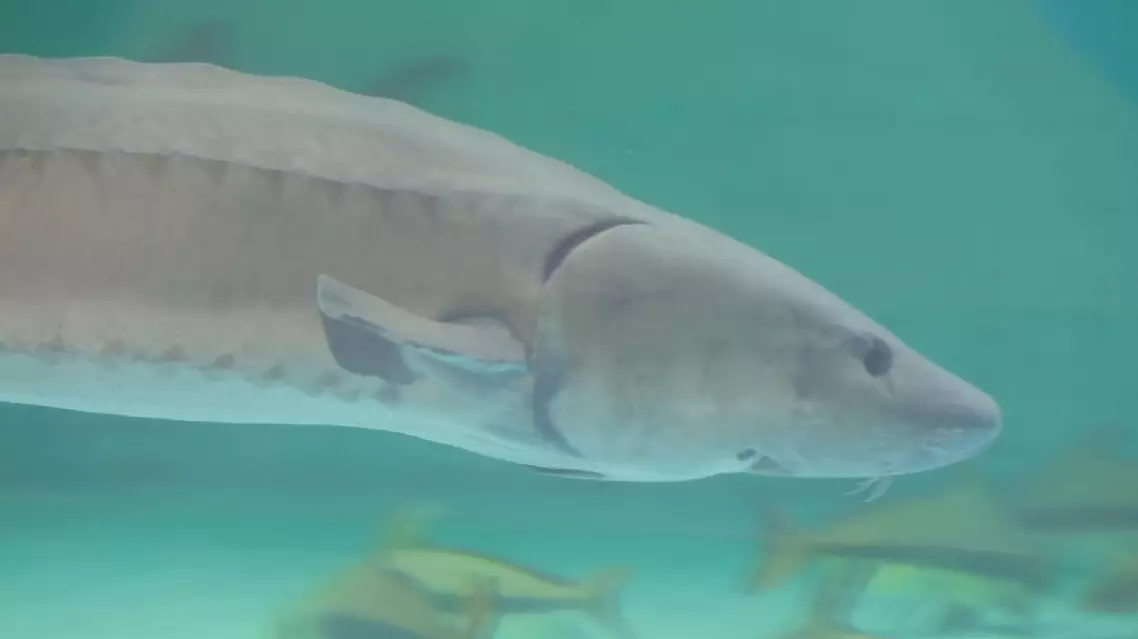
Chinese sturgeon thrives after China's decade-long conservation efforts