LINKÖPING, Sweden--(BUSINESS WIRE)--Jan 8, 2026--
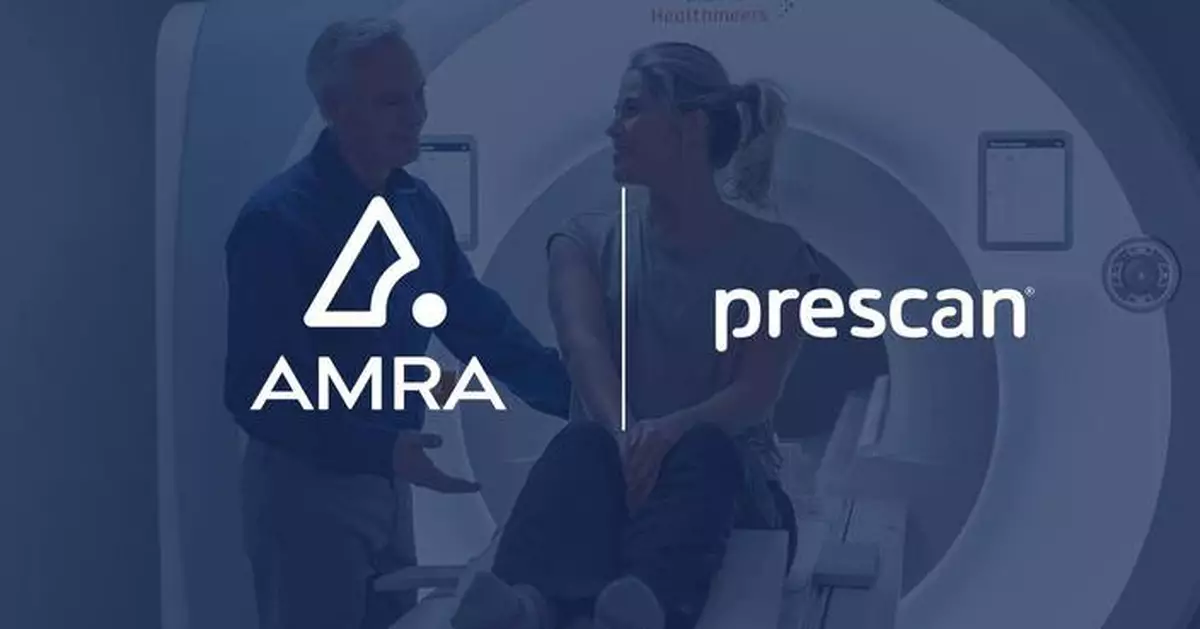
AMRA Medical, the global leader in MRI-based fat distribution and muscle composition analytics, alongside Dutch preventative healthcare leader Prescan, are pleased to announce the official launch of our cutting-edge AMRA® BCP Scan service, powered by AMRA® Profiler (CE, NB 2862), in the Netherlands. The launch, which marks BCP Scan’s third new market entry of 2025 ( Sweden & Germany ), expands the availability of our service within the EU into the Netherlands through an exclusive partnership with Prescan, an independent health & wellness clinic in Baarn which specializes in preventive health screenings and care.
This press release features multimedia. View the full release here: https://www.businesswire.com/news/home/20260108381985/en/
AMRA® BCP Scan available at Prescan
AMRA’s CEO, Olof Dahlqvist Leinhard, stated, “This is another important step in bringing our mission of driving scientific breakthroughs into the clinic by enabling deeper understanding of health and disease through MRI-based biomarkers to the global stage. By partnering with Prescan, we’re excited to help them empower individuals in the Netherlands to take proactive control of their health using AMRA® BCP Scan. ”
The AMRA® BCP Scan service provides clinicians with fat distribution measurements, including visceral fat, subcutaneous fat and liver fat, in addition to muscle composition biomarkers that comprise a detailed body composition profile (BCP) to assist in the assessment of health risks. Implemented directly in the clinic, the service delivers rapid, precise, and standardized body composition measurements, contextualizing insights at the individual patient level with high accuracy.
At launch, Prescan will make AMRA® BCP Scan available to customers as a standalone product, and will be the only center offering BCP Scan in the Netherlands. Haif Rood Nawzad, CEO of Prescan, remarked that “This collaboration with AMRA represents an important step forward in preventive diagnostics at Prescan. By adding precise measurement of visceral fat and assisting our clinicians with assessing their metabolic risk to our offering, we further expand our advanced MRI portfolio and provide clients with clinically relevant insights that go beyond traditional imaging. It perfectly aligns with our vision to continuously innovate and improve early detection in preventive healthcare.”
Currently, AMRA® BCP Scan service is additionally available through AMRA’s service provision in the US, Canada, Sweden, Germany, the Netherlands, and the UK - with plans to roll out in more countries in 2026 and beyond.
If you or your organization are based in the currently cleared markets and would like to know more about bringing the AMRA® BCP Scan service to your clinic, or if you want to learn more about how AMRA is using MRI-based fat distribution and muscle composition measures to advance both research and clinical care, please contact us here or reach out to one of our knowledgeable scientists at info@amramedical.com.
About AMRA Medical
AMRA Medical is a global leader in health informatics, pioneering the field of fat and muscle analysis with proprietary, MRI-based technologies. Our gold-standard platform delivers highly precise and standardized biomarkers, providing an advanced understanding of metabolic and musculoskeletal health that surpasses conventional body composition metrics. These insights play a critical role in optimizing clinical trial design, improving endpoint selection, and supporting data-driven decision-making in both research and clinical practice.
Built on rigorous science and driven by continuous innovation, AMRA’s solutions are designed to meet the complex demands of modern healthcare and pharmaceutical development. Through standardized, cloud-based workflows and strategic collaboration, we enable partners to access actionable data with clarity and confidence–accelerating progress from early-stage discovery to impactful clinical outcomes.
About Prescan
Prescan is an independent preventive healthcare organization based in the Netherlands, specializing in early health detection and lifestyle advice. Founded in 2003, Prescan combines advanced MRI diagnostics with cardiology, dermatology, and blood testing. With a wide variety of examinations available, ranging from targeted scans to comprehensive full-body screenings, Prescan enables clients to gain rapid, in-depth insight into their health, with results discussed immediately by medical specialists.
You can contact Prescan with any questions you might have by filling out their contact form, or by reaching out directly to info@prescan.nl to get in touch with one of their representatives.
AMRA® BCP Scan available at Prescan
A quarterback reportedly reneging on a lucrative deal to hit the transfer portal, only to return to his original school. Another starting QB, this one in the College Football Playoff, awaiting approval from the NCAA to play next season, an expensive NIL deal apparently hanging in the balance. A defensive star, sued by his former school after transferring, filing a lawsuit of his own.
It is easy to see why many observers say things are a mess in college football even amid a highly compelling postseason.
“It gets crazier and crazier. It really, really does,” said Sam Ehrlich, a Boise State legal studies professor who tracks litigation against the NCAA. He said he might have to add a new section for litigation against the NCAA stemming just from transfer portal issues.
“I think a guy signing a contract and then immediately deciding he wants to go to another school, that’s a kind of a new thing,” he said. “Not new kind of historically when you think about all the contract jumping that was going on in the ’60s and ’70s with the NBA. But it’s a new thing for college sports, that’s for sure.”
Washington quarterback Demond Williams Jr. said late Thursday he will return to school for the 2026 season rather than enter the transfer portal, avoiding a potentially messy dispute amid reports the Huskers were prepared to pursue legal options to enforce Williams’ name, image and likeness contract.
Edge rusher Damon Wilson is looking to transfer after one season at Missouri, having been sued for damages by Georgia over his decision to leave the Bulldogs. He has countersued.
Then there is Ole Miss quarterback Trinidad Chambliss, who reportedly has a new NIL deal signed but is awaiting an NCAA waiver allowing him to play another season as he and the Rebels played Thursday night's Collge Football Playoff semifinal against Miami. On the Hurricanes roster: Defensive back Xavier Lucas, whose transfer from Wisconsin led to a lawsuit against the Hurricanes last year with the Badgers claiming he was improperly lured by NIL money. Lucas has played all season for Miami. The case is pending.
Court rulings have favored athletes of late, winning them not just millions in compensation but the ability to play immediately after transferring rather than have to sit out a year as once was the case. They can also discuss specific NIL compensation with schools and boosters before enrolling and current court battles include players seeking to play longer without lower-college seasons counting against their eligibility and ability to land NIL money while doing it.
Ehrlich compared the situation to the labor upheaval professional leagues went through before finally settling on collective bargaining, which has been looked at as a potential solution by some in college sports over the past year. Athletes.org, a players association for college athletes, recently offered a 38-page proposal of what a labor deal could look like.
“I think NCAA is concerned, and rightfully so, that anything they try to do to tamp down this on their end is going to get shut down,” Ehrlich said. “Which is why really the only two solutions at this point are an act of Congress, which feels like an act of God at this point, or potentially collective bargaining, which has its own major, major challenges and roadblocks.”
The NCAA has been lobbying for years for limited antitrust protection to keep some kind of control over the new landscape — and to avoid more crippling lawsuits — but bills have gone nowhere in Congress.
Collective bargaining is complicated and universities have long balked at the idea that their athletes are employees in some way. Schools would become responsible for paying wages, benefits, and workers’ compensation. And while private institutions fall under the National Labor Relations Board, public universities must follow labor laws that vary from state to state; virtually every state in the South has “right to work” laws that present challenges for unions.
Ehrlich noted the short careers for college athletes and wondered whether a union for collective bargaining is even possible.
To sports attorney Mit Winter, employment contracts may be the simplest solution.
“This isn’t something that’s novel to college sports,” said Winter, a former college basketball player who is now a sports attorney with Kennyhertz Perry. “Employment contracts are a huge part of college sports, it’s just novel for the athletes.”
Employment contracts for players could be written like those for coaches, he suggested, which would offer buyouts and prevent players from using the portal as a revolving door.
“The contracts that schools are entering into with athletes now, they can be enforced, but they cannot keep an athlete out of school because they’re not signing employment contracts where the school is getting the right to have the athlete play football for their school or basketball or whatever sport it is,” Winter said. “They’re just acquiring the right to be able to use the athlete’s NIL rights in various ways. So, a NIL agreement is not going to stop an athlete from transferring or going to play whatever sport it is that he or she plays at another school.”
There are challenges here, too, of course: Should all college athletes be treated as employees or just those in revenue-producing sports? Can all injured athletes seek workers' compensation and insurance protection? Could states start taxing athlete NIL earnings?
Winter noted a pending federal case against the NCAA could allow for athletes to be treated as employees more than they currently are.
“What’s going on in college athletics now is trying to create this new novel system where the athletes are basically treated like employees, look like employees, but we don’t want to call them employees,” Winter said. “We want to call them something else and say they’re not being paid for athletic services. They’re being paid for use of their NIL. So, then it creates new legal issues that have to be hashed out and addressed, which results in a bumpy and chaotic system when you’re trying to kind of create it from scratch.”
He said employment contracts would allow for uniform rules, including how many schools an athlete can go to or if the athlete can go to another school when the deal is up. That could also lead to the need for collective bargaining.
“If the goal is to keep someone at a school for a certain defined period of time, it’s got to be employment contracts,” Winter said.
Get poll alerts and updates on the AP Top 25 throughout the season. Sign up here. AP college football: https://apnews.com/hub/ap-top-25-college-football-poll and https://apnews.com/hub/college-football
Mississippi quarterback Trinidad Chambliss (6) runs the ball during the second half of the Fiesta Bowl NCAA college football playoff semifinal game against Miami, Thursday, Jan. 8, 2026, in Glendale, Ariz. (AP Photo/Rick Scuteri)