Russia on Thursday strongly condemned the U.S. seizure of an oil tanker, heralding a new chill in relations between Moscow and Washington that could spread to other areas and affect President Donald Trump's efforts to persuade Russia to end its nearly four-year war in Ukraine.
The seizure Wednesday of the Russian-flagged tanker in the North Atlantic "can only lead to a further escalation of military and political tensions in the Euro-Atlantic region, as well as a visible lowering of the ‘threshold for the use of force’ against peaceful shipping,” the Russian Foreign Ministry said.
Russian President Vladimir Putin hasn’t yet commented on the seizure of the tanker and has remained silent about the U.S. capture of Venezuelan leader Nicolás Maduro, which his diplomats have denounced as a blatant act of aggression.
But while the Russian president has avoided any criticism of Trump, the seizure of the tanker by the U.S. military represents a new challenge for the Kremlin.
Hawkish commentators in Moscow criticized the government for failing to mount a quick response and argued that Russia should deploy its naval assets to protect ships of the shadow fleet.
Ukraine’s Western allies long have promised to tighten sanctions on the shadow fleet of tankers that Russia has used to carry its oil to global customers, and many observers in Moscow warned that the U.S. action could set a precedent for other nations.
Besides its tough rhetoric, Russia has few options when considering how to respond to the seizure, according to Daniel Fried, an assistant secretary of state for European and Eurasian affairs during the administrations of Presidents George W. Bush and Barack Obama.
“The Russians tend to scream and yell when they’ve been embarrassed, and they’ve been embarrassed in this case because Russian power is not what Vladimir Putin makes it out to be,” Fried said. “They couldn’t do anything about this ship.”
The U.S. European Command said the merchant vessel Bella 1 was seized Wednesday for “violations of U.S. sanctions.” When the U.S. started pursuing the tanker last month after it tried to evade a blockade on sanctioned oil vessels around Venezuela, it was renamed Marinera and flagged to Russia.
Trump’s administration has enforced an oil embargo on Venezuela, and the Energy Department says the only oil transported in and out of Venezuela will be through approved channels consistent with U.S. law and national security interests.
The Foreign Ministry said the U.S. attempt to frame the seizure of the tanker as part of a broad effort to establish control over Venezuela’s oil riches was an “utterly cynical” reflection of “neo-colonial ambitions.”
The ministry described it as a “gross violation” of international maritime law and insisted the ship had a permit to sail under the Russian flag issued in December. It said U.S. threats to prosecute the crew “under absurd pretexts” were “categorically unacceptable.”
It said sanctions imposed unilaterally by the U.S. and other Western countries were “illegitimate” and could not serve as justification to seize vessels on the high seas.
“Washington’s willingness to generate acute international crisis situations, including in relation to already extremely strained Russian-American relations, which are burdened by disagreements from past years, is a cause for regret and concern," the ministry said.
The White House declined to comment Thursday when asked about the Foreign Ministry’s statement.
The tanker’s seizure drew angry comments from Russian military bloggers, some of whom accused the Kremlin of failing to mount a stronger response to the U.S. action. Many criticized the military for failing to quickly dispatch a warship to escort the tanker.
Some proposed deploying teams of military contractors on shadow fleet ships to prevent such seizures in the future.
Alexander Kots, a military correspondent for the Komsomolskaya Pravda tabloid, argued that the Kremlin’s failure to forcefully respond to the tanker’s seizure could embolden the U.S. and other Western nations to impound more ships.
“Facing a bully who feels all-powerful, we must slap him across the face,” Kots wrote.
Fried said Russia has little credibility when it comes to complaints about international law, given its invasion of Ukraine. Russia’s claim to the ship is also tenuous, he noted, given that it was only given a temporary permit to fly the Russian flag late last month.
“If you talk about this legally, it’s a complicated issue. If you talk about this strategically, the Russians are badly overextended and vulnerable,” said Fried, now with the Atlantic Council, a Washington think tank. “They are hanging on to a war in Ukraine that they are not winning … their economy is hurting.”
He said while it was possible Moscow would react to the tanker's seizure by plotting an attack on U.S. interests, Putin may not want to risk antagonizing Trump.
“Putin has gotten further with Trump when he flatters him,” Fried said.
As the tensions over the ship’s seizure flared, Sen. Lindsey Graham, a South Carolina Republican, said Wednesday that Trump has “greenlit” a Russia sanctions bill intended to economically cripple Moscow that has been in the works for months.
Associated Press writer David Klepper in Washington contributed to this story.
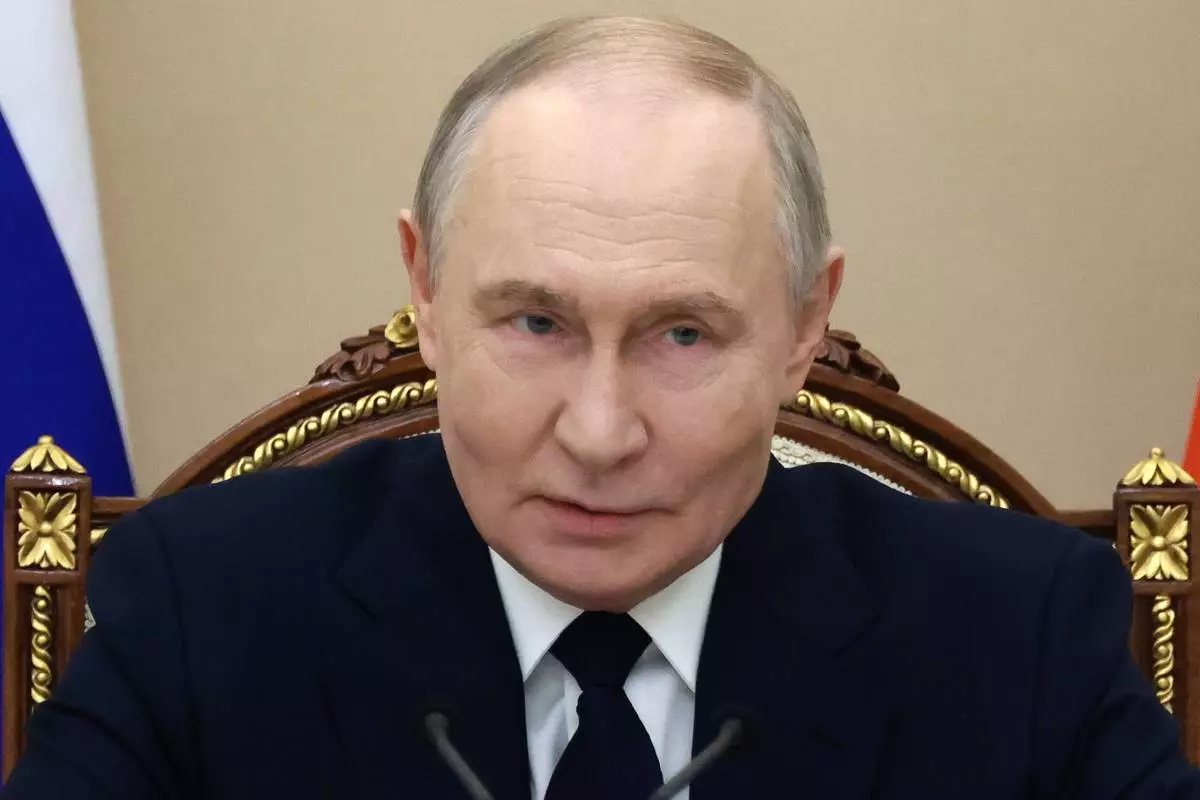
Russian President Vladimir Putin attends a meeting with senior military officers at the Kremlin in Moscow, Russia, Monday, Dec. 29, 2025. (Mikhail Metzel/Sputnik, Kremlin Pool Photo via AP)
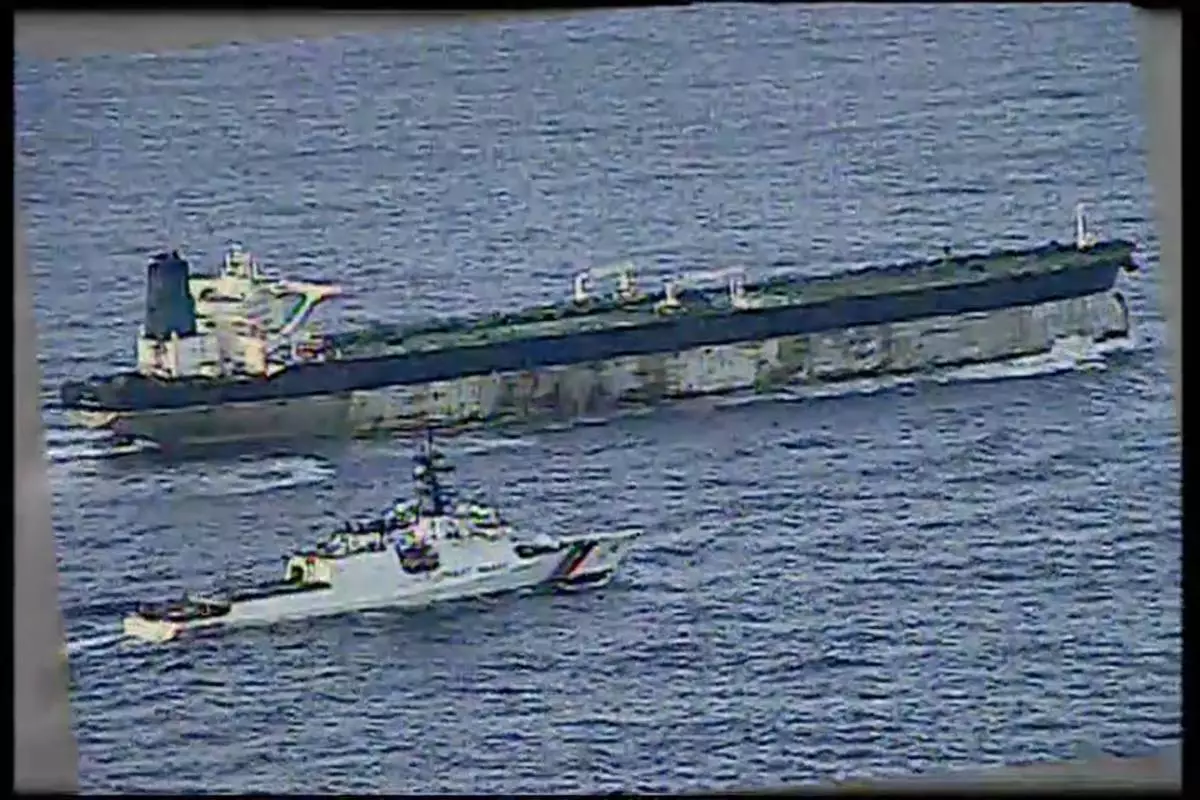
This image from video provided by the U.S. Department of Defense, shows the U.S. Coast Guard cutter Munro shadowing the MV Bella 1 in the North Atlantic Ocean during the maritime interdiction operation Wednesday, Jan. 7, 2026. (Department of Defense via AP)
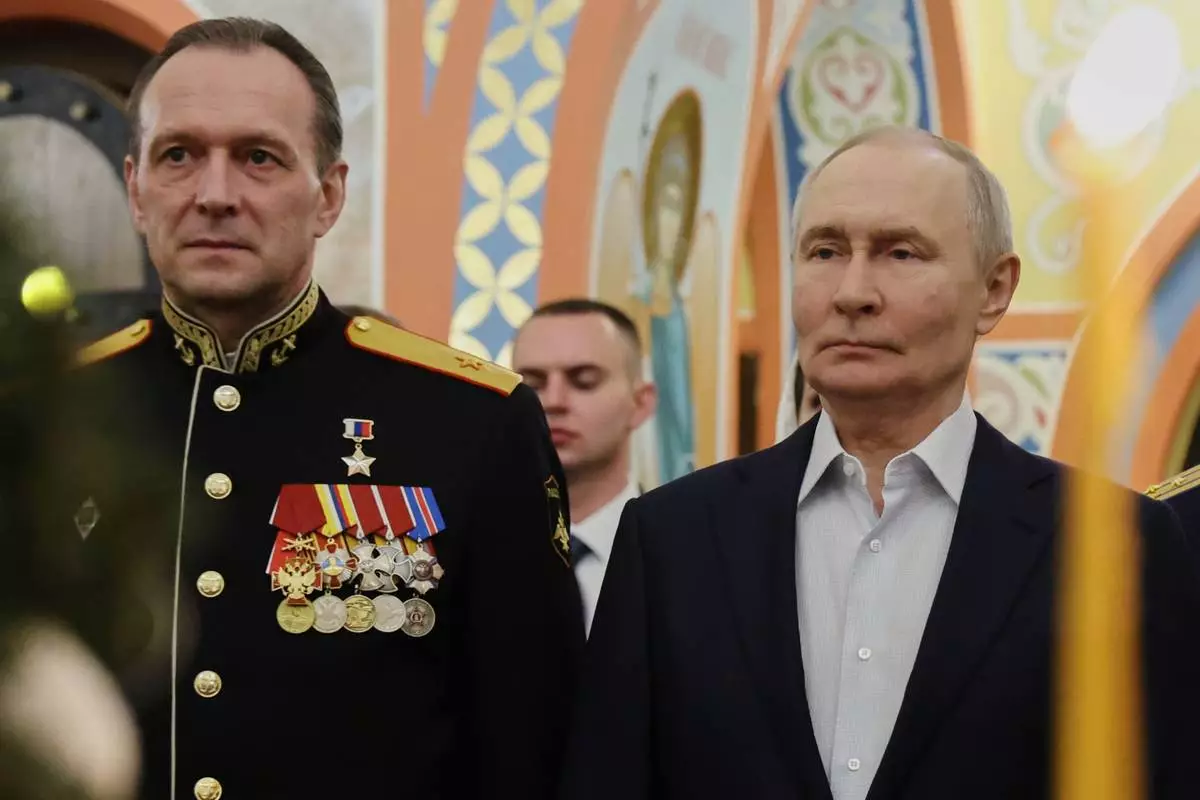
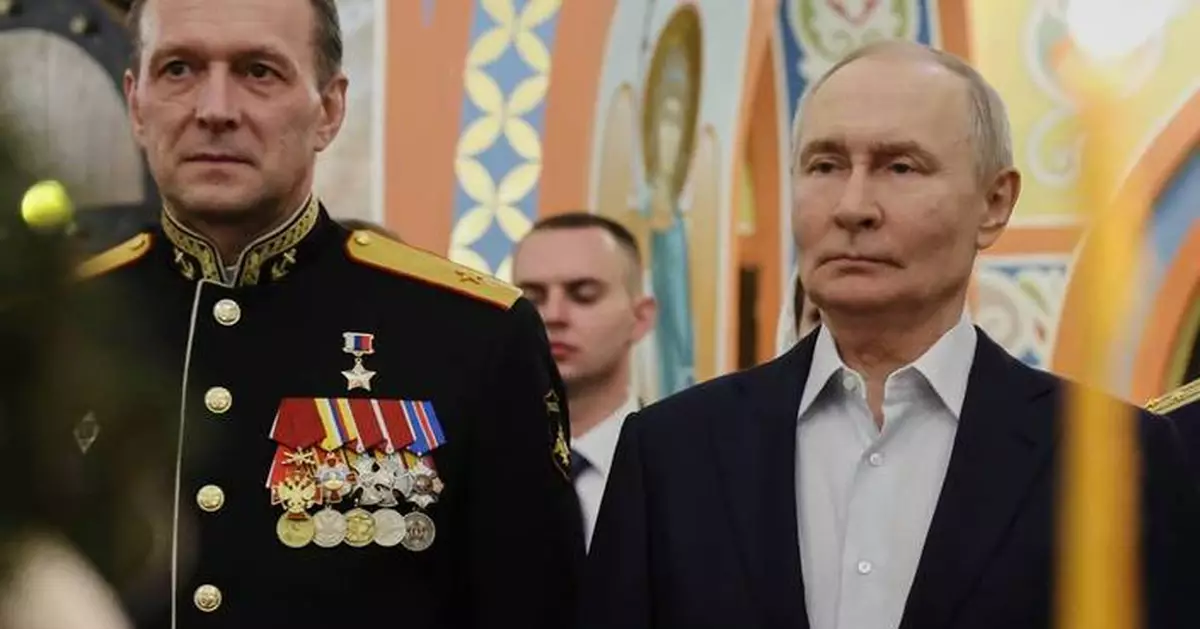
Russian President Vladimir Putin, right, accompanied by military personnel and their families, attends an Orthodox Christmas service at a church in Moscow Region, Russia, on Wednesday, Jan. 7, 2026. (Vyacheslav Prokofyev, Sputnik, Kremlin Pool Photo via AP)