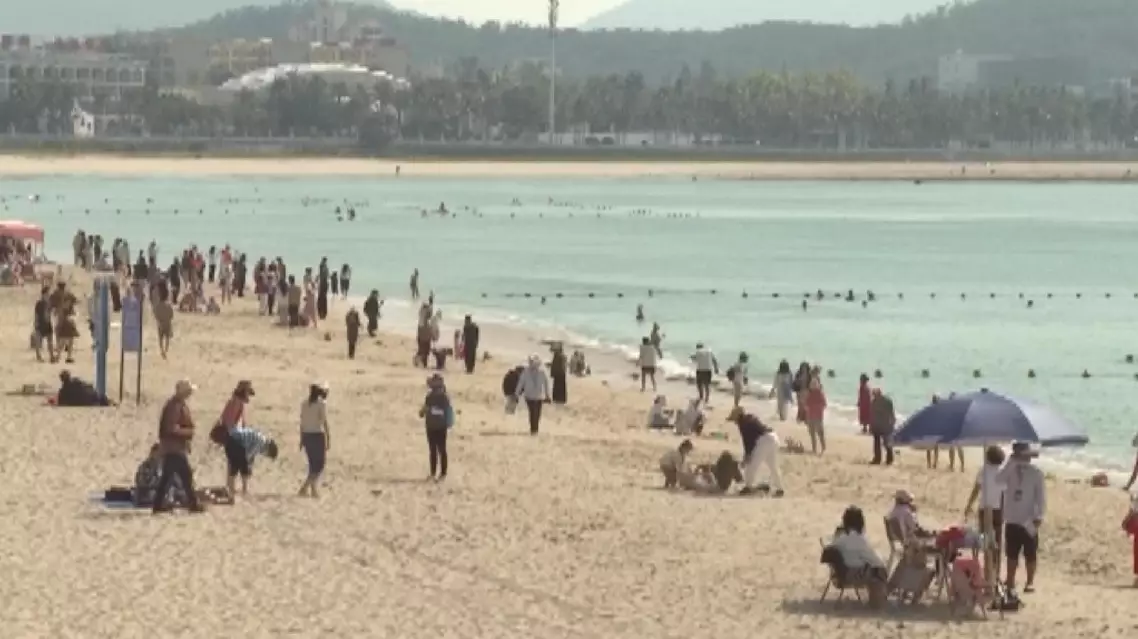
As Russia's chilly winter sets in, a growing number of Russians are flocking to the tropical shores of Sanya, a coastal city in south China's island province of Hainan, in search of sun-drenched beaches and holistic wellness.
In the first half of 2025, Sanya witnessed a staggering 266.2 percent year-on-year surge in Russian tourists, who accounted for over 40 percent of its international arrivals.
The city has become a hub for Russians seeking not just leisure but also cultural immersion, with this trend further fueled by China's visa-free policy trial for Russians launched in September 2025.
The Dadonghai scenic area in Sanya receives a daily average of over 3,000 Russian tourists.
"We are from Moscow, and my friend is from St. Petersburg. We came here for a two-week vacation. We have spent half of our time here, staying at a fantastic hotel and relaxing on the beach," said Elena, a Russian tourist.
"I come from Volgograd, Russia, and it's my first time visiting Sanya," said another Russian tourist.
"I'm from Moscow and plan to stay here for seven days. I'm very satisfied with the hotel, which is close to the sea, and the weather is great," a Russian tourist said.
To improve their stays, Sanya has rolled out tailored services for its Russian guests -- frontline staff undergo Russian language training for hotel check-ins and tour guidance, government hotlines offer Russian-language assistance, and 76 bus stops have added Russian to their signage.
Accommodation registration has been streamlined through online platforms, with Russians constituting the majority of foreign guests using these services. Payment barriers are also fading, as high-end hotels and key attractions have installed POS machines that accept foreign bank cards, while over 479 ATMs across the island support cash withdrawals using Russian cards.
Traditional Chinese medicine (TCM) stands out as a key attraction for many Russians, who travel specifically for therapies such as acupuncture and moxibustion, a traditional Chinese medical therapy that involves burning dried mugwort to stimulate specific points on the body.
The expansion and increased frequency of international flights to Sanya have further lowered the travel barriers for Russian tourists.
Sanya now has international air routes to 10 major Russian cities, including Moscow, St. Petersburg, and Kazan.
"In 2024, Sanya's hotels received approximately 170,000 inbound Russian tourists throughout the year. In 2025, the number rose to 350,000. In 2026, we plan to launch new routes to major cities such as Tyumen and Irkutsk. We hope to enable more Russian tourists to reach Sanya directly from their hometowns," said Ma Nan, senior director of the Sanya Tourism Board.
Russian visitors drawn to south China's Sanya by sun, sea, healthcare