A smart robot traffic police officer was put into use at bustling streets in Wuhu City of east China's Anhui Province on Saturday to participate in frontline traffic control and order maintenance.
At a key intersection of Wuhu City, a robot in a police uniform with a traffic police logo and a police officer number on its chest is cooperating with human traffic police officers on site to participate in traffic control and promote civilized travel.
The smart traffic police officer was fixed to a small mobile platform, which allows it to move to the designated position and direct traffic from all directions by platform rotation.
"I think it's very high-tech because it can move independently and also direct traffic in the middle of the road," said local resident Wang Ruohan.
With its functions focused on high-frequency needs in urban traffic management, this traffic police robot mainly carries out its training in four application scenarios: popularizing traffic regulations, coordinating traffic command at intersections, intelligently identifying and advising against uncivilized behavior, and automatically capturing and collecting evidence of violations.
By connecting to traffic lights and traffic management systems, traffic police robots can assist human traffic police in handling repetitive tasks during peak hours, making on-site law enforcement and services more efficient, according to traffic police officers.
"It can work closely with us human traffic police based on our traffic light system to autonomously direct traffic. While on duty in our area, it can also identify violations by non-motorized vehicles," said Jiang Zihao, instructor of the First Squadron of the Jiujiang Brigade of Traffic Management Detachment of the Wuhu Municipal Public Security Bureau.
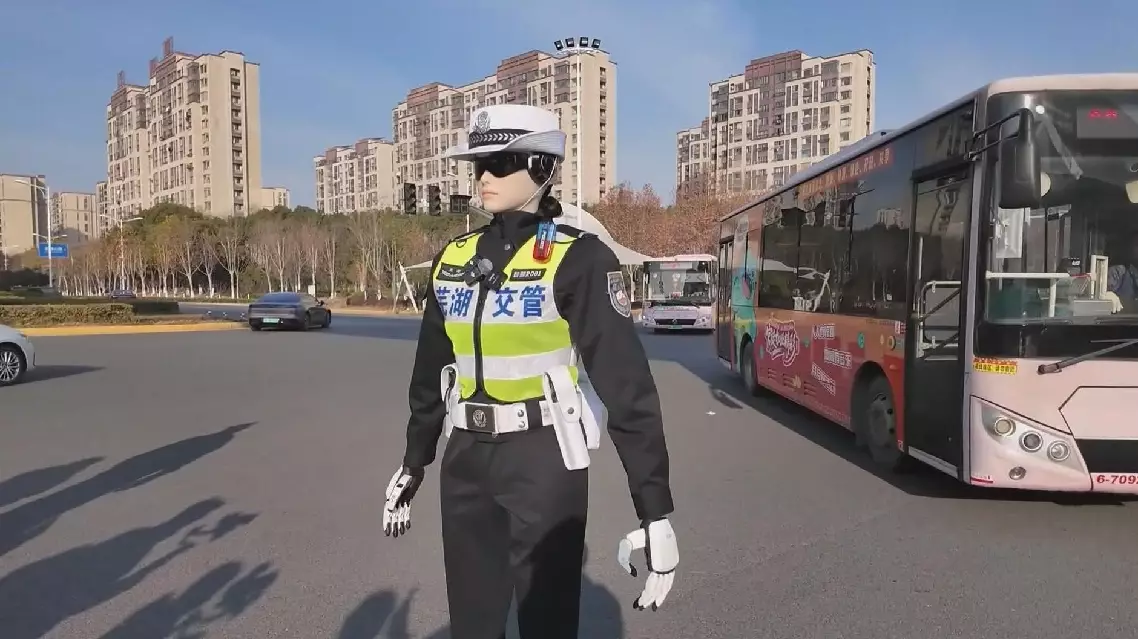
First innovative robot traffic police officer put on duty in east China city
Chicago policymakers have introduced measures to increase housing supply, in a move that local activists and construction industry stakeholders have hailed as key to easing affordability pressures on residents.
According to the city's 2025 annual report on homelessness, Chicago is facing its largest gap in affordable and available housing in a decade, with the annual Point-in-Time (PIT) Count estimating that 7,452 people were experiencing homelessness, either in shelters or unsheltered locations, on January 23, 2025.
Steven Vance, a social worker in Chicago, said policies that previously curbed the city's housing supply have pushed up rent costs amid demographic changes.
"Households are declining in size, and that means we need more homes, and I thought it was strange that we would artificially restrict how many homes could get built in Chicago. Right now in Chicago, we have one of the highest rent growths, compared year to year in the country, and so now is a pivotal time to allow more housing," he said.
To address the challenge, Chicago has introduced zoning and land-use reforms, including the Additional Dwelling Units (ADU) Ordinance, aimed at increasing residential density and expanding housing supply.
The ordinance effectively expands housing access across the city by allowing ADUs in attics, basements, and accessory buildings, easing the rent burden and creating more budget-friendly housing options.
"In December 2020, City Council adopted an ordinance that would legalize ADUs in five pilot areas. (With ADU,) rents will maybe not always come down, but they will not climb as quickly as they are now if we have more housing options," he said.
The construction sector in the city has welcomed the policy change, with builders jumping on the opportunity to create new structures. For many in the industry, boosting housing supply is not just about doing business, but about addressing the issue of affordability as Chicago residents themselves.
"The housing market in Chicago has been impacted by the ADU program, to me, in a really big way. It's enabled a lot more rental projects to be constructed. I want there to be more housing in Chicago. I think there is a need for that, and I think there's also a need for responsible development that maintains the character of the neighborhood. Affordable housing to me is a really important issue, and to me, the biggest denominator in affordable housing is the lack of supply. The best route to affordable housing is to have an influx of housing," said Nick Serra, a construction professional.
Chicago expands housing supply to ease affordability pressure