Residents in Greenland's capital, Nuuk, shared their anxiety and opposition against threats from U.S. President Donald Trump, who has claimed that the U.S. "has to have" the island.
U.S. Vice President JD Vance and Foreign Minister Marco Rubio will host the Danish and Greenlandic foreign ministers at the White House on Wednesday to discuss the topic.
The Prime Ministers of Denmark and Greenland voiced their firm rejection of external claims over Greenland on Tuesday afternoon, as residents in Nuuk remain disturbed.
"Overwhelming - if I can put that in one word. It is quite overwhelming, especially with the example he set with Venezuela. Last year was a whole different thing. It felt more neutral, it felt more of a negotiation. This year, it feels more of a threat," said Nuuk resident Kristoffer.
Trump's claims over the island have not only impacted global geopolitical relations. For Nuunu Binzer, living in Nuuk and studying at a university in Oslo, the issue has brought significant uncertainties as to the future of her young family.
"I don't know how to prepare myself and my son. I have a six-year-old, so I don't know how to prepare," said the young mum.
Despite NATO frameworks, residents have been worrying about the possibility of an American invasion.
"It will all happen - the United States will try to buy Greenland, or they will invade it. They (Greenlanders) have anger, they are very upset, they are frightened. But what we need to remember is that after we felt these feelings, it's OK to be scared, it's OK to be frightened. But after that, we need to think clearly and think about how we can defend our country," said another resident, Aqqalukkuluk Fontain.
Media observers noted that the pressure is also mounting in Denmark, with officials struggling to understand Washington's intentions.
"Tensions are obviously extremely high both here in Greenland and in Denmark. I mean, there is definitely a worry - a fear in Denmark - that this is going to tear basically the Western alliance apart. It's a very hot situation for the Danish government to handle, basically because they don't really get what the U.S. president wants," Jesper Steinmetz, Europe Correspondent from Danish government-owned TV channel TV2.
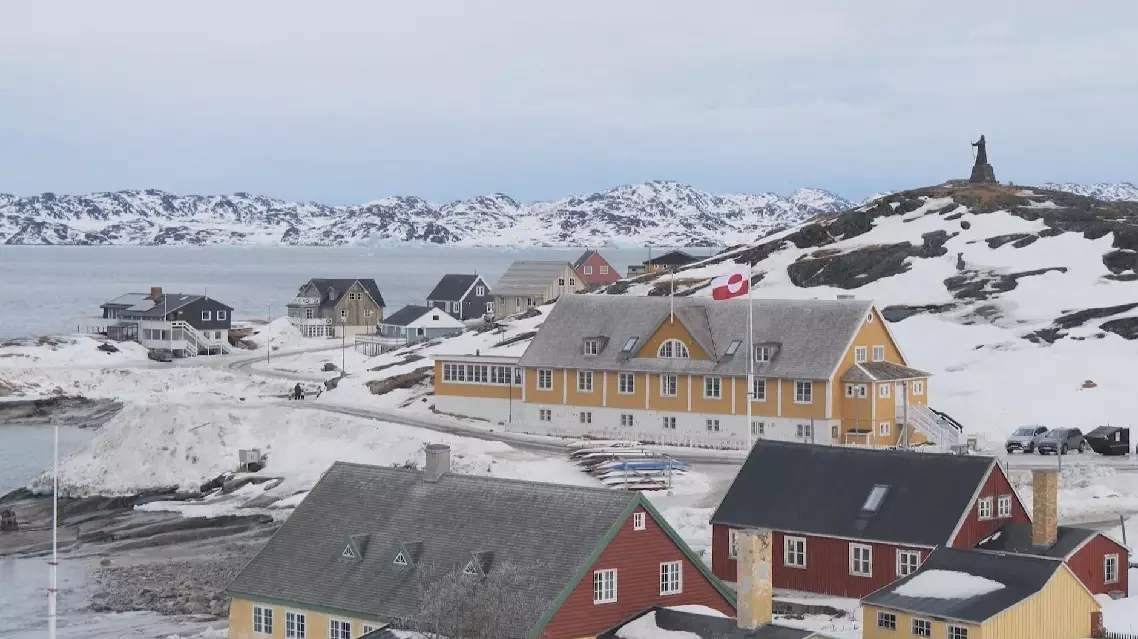
Unnerved Greenlanders voice rejection of Trump's claim over island
The improving bilateral relations between China and Canada helps the North American country to build up its economic resilience, and the Canadian government is putting efforts to recalibrate the relationship, a professor from the University of Toronto has said.
Canadian Prime Minister Mark Carney began his official visit to China on Wednesday, marking the first trip by a Canadian prime minister to China since 2017.
Endorsing his visit, Aurel Braun, professor of International Relations and Political Science from the University of Toronto, highlighted the importance for Canada to actively engage and expand trade with China.
"China is an important player not only internationally, but in terms of Canada as well, and the operative word being used by the Canadian government is to recalibrate the relationship. Clearly, the Canadian government is putting a lot of effort into this. There's a very heavy delegation going, [including] the foreign minister. There are people from the provinces as well. Canada, as you know, is a federation. And this is part of Canada's overall goal to diversify trade to build greater resiliency," said the professor.
The effort aligns with Canada's long-term goal of building economic resilience, yet current overdependence on the single market of the U.S. has restrained the Canadian government from taking drastic moves.
"Only about four percent of Canadian exports go to China, and China is the third largest market after the EU. The problem is that about three-quarters of our exports go to the United States, and therefore, you cannot just shift that around in an entirely dramatic way. You can make incremental changes, but there are certain obstacles to that," he said.
The professor cited Canada's tariffs on automobiles, particularly Chinese electric vehicles, as an example of its political and economic constraints.
"Let me give you an example. There have been Canadian tariffs that have been placed on automobiles and vehicles, particularly China's electric vehicles. And that has been done partly because there's an attempt to protect the industry in Canada and also because of pressure from the United States. There has been retaliation on the part of China, which has hurt Canada very hard when it comes to canola exports, when it comes to seafood and beef," he said.
Efforts to ease tensions with China face resistance not only from within the country but also from the United States, making policy adjustments more complex.
"But to change that, there's not only going to be opposition from the province of Ontario, with the automobile industry has [having] been very hard hit, but also from the United States. So this really involves some very careful political and economic choreography on the part of both Canada and China, and also in Canada's relationship with the United States," he said.
China-Canada friendship benefits Canadian economic resilience: professor