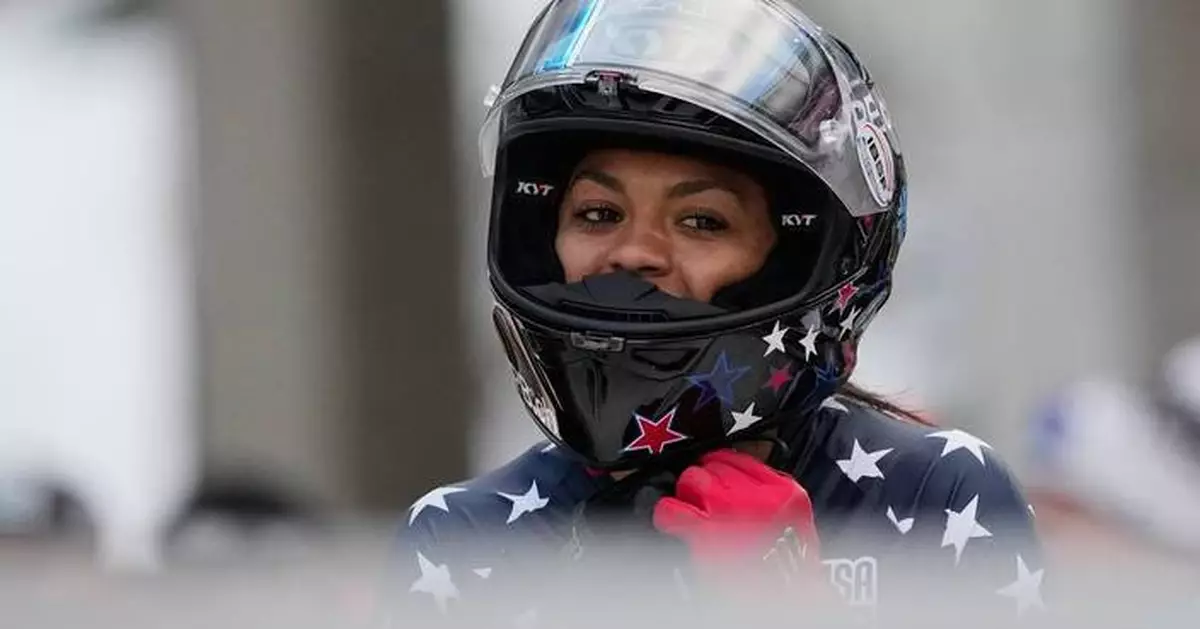
LAKE PLACID, N.Y. (AP) — When USA Bobsled and Skeleton unveils its Olympic rosters, the most likely scenario is that either eight or nine women will wind up competing for that federation on the ice at the Milan Cortina Winter Games.
Most of those sliders will almost certainly be women of color.
By the time the Games open, this could be the most diverse U.S. Olympic winter roster ever assembled. The 2018 U.S. roster for the 2018 Games included 21 athletes of either Black or Asian descent, about 8% of the total; the 2026 team could top that number. There is still obvious potential for far more growth on the diversity front, but some athletes feel that steps are being taken in the right direction.
“We’re really doing this,” said U.S. skeleton athlete Mystique Ro, a woman of Black and Korean descent and someone who teamed with Austin Florian to win last year’s world championship in the sport’s mixed event. “The train has left the station. We’re going. And it’s such a surreal feeling. … We’re really making history out here and it’s not slowing down at all.”
People of color fill the rosters for non-traditional winter sports nations like Jamaica but most of the dominant teams from European powers — and, to be fair, the U.S. as well — are almost entirely white. Still, some of the top American medal hopefuls at these Olympics will be Black women, and that’s not exactly a new phenomenon — especially in bobsled.
Bobsledder Elana Meyers Taylor is a five-time Olympic medalist and is the most decorated Black athlete in Winter Games history. Kaysha Love is the reigning world champion in monobob, making her the first Black woman to hold that title. Speedskater Erin Jackson, who in 2022 became the first Black woman to win Olympic winter gold in an individual sport, is back for more in 2026. Laila Edwards is a rising star of the powerhouse U.S. women’s hockey team and will be the first Black woman to wear the American sweater on the Olympic stage.
“It’s a really big deal,” Edwards said when the roster was unveiled. “Representation matters. In terms of processing it, I think I’m just trying to use it as something that motivates me to be the best role model and person I can be.”
It also remains clear that the sports offered as part of the Winter Olympic program seem to come with fewer opportunities for athletes of color. The National Ski Areas Association said in 2024 that, of all guests who visit U.S. ski resorts, about 1% identify as Black. The reasons most commonly cited are cost and accessibility: many winter sports are expensive and ski areas are generally remote.
Of the 2,900 or so athletes who competed at the most recent Winter Games in Beijing, the overwhelming majority of them identified white. There was a smattering of non-traditional winter sports nations to see athletes qualify — Ghana, Nigeria and Haiti among them — and the impact that Jamaica’s famed “Cool Runnings” bobsled team had when it debuted at the Olympics a generation ago is still felt today.
“I never thought I would be doing this." said bobsledder Adanna Johnson, who was 17 when she competed for Jamaica at last year's world championships. “The sport is growing. There are more opportunities.”
Much more needs to be done, Ro said, particularly in the years where the Winter Olympic spotlight doesn’t shine on these sports.
“There’s a lot more diversity,” Ro said. “But seeing us without the helmet, seeing the roster, seeing the names, it’s just really important how we present it to the people so it’s not just at the Olympics. It has to be every year because we compete every year.”
Almost every person who has made a national team over the last few decades came to bobsled after being recruited from another sport — often track, since bobsled thrives on a combination of speed and power. Vonetta Flowers was the first Black woman to win a bobsled medal for the U.S., teaming with Jill Bakken for gold at the Salt Lake City Games in 2002, and the Americans have seen women of color make their way to the medal stand steadily ever since.
Meyers Taylor, an elite softball player in college, counts Flowers as one of her top inspirations. So does Love, who was a record-setting sprinter in high school who went on to UNLV. She then got invited to try bobsled and is about to become a two-time Olympian.
She always knew she’d get there. She just thought it’d be in gymnastics.
“Growing up, I was really only excited about summer sports because that’s where I saw me. That’s where I saw representation,” Love said. “You always had Black athletes in gymnastics and track and even swimming sometimes. So, to know that now I get to be that representation along with like some of my other teammates who have worked so hard to be a part of this … that change is inspiring.”
AP Olympics: https://apnews.com/hub/milan-cortina-2026-winter-olympics
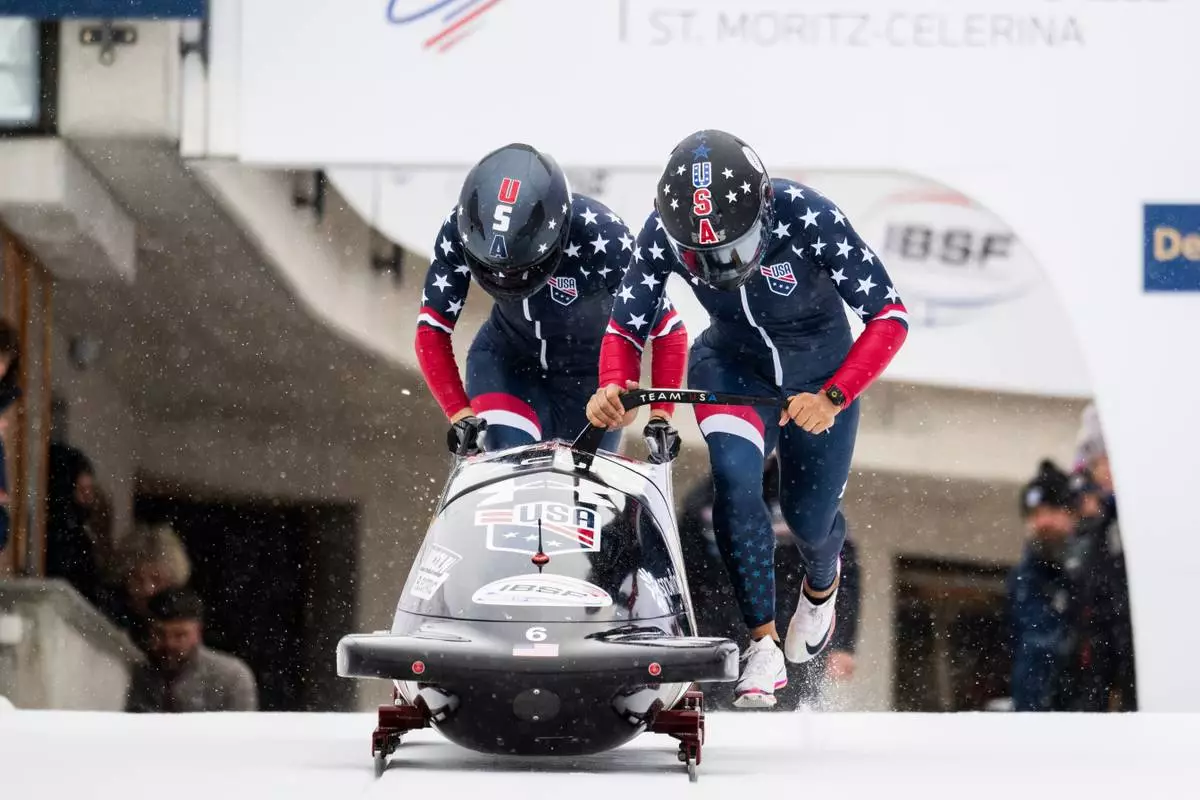
Elana Meyers Taylor/Jadin O'Brien of the USA in action during the Women's 2-Bob World Cup, in St. Moritz, Switzerland, Sunday, Jan. 11, 2026. (Mayk Wendt/Keystone via AP)
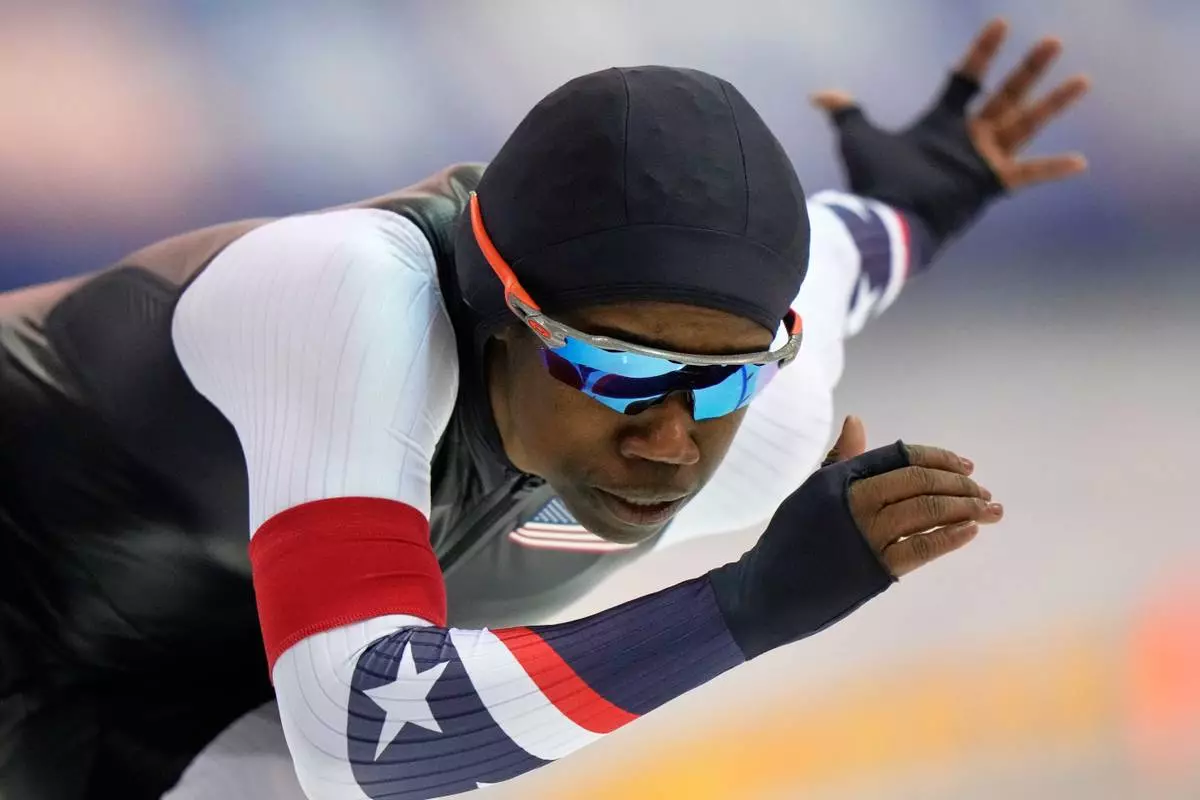
Erin Jackson competes in the women's 500 meters at the U.S. Olympic trials for long track speed skating at the Pettit National Ice Center Sunday, Jan. 4, 2026 in Milwaukee. (AP Photo/Morry Gash)
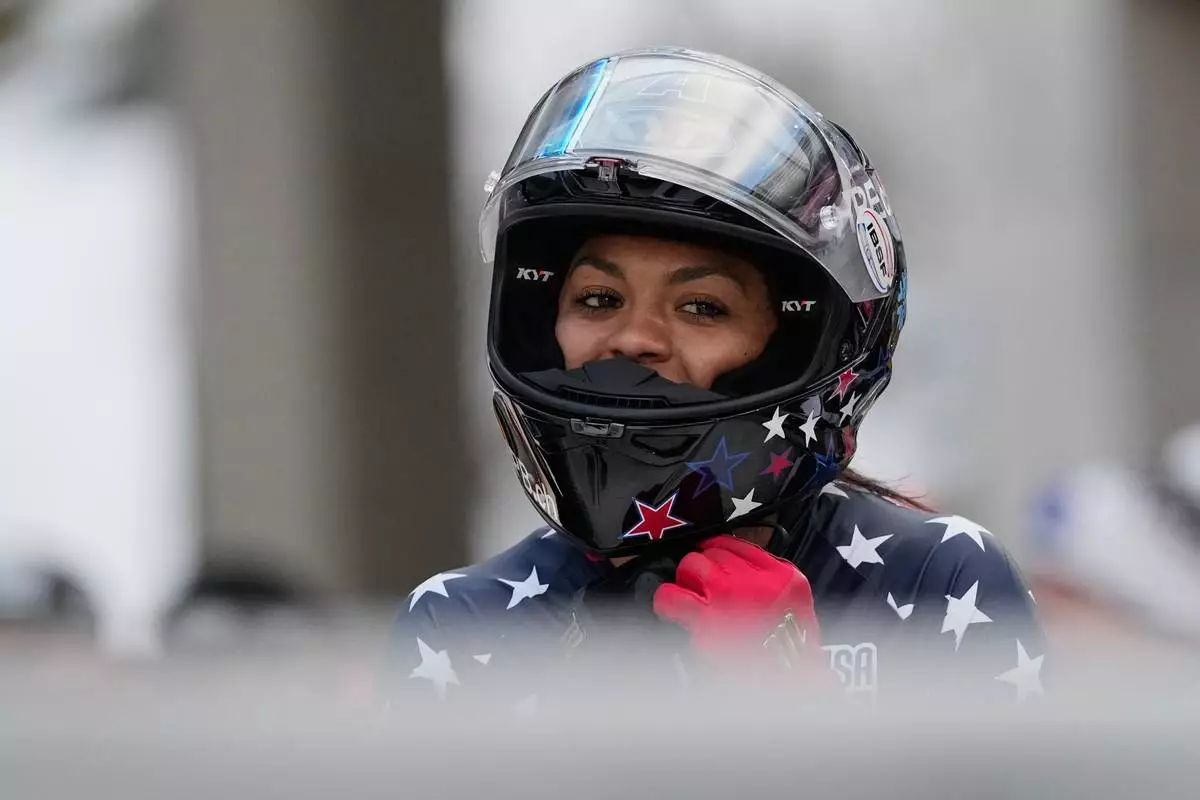
FILE - Winner Kaysha Love of the United States celebrates after the women's monobob race at the Bobsleigh World Cup in Innsbruck, Austria, Saturday, Nov. 29, 2025. (AP Photo/Matthias Schrader, File)
BANGKOK (AP) — Iranian demonstrators' ability to get details of bloody nationwide protests out to the world has been given a strong boost, with SpaceX's Starlink satellite internet service dropping its fees to allow more people to circumvent the Tehran government's strongest attempt ever to prevent information from spilling outside its borders, activists said Wednesday.
The move by the American aerospace company run by Elon Musk follows the complete shutdown of telecommunications and internet access to Iran's 85 million people on Jan. 8, as protests expanded over the Islamic Republic's faltering economy and the collapse of its currency.
SpaceX has not officially announced the decision and did not respond to a request for comment, but activists told The Associated Press that Starlink has been available for free to anyone in Iran with the receivers since Tuesday.
“Starlink has been crucial,” said Mehdi Yahyanejad, an Iranian whose nonprofit Net Freedom Pioneers has helped smuggle units into Iran, pointing to video that emerged Sunday showing rows of bodies at a forensic medical center near Tehran.
“That showed a few hundred bodies on the ground, that came out because of Starlink," he said in an interview from Los Angeles. "I think that those videos from the center pretty much changed everyone's understanding of what's happening because they saw it with their own eyes.”
Since the outbreak of demonstrations Dec. 28, the death toll has risen to more than 2,500 people, primarily protesters but also security personnel, according to the U.S.-based Human Rights Activists News Agency.
Starlink is banned in Iran by telecommunication regulations, as the country never authorized the importation, sale or use of the devices. Activists fear they could be accused of helping the U.S. or Israel by using Starlink and charged with espionage, which can carry the death penalty.
The first units were smuggled into Iran in 2022 during protests over the country's mandatory headscarf law, after Musk got the Biden administration to exempt the Starlink service from Iran sanctions.
Since then, more than 50,000 units are estimated to have been sneaked in, with people going to great lengths to conceal them, using virtual private networks while on the system to hide IP addresses and taking other precautions, said Ahmad Ahmadian, the executive director of Holistic Resilience, a Los Angeles-based organization that was responsible for getting some of the first Starlink units into Iran.
Starlink is a global internet network that relies on some 10,000 satellites orbiting Earth. Subscribers need to have equipment, including an antenna that requires a line of sight to the satellite, so must be deployed in the open, where it could be spotted by authorities. Many Iranians disguise them as solar panels, Ahmadian said.
After efforts to shut down communications during the 12-day war with Israel in June proved to be not terribly effective, Iranian security services have taken more “extreme tactics” now to jam Starlink's radio signals and GPS systems, Ahmadian said in a phone interview. After Holistic Resilience passed on reports to SpaceX, Ahmadian said, the company pushed a firmware update that helped circumvent the new countermeasures.
Security services also rely on informers to tell them who might be using Starlink, and search internet and social media traffic for signs it has been used. There have been reports they have raided apartments with satellite dishes.
“There has always been a cat-and-mouse game,” said Ahmadian, who fled Iran in 2012 after serving time in prison for student activism. “The government is using every tool in its toolbox.”
Still, Ahmadian noted that the government jamming attempts had only been effective in certain urban areas, suggesting that security services lack the resources to block Starlink more broadly.
Iran did begin to allow people to call out internationally on Tuesday via mobile phones, but calls from outside the country into Iran remain blocked.
Compared to protests in 2019, when lesser measures by the government were able to effectively stifle information reaching the rest of the world for more than a week, Ahmadian said the proliferation of Starlink has made it impossible to prevent communications. He said the flow could increase now that the service has been made free.
“This time around they really shut it down, even fixed landlines were not working,” he said. “But despite this, the information was coming out, and it also shows how distributed this community of Starlink users is in the country.”
Musk has made Starlink free for use during several natural disasters, and Ukraine has relied heavily on the service since Russia's full-scale invasion in 2022. It was initially funded by SpaceX and later through an American government contract.
Musk had raised concerns over the power of such a system being in the hands of one person, after he refused to extend Ukraine's Starlink coverage to support a planned Ukrainian counterattack in Russian-occupied Crimea.
As a proponent of Starlink for Iran, Ahmadian said the Crimea decision was a wake-up call for him, but that he couldn't see any reason why Musk might be inclined to act similarly in Iran.
“Looking at the political Elon, I think he would have more interest ... in a free Iran as a new market,” he said.
Julia Voo, who heads the International Institute for Strategic Studies' Cyber Power and Future Conflict Program in Singapore, said there is a risk in becoming reliant on one company as a lifeline, as it “creates a single point of failure,” though currently there are no comparable alternatives.
China has been exploring ways to hunt and destroy Starlink satellites, and Voo said the more effective Starlink proves itself at penetrating “government-mandated terrestrial blackouts, the more states will be observing.”
“It's just going to result in more efforts to broaden controls over various ways of communication, for those in Iran and everywhere else watching,” she said.
Associated Press writers Jon Gambrell in Dubai, United Arab Emirates and Melanie Lidman in Tel Aviv, Israel contributed to this report.
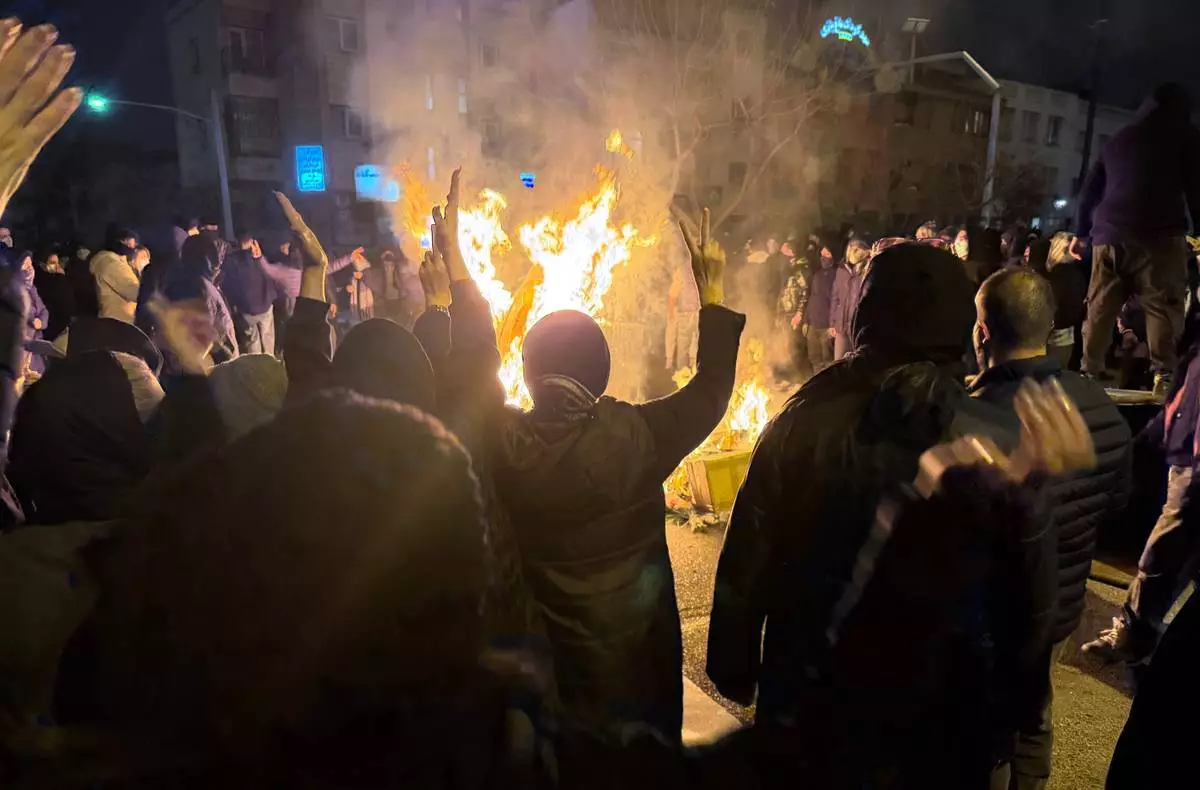
FILE - In this photo obtained by The Associated Press, Iranians attend an anti-government protest in Tehran, Iran, Friday, Jan. 9, 2026. (UGC via AP, file)
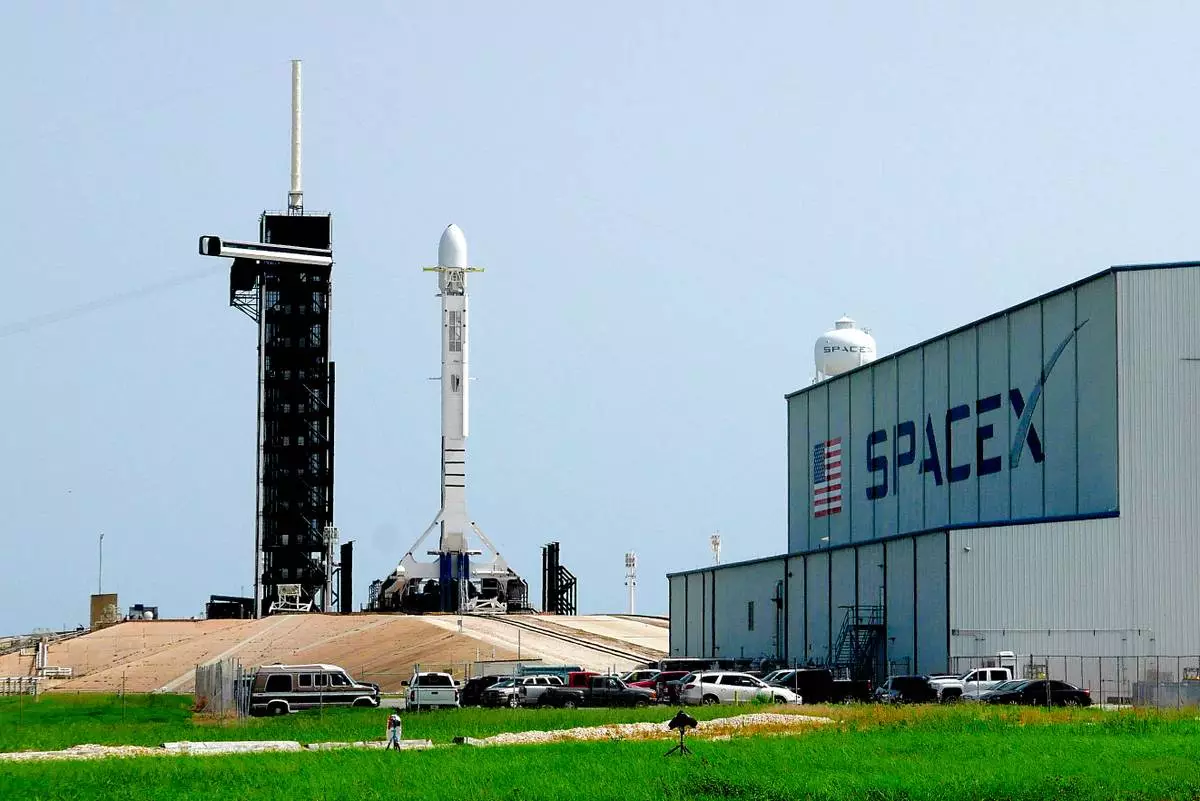
FILE - A Falcon 9 SpaceX rocket stands ready for launch at pad 39A at the Kennedy Space Center in Cape Canaveral, Fla., Friday, June 26, 2020. (AP Photo/John Raoux, file)