CALGARY, Alberta--(BUSINESS WIRE)--Jan 15, 2026--
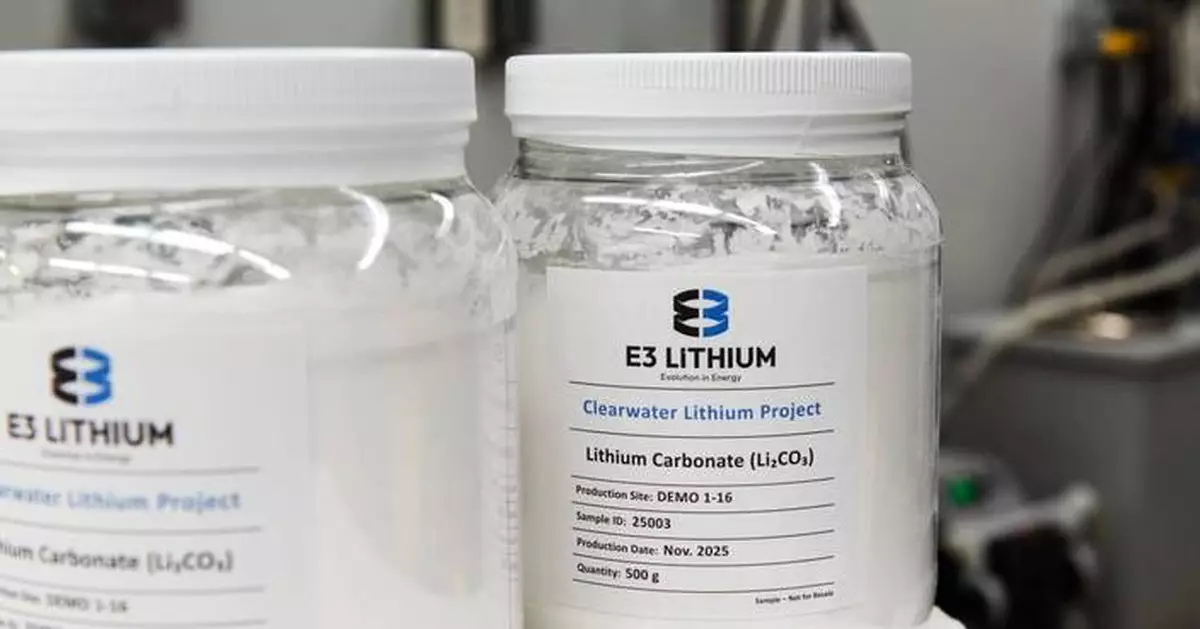
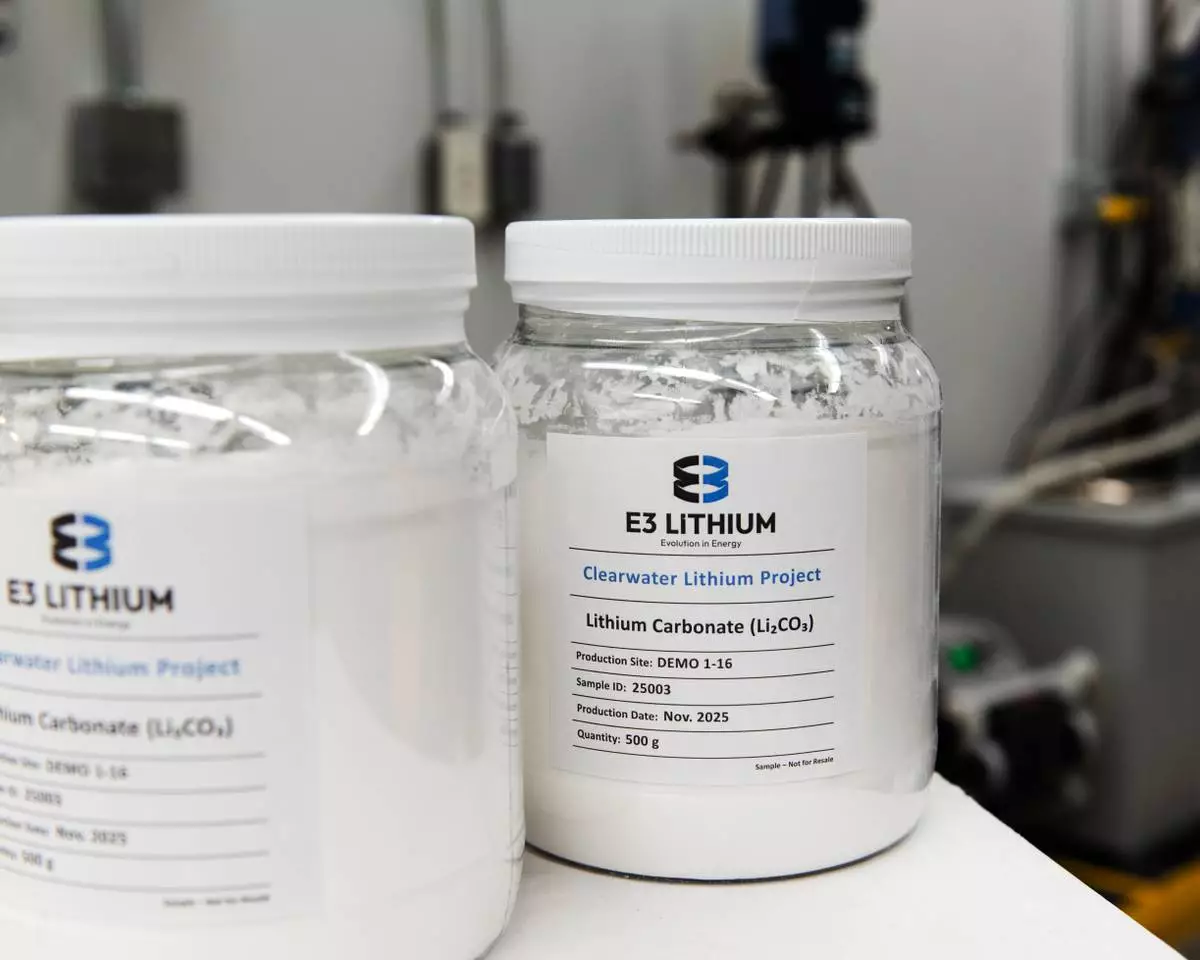
E3 LITHIUM LTD. (TSXV: ETL) (FSE: OW3) (OTCQX: EEMMF), “E3”, “E3 Lithium” or the “Company,” a leader in Canadian lithium development, has, and will continue to deliver battery-grade lithium carbonate produced from its Demonstration program to multiple parties as part of its engagement with targeted offtake and strategic partners.
This press release features multimedia. View the full release here: https://www.businesswire.com/news/home/20260114839862/en/
“This milestone marks an important step in E3’s commercial process toward securing long-term offtake agreements and advancing our relationships with key players in the battery and critical minerals industry,” said Chris Doornbos, President and CEO of E3 Lithium. “Our ability to continually produce significant quantities of lithium carbonate from our demonstration facility highlights the size and sophistication of our operations.”
E3 Lithium continues to produce battery-grade lithium carbonate from lithium chloride generated from its Direct Lithium Extraction process, all now operating as part of its Demonstration program in Alberta. The Company is now shipping 0.5 kilogram lots to prospective parties across the lithium battery industry, with several requesting multiple kilograms for additional analysis.
The Demonstration equipment was designed based on the Pre-Feasibility Study published in 2024, fabricated in early 2025, and deployed to site for Phase one in the third quarter of 2025. The team achieved the targeted specifications for battery-grade lithium carbonate within three weeks of commissioning, showcasing the strength of the facility design. The delivery of E3’s lithium carbonate to potential customers is part of a structured qualification process and E3’s lithium carbonate has consistently met the targeted level of purity across all potential contaminants required for battery applications.
The Demonstration program is being conducted within the Company's flagship Clearwater Project to collect data and operational information to complete E3's Front End Engineering and Design (FEED) leading to the publication of a Feasibility Study. The Clearwater Project is an advanced-stage lithium carbonate production facility in development, 15km east of Olds, Alberta, approximately one hour north of Calgary, Alberta. The Company has proposed a staged development plan with a capacity of 12,000 tonnes of lithium carbonate per year as the first stage of production, and expansion potential to up to 36,0000 tonnes of lithium carbonate per year.
E3 Lithium is advancing its development activities in parallel with commercial offtake agreements as the Clearwater Project advances towards being shovel ready.
ON BEHALF OF THE BOARD OF DIRECTORS
Chris Doornbos, President, CEO & Chair
E3 Lithium Ltd.
About E3 Lithium
E3 Lithium is a development company with a total of 21.2 million tonnes of lithium carbonate equivalent (LCE) Measured and Indicated 1 as well as 0.3 Mt LCE Inferred mineral resources 2 in Alberta. The Clearwater Pre-Feasibility Study outlined a 1.13 Mt LCE proven and probable mineral reserve with a pre-tax NPV(8%) of USD 5.2 Billion with a 29.2% IRR and an after-tax NPV(8%) of USD 3.7 Billion with a 24.6% IRR 1.
Unless otherwise indicated, Kevin Carroll, P. Eng., Chief Development Officer and a Qualified Person under National Instrument 43-101, has reviewed and approved the technical information contained on this news release.
Forward-Looking and Cautionary Statements
This news release includes certain forward-looking statements as well as management’s objectives, strategies, beliefs and intentions or forward-looking information within the meaning of applicable securities laws. Forward-looking statements are frequently identified by such words as “believe”, “may”, “will”, “plan”, “expect”, “anticipate”, “estimate”, “intend”, “project”, “potential”, “possible” and similar words referring to future events and results. Forward-looking statements are based on the current opinions, expectations, estimates and assumptions of management in light of its experience, perception of historical trends, and results of the PFS, but such statements are not guarantees of future performance. In particular, this news release contains forward-looking information relating to: the Company’s expectations regarding the production of lithium carbonate; shipping of additional lithium carbonate; collection of information and data for the completion of E3's Front End Engineering and Design (FEED) that will lead to publication of a Feasibility Study; plans and objectives of management for the Company’s operations of the Demonstration Facility; and the inherent hazards associated with mineral exploration and mining operations. In preparing the forward-looking information in this news release, the Company has applied several material assumptions, including, but not limited to, that any additional financing needed will be available on reasonable terms; the exchange rates for the U.S. and Canadian currencies will be consistent with the Company’s expectations; that the current exploration, development, environmental and other objectives concerning the Demonstration Facility can be achieved and that its other corporate activities will proceed as expected; that general business and economic conditions will not change in a materially adverse manner and that all necessary governmental approvals for the planned activities on the Demonstration Facility will be obtained in a timely manner and on acceptable terms.
All forward-looking information (including future-orientated financial information) is inherently uncertain and subject to a variety of assumptions, risks and uncertainties, including the speculative nature of mineral exploration and development, fluctuating commodity prices, the effectiveness and feasibility of emerging lithium extraction technologies which have not yet been tested or proven on a commercial scale or on the Company’s brine, risks related to the availability of financing on commercially reasonable terms and the expected use of proceeds; operations and contractual obligations; changes in estimated mineral reserves or mineral resources; future prices of lithium and other metals; availability of third party contractors; availability of equipment; failure of equipment to operate as anticipated; accidents, effects of weather and other natural phenomena and other risks associated with the mineral exploration industry; the Company’s lack of operating revenues; currency fluctuations; risks related to dependence on key personnel; estimates used in financial statements proving to be incorrect; competitive risks and the availability of financing, as described in more detail in our recent securities filings available under the Company’s profile on SEDAR+ (www.sedarplus.ca). Actual events or results may differ materially from those projected in the forward-looking statements and we caution against placing undue reliance thereon. We assume no obligation to revise or update these forward-looking statements except as required by applicable law.
Battery-Grade Lithium Carbonate Shipped to Global Partners