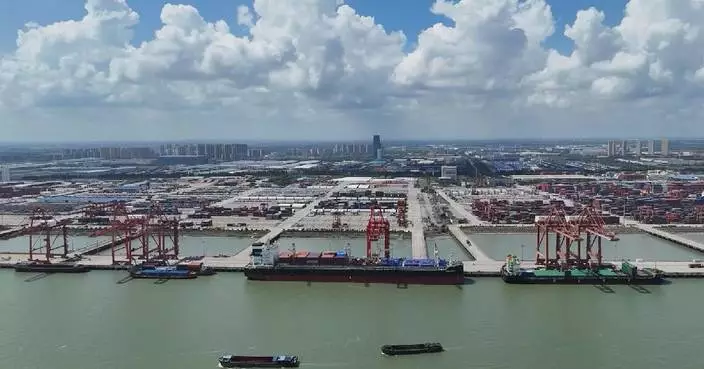
Chinese customs authorities will roll out a greater number of policy measures to promote innovative growth in foreign trade during the 15th Five-Year Plan period (2026-2030) for national socioeconomic development, in efforts to better balance the development of exports and imports, the General Administration of Customs (GAC) announced on Saturday.
Speaking at the National Customs Work Conference held in Beijing, Sun Meijun, head of the GAC, recalled major developments of China's foreign trade in the previous Five-Year Plan period and briefed the press on the more effective policy tools to be rolled out in the opening year of the 15th Five-Year Plan period to advance high-quality trade development.
Over the past five years, Chinese customs authorities effectively navigated risks and challenges, overseeing an annual average of 5.2 billion tons of imported and exported goods valued at 42.3 trillion yuan (about 6 trillion U.S. dollars), maintaining the world's largest trade volume with overall security under control. This has provided strong support for the successful fulfillment of the relevant targets set in the 14th Five-Year Plan, according to Sun.
Sun emphasized that during the 15th Five-Year Plan period, Chinese customs authorities are required to strengthen overall coordination, adhere to a systematic approach, and maintain balance between trade facilitation and security and between imports and exports.
"We must effectively oversee both imports and exports, expand exports while also appropriately increasing imports, extend our participation in the global circulation, so as to promote unimpeded domestic and international economic flows and achieve better integration of domestic and foreign trade," Sun said.
Sun added that in 2026, Chinese customs authorities will launch a new round of special operations to facilitate cross-border trade and introduce more practical policy measures. Support will be enhanced for new business models such as cross-border e-commerce, overseas warehouses, the low-altitude economy, market procurement, bonded maintenance, testing, and remanufacturing.
"We will work to optimize inspection and quarantine supervision models, facilitate increased imports of high-quality agricultural and food products, consumer goods, and germplasm resources and strengthen supervision and service support for major expos such as the China International Import Expo, China Import and Export Fair (Canton Fair), and China International Fair for Trade in Services, to promote balanced import-export development," Sun noted.

China to boost both exports, imports in 2026-2030: customs authority