The recent heavy snowfall has worsened life for many displaced people in war-torn Syria, particularly those living in makeshift tents set up in the northwestern province of Idlib. Recently, Idlib has experienced significant snowfall, with some areas recording higher snow accumulation than in previous years at this time.
The combination of extreme weather and lingering war-related issues has made life even more difficult for displaced people in the region.
In a refugee camp in western Idlib, snowfall has persisted for several days, leaving muddy paths and piles of unmelted snow outside the tents.
Many people who lost their homes during years of conflict reside in the camp, where makeshift tents serve as their sole shelter to fend them from the harsh winter weather.
As temperatures plummets, issues such as fuel shortages for heating and leaking tents worsen.
The massive displacement caused by years of conflict remains unresolved, and the arrival of extreme weather has further amplified the survival risks for these families.
The displaced people rely solely on sporadic aid and occasional odd jobs to survive, and the harsh weather exacerbates their already difficult situation.
For them, the end of war does not mean a return to normal life. Every day in the bitter cold is a test.

Extreme weather worsens life for displaced Syrians

Extreme weather worsens life for displaced Syrians
An exciting wave of innovative winter tourism experiences is drawing visitors to the icy parts of China, as destinations transform ice and snow resources into immersive, experience-driven attractions that boost local consumption and development.
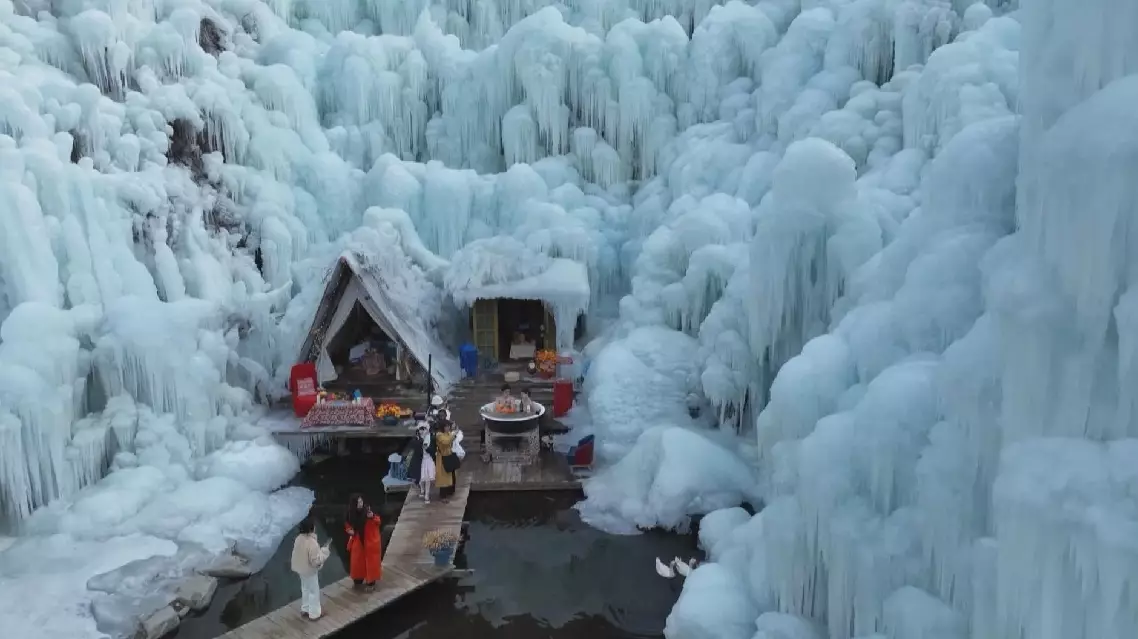
In Jiuru Mountain Scenic Area in Jinan City, east China's Shandong Province, towering icefalls formed by the area's canyon terrain and sustained winter cold create a spectacular frozen landscape.
Covering around 30,000 square meters, dense icicles and ice curtains hang like crystal glass, offering visitors a prime viewing season.
This winter, the scenic area has creatively incorporated fire elements, installing more than 100 stoves and log cabins throughout the park, creating a unique scene with "a stove available every few steps and a wooden cabin every 100 meters."
"The experience is really amazing and far beyond my expectations," said a tourist named Tian Yujuan.
Beyond sightseeing, the tourist attraction has also introduced more than 20 creative handicraft studios where visitors can make sachets and chocolates, while its snow play park that features ice sleds and snow tubing has become especially popular with families.
Since the New Year's Day, both visitor numbers and operating revenues at the site have more than doubled year on year.
In Yinchuan City, northwest China's Ningxia Hui Autonomous Region, local attractions are also expanding winter offerings through a "snow and ice plus" model.
On the Yuehai Lake, tourists wearing specially designed red protective suits float calmly in icy water in an activity known as "ice floating". The suits feature heat-locking inner layers and high-buoyancy outer layers, ensuring warmth and safety, while on-site photography services use drones and cameras to capture the experience.
"On weekends, I am willing to come to nearby cities to experience this kind of effortless relaxation. I find it quite stress-relieving," said a tourist.
In Pingxiliang Village, a small mountain village in suburban Urumqi, northwest China's Xinjiang Uygur Autonomous Region, ice and snow tourism has become a catalyst for rural revitalization.
Once an extremely impoverished village, Pingxiliang has developed winter cultural tourism by leveraging local resources.
Nowadays, more than 80 percent of households in the village operate homestays, and 236 villagers work in tourism, with related income accounting for over 70 percent of the total revenue.
Meanwhile, at the Sayram Lake in Xinjiang, winter visitors are flocking to newly created blue ice waterfalls -- each about 10 meters high and covering a total area of 15,000 square meters.
Built by staff who erected supports and sprayed water starting in November, the frozen formations preserve the natural shape of cascading water, creating a striking man-made icefall.
Shared widely on social media, the blue ice waterfalls have become a new must-see destination for winter tourists to the Sayram Lake.
China's winter tourism blends ice landscapes with immersive experiences
China's winter tourism blends ice landscapes with immersive experiences