VALENCIA, Spain--(BUSINESS WIRE)--Jan 19, 2026--
Prodalim, a global leader in juice and specialty ingredients solutions, announced today the expansion of its SOLOS division with the opening of a dedicated dealcoholization and aroma recovery site in Valencia, Spain. The new facility is fully operational and strengthens Prodalim’s ability to support the rapidly growing no- and low-alcohol (NoLo) beverage market across Europe. During the coming months, an additional SOLOS site in California is planned to be inaugurated, further expanding overall capacity.
This press release features multimedia. View the full release here: https://www.businesswire.com/news/home/20260118626123/en/
The global NoLo category continues to expand, driven by consumer demand for mindful drinking and healthier lifestyle choices. Industry forecasts estimate the NoLo global market at approximately USD 25 billion in 2025, with expected annual growth of 8–10% as the category expands across beers, wines, spirits, and functional beverages.
Preserving aroma, flavor, and authenticity during dealcoholization remains one of the industry’s most complex technical challenges. SOLOS addresses this challenge, enabling producers to create NoLo wines, beers, and spirits that remain true to their original sensory profiles. At the core of the SOLOS platform is its proprietary, patent-based Aroma Recovery System (ARS), developed over more than a decade of research to capture and reintegrate a beverage’s original aromatic profile during alcohol removal.
The Valencia site forms a complementary SOLOS platform, offering full-service dealcoholization, aroma recovery, pilot-scale trials, and white-label development. Designed for close technical collaboration, the facility enables customers to move efficiently from concept to commercial production, supported by Prodalim’s global infrastructure and expertise.
The expansion of SOLOS reflects Prodalim’s broader transformation into a purpose-driven, vertically integrated ingredient solutions group. As part of this transformation, Prodalim has reorganized its operations into three divisions:
All divisions are supported by Prodalim’s vertically integrated, regenerative supply chain, anchored in circular economy principles. Through this integrated approach, Prodalim empowers food and beverage brands to innovate with authenticity, sustainability, and performance at their core.
About Prodalim
Prodalim is a global leader in juice and specialty ingredients solutions, harnessing nature’s essence to craft healthier creations. With its tree-to-table supply chain and global footprint, the company develops sustainable, innovative solutions for the food and beverage industry, making a meaningful impact for people and planet.
Visit Prodalim at: www.prodalim.com

Inauguration of the SOLOS Valencia Site for Advanced NoLo Solutions
ADAMUZ, Spain (AP) — Spanish police said Monday that at least 39 people died in the high-speed train collision Sunday in southern Spain and rescue efforts were continuing.
The collision occurred when the tail end of a train traveling between Malaga and Madrid with some 300 passengers went off the rails near Cordoba at 7:45 p.m. It slammed into an incoming train from Madrid to Huelva, another southern Spanish city, according to rail operator Adif.
Earlier in the morning, Andalusian regional leader Juan Moreno said 75 passengers were hospitalized, 15 in serious condition. Most were taken to Cordoba, about 390 kilometers (242 miles) south of Madrid.
The Spanish Red Cross set up a help center in the town of Adamuz, near the crash site, offering assistance to emergency services and people seeking information. Members of Spain’s civil guard and civil defense worked on site throughout the night.
Video and photos showed twisted train cars lying on their sides under floodlights. Passengers reported climbing out of smashed windows, with some using emergency hammers to break the windows, according to Salvador Jiménez, a journalist for Spanish broadcaster RTVE, who was on board one of the derailed trains.
He told the network by phone that “there was a moment when it felt like an earthquake and the train had indeed derailed.”
Spain’s Transport Minister Óscar Puente early Monday said the cause of the crash was unknown.
He called it “a truly strange” incident because it happened on a flat stretch of track that had been renovated in May. He also said the train that jumped the track was less than 4 years old. That train belonged to the private company Iryo, while the second train, which took the brunt of the impact, was part of Spain’s public train company Renfe.
According to Puente, the back part of the first train derailed and crashed into the head of the other train, knocking its first two carriages off the track and down a 4-meter (13-foot) slope. He said the worst damage was to the front section of the Renfe train.
When asked by reporters how long an inquiry into the crash’s cause could take, he said it could be a month.
Spain has the largest high-speed rail network in Europe for trains moving over 250 kph (155 mph), with more than 3,100 kilometers (1,900 miles) of track, according to the European Union.
The network is a popular, competitively priced and safe mode of transport. Renfe said more than 25 million passengers took one of its high-speed trains in 2024.
Train services between Madrid and cities in Andalusia were cancelled Monday.
Spain’s worst train accident this century occurred in 2013, when 80 people died after a train derailed in the country’s northwest. An investigation concluded the train was traveling 179 kph (111 mph) on a stretch with an 80 kph (50 mph) speed limit when it left the tracks.
Wilson reported from Barcelona, Spain, and Naishadham from Madrid. AP journalist Barry Hatton contributed from Lisbon, Portugal.
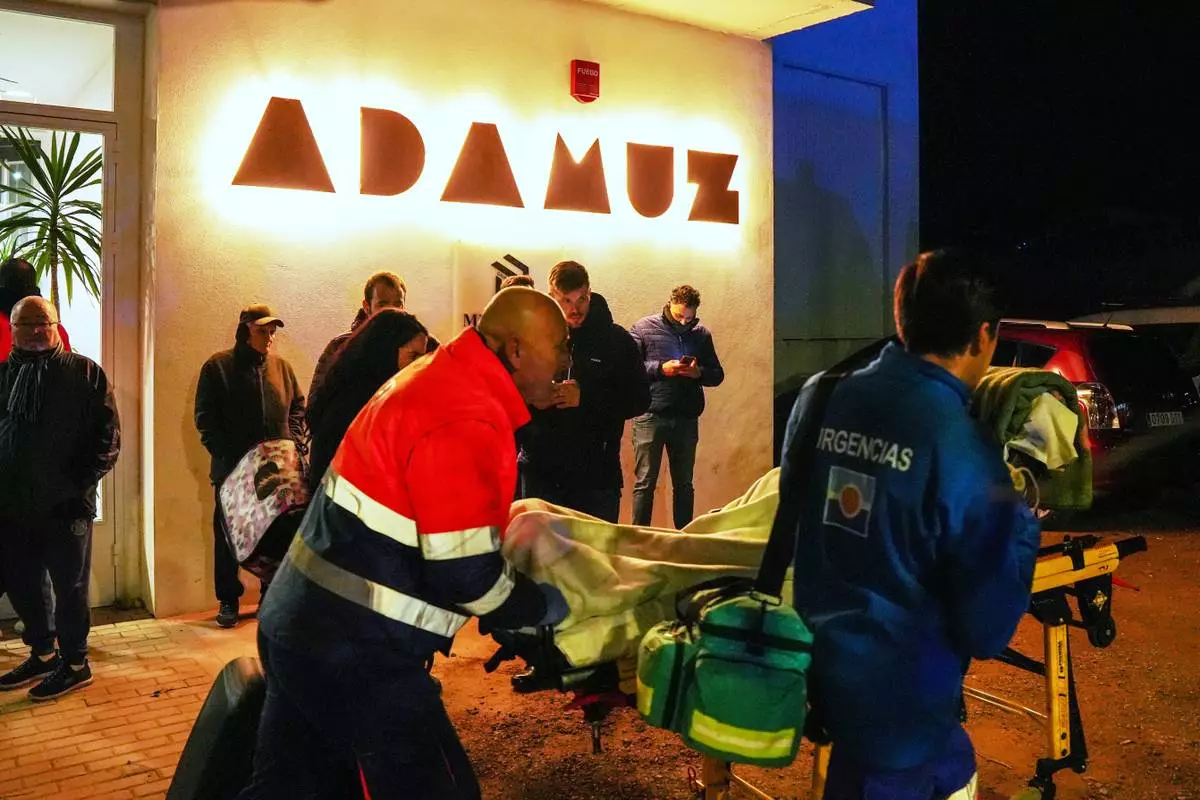
An injured person is transported to the makeshift hospital in the sports center in Adamuz, near Córdoba, southern Spain, Monday, Jan. 19, 2026, after a high-speed train derailed and collided with another train. (Francisco J. Olmo/Europa Press via AP)

An injured person is transported to the makeshift hospital in the sports center in Adamuz, near Córdoba, southern Spain, Monday, Jan. 19, 2026, after a high-speed train derailed and collided with another train. (Francisco J. Olmo/Europa Press via AP)
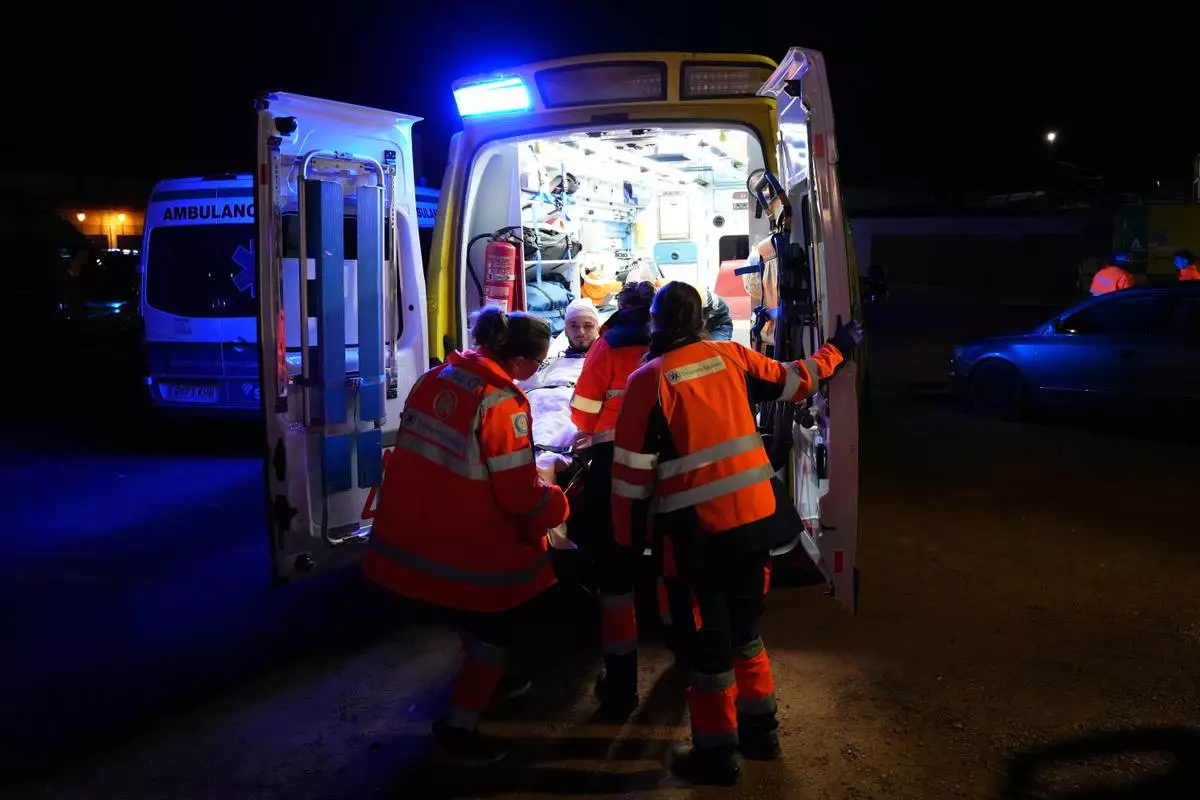
An injured person is transported by ambulance in Adamuz, near Córdoba, southern Spain, Monday, Jan. 19, 2026, after a high-speed train derailed and collided with another train. (Francisco J. Olmo/Europa Press via AP)