A long-serving extravehicular activity (EVA) spacesuit returned to Earth on Monday aboard the reentry capsule of China's Shenzhou-20 spaceship, concluding a distinguished service period spanning more than four years in orbit, far exceeding its original design life.
Known as "Spacesuit B", it was among a number of large scientific payload items sent back to Earth on the unmanned Shenzhou-20 return capsule, which touched down in north China's Inner Mongolia Autonomous Region on Monday morning.
The capsule's original return had been delayed due to concerns over damage sustained in a suspected space debris incident, while an alternative spacecraft was used to transport the three Chinese astronauts of the Shenzhou-20 mission safely back home in November.
Prior to dissembling and packing the spacesuit for its return, astronauts currently aboard China's Tiangong Space Station gave the well-worn "Spacesuit B" a triumphant send-off.
First launched in May 2021 aboard the Tianzhou-2 cargo craft, "Spacesuit B" made its debut during the inaugural EVA conducted from the then under-construction Tiangong Space Station in July 2021, when it was used as part of a landmark seven-hour spacewalk.
Over the next four and a half years, the suit has supported 11 Chinese astronauts across eight crewed missions, enabling 20 successful EVAs to be conducted.
Before its departure from the Tiangong Space Station, Zhang Lu, commander of the current Shenzhou-21 mission, bid an emotional farewell to the storied spacesuit, which he had donned several times himself during a previous stint in space.
"Today, we bid farewell to a veteran comrade that made tremendous contributions to our space station's extravehicular activities. This is the retired Extravehicular Mobility Unit (EMU) B. I personally wore it during four of my spacewalks on the Shenzhou-15 mission, and together we set the record at the time for the most EVAs conducted by a single crew. Many thanks to this meritorious spacesuit," said Zhang, as he held aloft the spacesuit in the space station.
Though neither of his crewmates Wu Fei and Zhang Hongzhang had worn Spacesuit B outside the station, both expressed deep respect for its legacy.
"The journey of space exploration will never stop. Although it is leaving the space station, it will take on a new mission, serving as a key reference for researchers and making future contributions to China's technological advancement and the manned space program," said Wu.
"Every stitch and every component of Extravehicular Spacesuit B embodies the wisdom and hard work of countless scientists and engineers. You have now successfully completed your mission. We will continue our efforts aboard the space station and strive for even greater achievements in future extravehicular activities," said Zhang Hongzhang.
The three Shenzhou-21 astronauts arrived at the space station on Nov 1, with their return capsule later being used to bring back the Shenzhou-20 crew members after tiny cracks were found in the viewport window of the latter spacecraft. The damage was likely caused by an external impact from space debris, according to the China Manned Space Agency (CMSA).
A subsequent emergency mission was launched with the Shenzhou-22 spacecraft being sent to the space station, which will serve the Shenzhou-21 crew on their expected return at the conclusion of their six-month mission.
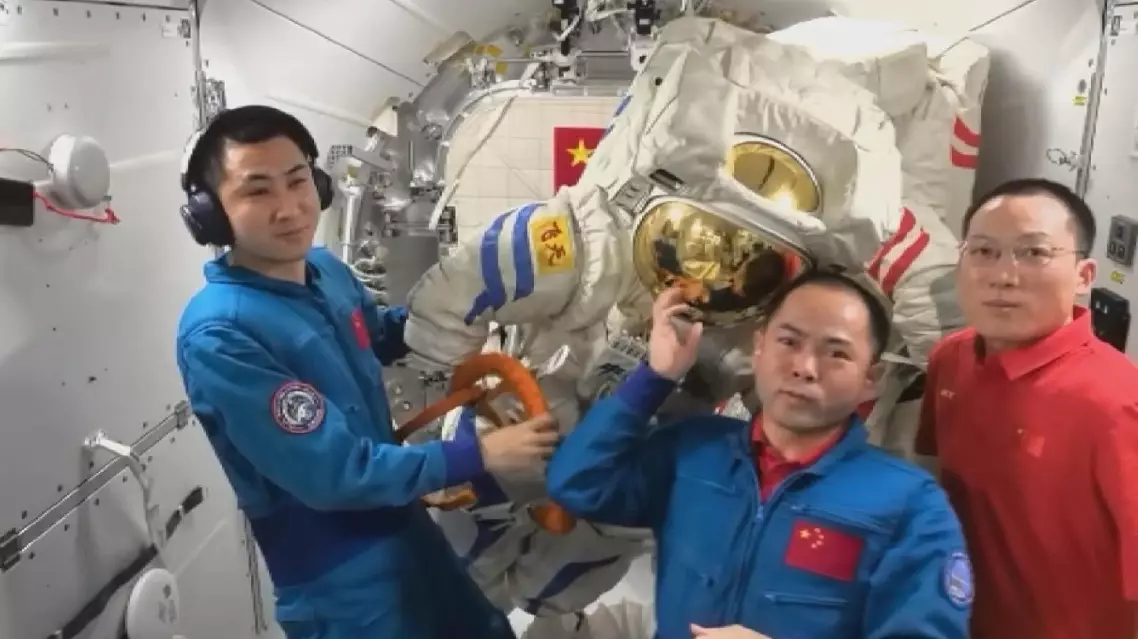
Long-serving EVA spacesuit returns to Earth aboard Shenzhou-20 spaceship