Skip to Content Facebook Feature Image

Diamond Quanta Announces Adamantine Thermal™, Extending Its Advanced Packaging Roadmap Following CES 2026

Business

Diamond Quanta Announces Adamantine Thermal™, Extending Its Advanced Packaging Roadmap Following CES 2026
Business

Business

Diamond Quanta Announces Adamantine Thermal™, Extending Its Advanced Packaging Roadmap Following CES 2026

2026-01-19 21:02 Last Updated At:01-20 00:30

MOUNTAIN VIEW, Calif.--(BUSINESS WIRE)--Jan 19, 2026--

Diamond Quanta today announced Adamantine Thermal™, an engineered-diamond thermal platform designed for integration into advanced packaging workflows and heterogeneous semiconductor systems. The announcement builds on the company’s CES 2026 Eureka Park debut and reflects growing customer interest in diamond-enabled solutions for next-generation electronics.

This press release features multimedia. View the full release here: https://www.businesswire.com/news/home/20260119507092/en/

The announcement follows Diamond Quanta’s CES 2026 debut, where the company demonstrated 300 mm diamond-on-silicon wafer technology, designed for wafer-to-wafer (W2W) and chip-to-wafer (C2W) bonding compatibility, along with its first commercial diamond glass product, Adamantine Optics™. At CES, the company engaged with system OEMs, semiconductor manufacturers, and ecosystem partners around practical insertion points for diamond within advanced packaging flows.

Extending Diamond Quanta’s CES 2026 Demonstrations

Adamantine Thermal builds directly on the same engineered-diamond manufacturing approach introduced at CES. While diamond is well known for its high intrinsic thermal conductivity, its integration into modern semiconductor packaging has historically been limited by surface roughness, bonding compatibility, and manufacturability at scale.

Diamond Quanta’s approach addresses these challenges by combining:
- CMOS-compatible, low-temperature diamond growth on industry-standard substrates
- Laser-based densification to produce smooth, bond-ready diamond surfaces
- W2W and C2W bonding workflows that support integration into advanced packaging stacks

“Thermal is the most immediate and universal entry point for diamond in electronics,” said Adam Khan, Founder and CEO of Diamond Quanta. “Once diamond can be bonded reliably and at scale, it stops being a research material and becomes a practical platform.”

A key application area for Adamantine Thermal is engineered-diamond glass interposers, where diamond is integrated with glass cores that are already entering advanced packaging workflows. Glass interposers are gaining traction for signal integrity and dimensional stability, and the addition of diamond enables more uniform thermal management while improving flatness and mechanical robustness.

Adamantine Thermal is architected from the outset to support W2W and C2W bonding approaches that are critical for next-generation interposers and stacked systems. By maintaining compatibility with standard fab infrastructure and panel-scale workflows, the platform is designed to bridge today’s passive thermal materials and future diamond-enabled electronic architectures.

Diamond Quanta confirmed that Adamantine Thermal is entering partner evaluation programs, with engineered-diamond interposer concepts advancing in alignment with industry adoption cycles for advanced packaging. The thermal platform complements the company’s recently launched Adamantine Optics offering and reinforces a broader roadmap spanning thermal management, photonics, interposers, and future diamond-enabled systems.

ABOUT DIAMOND QUANTA

Based in Mountain View, California, Diamond Quanta is a materials and semiconductor enablement company developing an engineered-diamond platform designed to integrate into existing semiconductor manufacturing workflows. The company focuses on addressing system-level constraints in advanced electronics, including thermal management and optical performance, through scalable, manufacturable diamond-based solutions. Diamond Quanta’s mission is to make diamond as accessible to the world as silicon. The Physics of Forever™. Learn more at www.diamondquanta.com or contact info@diamondquanta.com.
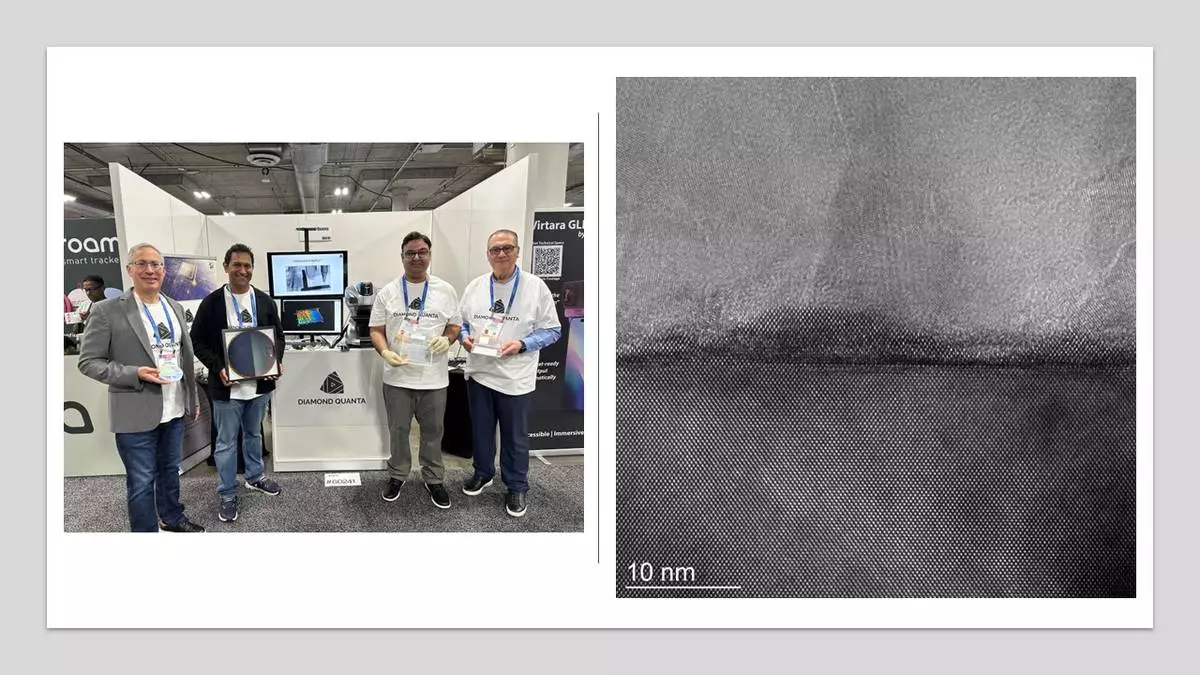
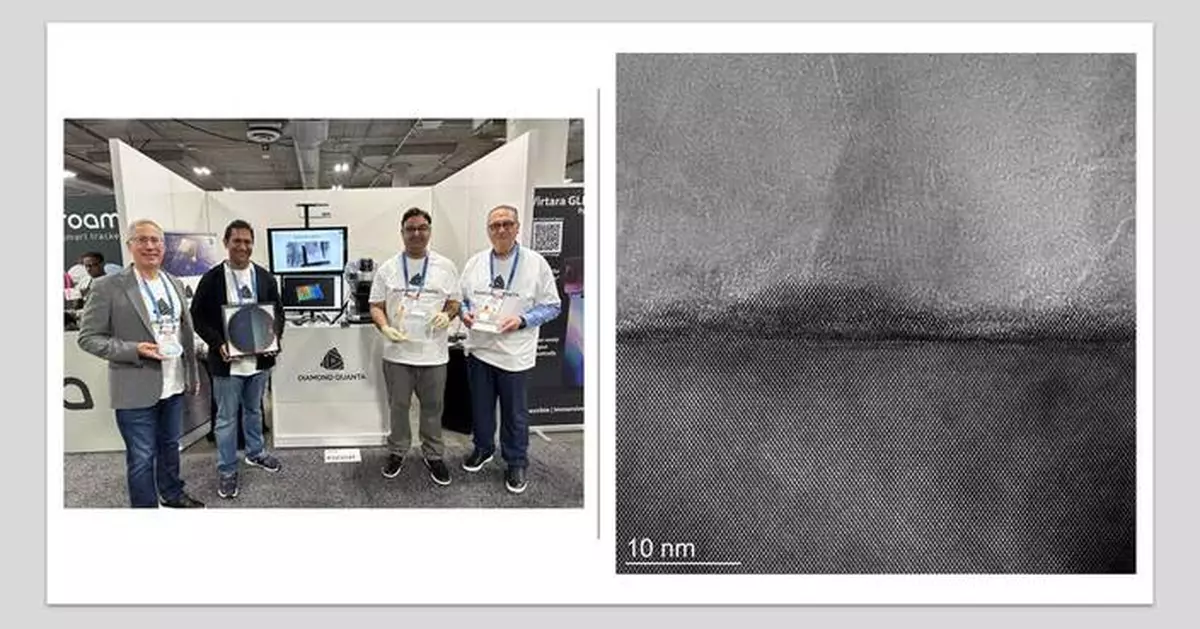
The Diamond Quanta team at CES 2026 holding Adamantine Optics™ & Adamantine Thermal Products™ and High-Resolution TEM image of DQ's high quality diamond stack interface

The Diamond Quanta team at CES 2026 holding Adamantine Optics™ & Adamantine Thermal Products™ and High-Resolution TEM image of DQ's high quality diamond stack interface

WASHINGTON (AP) — Defense Secretary Pete Hegseth said Thursday that he will allow service members to carry personal weapons onto military installations, citing the Second Amendment and recent shootings at bases across the country.

In a video posted to X, Hegseth said he is signing a memo that will direct base commanders to allow requests for troops to carry privately owned firearms “with the presumption that it is necessary for personal protection.”

He said any denial of a service member's request must be explained in detail and in writing.

“Effectively, our bases across the country were gun-free zones,” Hegseth said. “Unless you're training or unless you are a military policeman, you couldn't carry, you couldn't bring your own firearm for your own personal protection onto post.”

Questions about why service members lacked access to weapons have often emerged following shootings on the nation's military bases. Such shootings have ranged from isolated events between service members to mass casualty events, such as the shootings by an Army psychiatrist at Texas’ Ford Hood in 2009 that left 13 people dead.

Hegseth cited some of the events in his video, including a shooting that injured five soldiers at Fort Stewart in Georgia last year. Officials said the shooter, an Army sergeant who worked at the base, used his personal handgun before he was tackled by fellow soldiers and arrested.

“In these instances, minutes are a lifetime,” Hegseth said. “And our service members have the courage and training to make those precious, short minutes count.”

Defense Department policy has prohibited military personnel from carrying personal weapons on base without permission from a senior commander, with strict protocol for how the firearms must be stored.

Typically, military personnel must officially check their guns out of secure storage to go to on-base hunting areas or shooting ranges, then check all firearms back in promptly after their sanctioned use. Military police are often the only armed personnel on base, outside of shooting ranges, hunting areas or in training, where soldiers can wield their service weapons without ammunition.

Tanya Schardt, senior counsel at the Brady gun violence prevention organization, said in a statement that Defense Department leaders and the military’s top brass have opposed relaxing the current policy, which was originally enacted under President George H.W. Bush.

Schardt noted that most active duty service members who die by suicide do so with a weapon they own personally, not one military-issued, and argued that there will “undoubtedly be an increase in gun suicide and other gun violence.”

While fewer American service members died by suicide in 2024, the suicide rates among active duty troops overall still have gradually increased between 2011 and 2024, according to a Pentagon report released Tuesday.

“Our military installations are among the most guarded, protected properties in the world, and they’ve never been ‘gun-free zones,’” Schardt said. “If there is a problem with violent crime on these installations, then the Secretary of Defense has an obligation to alert the American people and describe how he’s working to prevent that crime.”

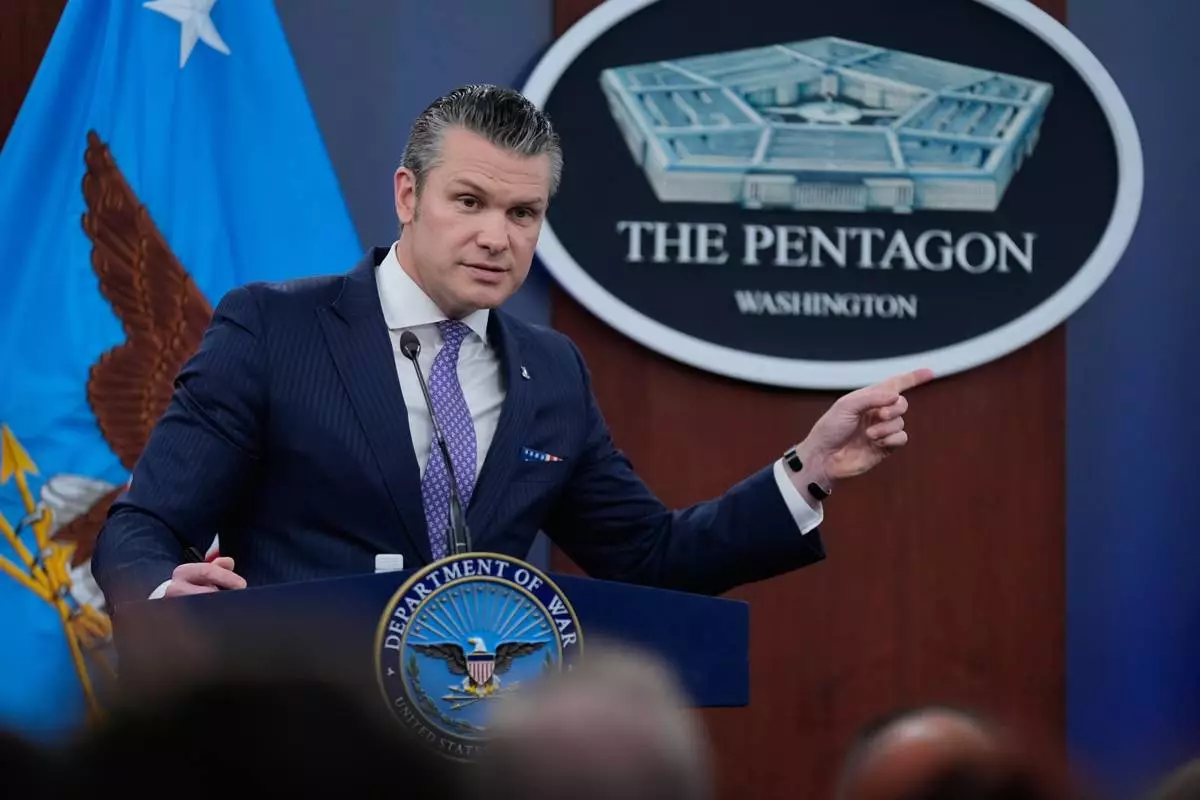
Defense Secretary Pete Hegseth speaks to members of the media during a press briefing at the Pentagon in Washington, Tuesday, March 31, 2026. (AP Photo/Manuel Balce Ceneta)

Defense Secretary Pete Hegseth speaks to members of the media during a press briefing at the Pentagon in Washington, Tuesday, March 31, 2026. (AP Photo/Manuel Balce Ceneta)

Recommended Articles