Skip to Content Facebook Feature Image

Efforts to ensure food supply underway as cold wave sweeps across China

China

China

China

Efforts to ensure food supply underway as cold wave sweeps across China

2026-01-20 17:41 Last Updated At:01-22 23:40

Chinese authorities have ramped up emergency measures to ensure food supply and stabilize prices, as a powerful cold wave grips large parts of the country, bringing heavy snow, strong winds, and plunging temperatures that are likely to adversely affect agricultural production.

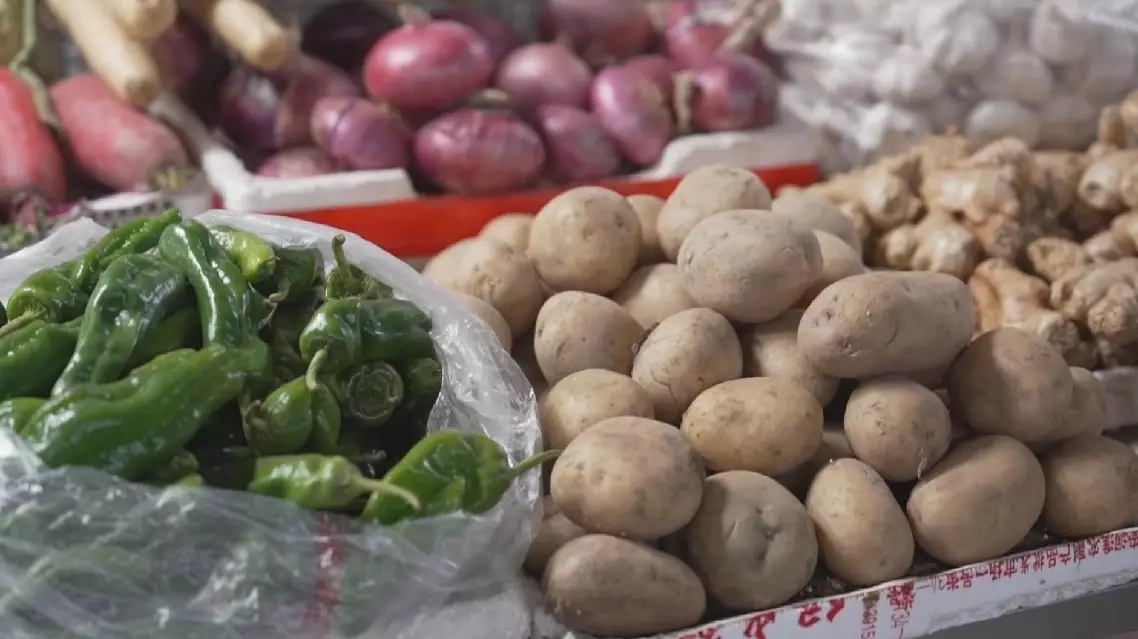
In the Dongcheng Trade Market in Huai'an City of east China's Jiangsu Province, the morning bustle begins early. Stalls are neatly stocked with a sufficient supply of vegetables, such as potatoes and Chinese cabbage, ready for residents to purchase.

As one of the largest local agricultural markets, Dongcheng Trade Market plays a crucial role in ensuring food supply for hundreds of thousands of people in the surrounding communities. To mitigate the potential impacts of the current cold wave, market management has taken multiple measures to stabilize supply and prices, including expanding sourcing platforms, smoothing logistics channels, and stockpiling vegetables, meat, and aquatic products in advance.

On the production front, farmers and agricultural experts are teaming up to maintain stable vegetable output. For instance, in a rapeseed cultivation base in the city of Changde in central China's Hunan Province, tailored frost prevention measures have been put in place.

"Prolonged low temperatures can cause significant frost damage to the stems and leaves of rapeseed. For weaker seedlings, we can apply winter fertilizer, and where conditions allow, anti-frost agents can also be sprayed," said Xue Gaoshang, director of the oil crop research institute at the Changde Academy of Agricultural and Forestry Sciences.

In Changde, the agricultural department has collaborated with local meteorological and other relevant departments to analyze data including soil moisture and seedling age. Based on the findings, rapeseed fields have been classified into three categories -- "overgrown seedlings", "weak seedlings", and "normal seedlings" -- allowing for the early implementation of differentiated preventive measures.

Additionally, agricultural experts have formed special teams and been dispatched to several major rapeseed production areas.

They provide customized guidance by classifying and managing fields according to their specific conditions and seedling types, helping farmers take scientific and effective steps to prevent frost damage and ensure the safety and stability of agricultural production.

Currently, the 4.329 million mu (about 288,600 hectares) of winter rapeseed planted in Changde are growing well.
Efforts to ensure food supply underway as cold wave sweeps across China

Efforts to ensure food supply underway as cold wave sweeps across China

China's two major power grid operators -- the State Grid Corporation of China (State Grid) and China Southern Power Grid (CSG) -- reported a surge in investment in the first quarter of 2026, underscoring efforts to strengthen infrastructure construction and support high-quality socioeconomic development in China.

The State Grid said it completed fixed-asset investment worth 129 billion yuan (about 18.77 billion U.S. dollars) in the first three months of this year, up 37 percent the corresponding period of the previous year. The spending has driven more than 250 billion yuan (36 billion U.S. dollars) of investment across the wider industrial chain.

Key projects such as the Panxi ultra-high-voltage (UHV) alternating current (AC) line and the Anhui-Hubei back-to-back direct current (DC) project have seen ground broken for their construction, while several west-to-east power transmission projects have been upgraded.

Investment in connecting renewable energy generation to the grid was reported to have exceeded 10 billion yuan (1.45 billion U.S. dollars) from January to March, a year-on-year rise of more than 50 percent.

The CSG also reported robust growth in investment in the three-month period, with fixed-asset investment reaching 38.45 billion yuan (5.58 billion U.S. dollars), up about 50 percent from a year earlier.

Among its achievements, the company completed and commissioned 80 key projects, including the 220 kV cross-sea power grid interconnection project, which was officially put into operation on March 20. The project ended years of grid isolation on the Weizhou Island in south China by linking it to the main power system of the Guangxi Zhuang Autonomous Region.

The construction of 17 other major energy projects, including one linking the power grid of the Xizang Autonomous Region in southwest China with that of Guangdong Province in south China, is advancing rapidly. These projects are expected to bolster regional industries, the maritime economy, digital collaboration and the transition to green energy.

"By accelerating major project construction, investment during the 15th Five-Year Plan period (2026-2030) is expected to approach 1 trillion yuan (145 billion U.S. dollars), driving a further 2 trillion yuan (290 billion U.S. dollars) of investment across upstream and downstream industries," said Dong Yanle, deputy general manager of the Engineering Construction Department under the China Southern Power Grid.

China ramps up power grid investment in January-March to boost growth

China ramps up power grid investment in January-March to boost growth

Recommended Articles