Skip to Content Facebook Feature Image

Severe flooding in South Africa damages infrastructure, disrupts daily life

HotTV

HotTV

HotTV

Severe flooding in South Africa damages infrastructure, disrupts daily life

2026-01-20 20:07 Last Updated At:01-22 23:41

⁠⁠⁠⁠⁠⁠⁠Heavy rainfall over the past two weeks has caused extensive flooding across South Africa, severely damaging local infrastructure and disrupting daily life, prompting authorities to activate emergency measures.

The hardest-hit region is Mpumalanga Province, where roads, bridges and other critical infrastructure have suffered large-scale damage.

"Now the damage is very huge, because like cars now can't be able to make movement, we are mostly affected in our villages. So probably each and every section needs to [have] serious intervention, so that it can be back to normal," said Bio Mpungane, a municipal councillor of Bushbuckridge District, Mpumalanga Province.

"When it was raining, we started to experience, or to receive reports, of houses that were falling and also bridges that were really being washed away. This has really affected badly the communities living around the areas that had a damage. We've never had a flood like this, for the past 6-7 years. Our infrastructure is unable to withstand," said an official of Bushbuckridge District.

Pools of floodwater are posing great dangers to locals.

"[For] the children who are going to school, they also use this road, and the road now is very [much] damaged. It's very dangerous. Especially for these children, it's very, very dangerous," said Malela, a local resident.

South Africa's National Disaster Management Center declared a national disaster on Sunday. The government has stated that it will continue to coordinate resources in response to the evolving situation, aiming to reduce the impact of the floods on lives and property.

Data from the South African Weather Service showed that since the start of the rainy season, multiple parts of the country have received rainfall far above historical averages.

Severe flooding in South Africa damages infrastructure, disrupts daily life

Severe flooding in South Africa damages infrastructure, disrupts daily life

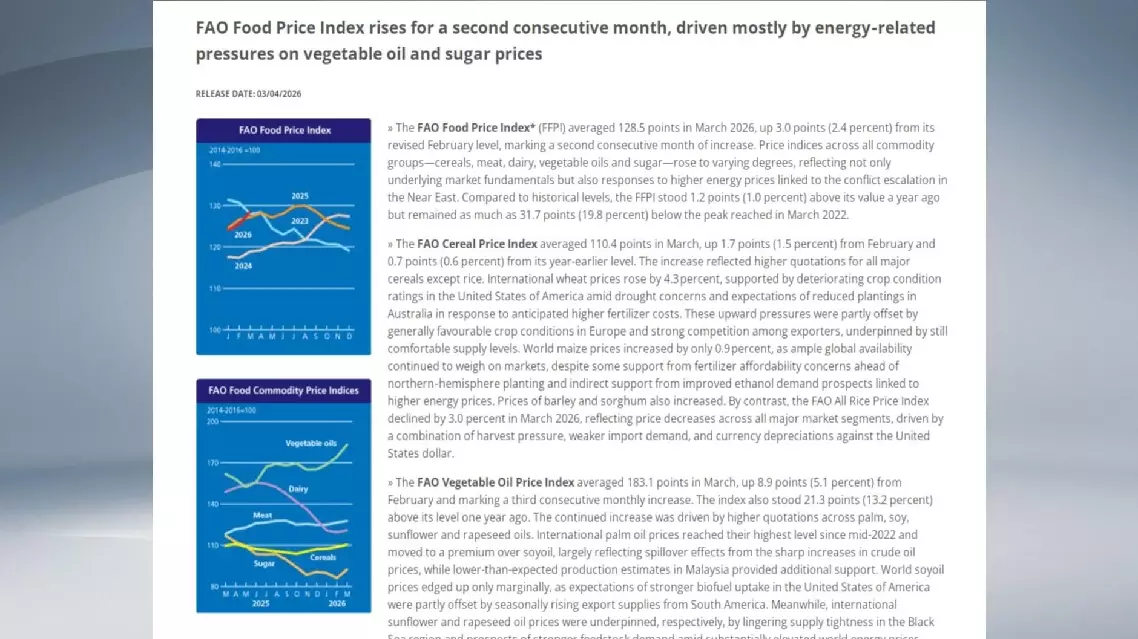
Global food commodity prices climbed for a second consecutive month in March, driven mainly by higher energy costs linked to escalating conflict in the Middle East, the Food and Agriculture Organization of the United Nations (FAO) said in report released on Friday.

The FAO Food Price Index, which tracks monthly changes in the international prices of a basket of globally traded food commodities, averaged 128.5 points in March, up 2.4 percent from February and 1.0 percent above its level a year ago.

According to the report, the FAO Vegetable Oil Index and Sugar Price Index showed the largest increases, up 5.1 percent and 7.2 percent, respectively.

The FAO Cereal Price Index increased by 1.5 percent from the previous month, driven primarily by higher world wheat prices, which rose 4.3 percent.

The FAO Meat Price Index rose by 1.0 percent from the previous month, and the FAO All-Rice Price Index declined by 3.0 percent in March, according to the report.

FAO stated that rising energy and fertilizer prices have been driving up agricultural input costs.

If the conflict stretches beyond 40 days, farmers will have to choose to farm the same with fewer inputs, plant less, or switch to less intensive fertilizer crops, according to FAO Chief Economist Maximo Torero.

These choices will hit future yields and shape food supply and commodity prices for the rest of this year and beyond, Torero said.

Global food prices rise for 2nd consecutive month in March amid Middle East conflict: FAO

Global food prices rise for 2nd consecutive month in March amid Middle East conflict: FAO

Recommended Articles