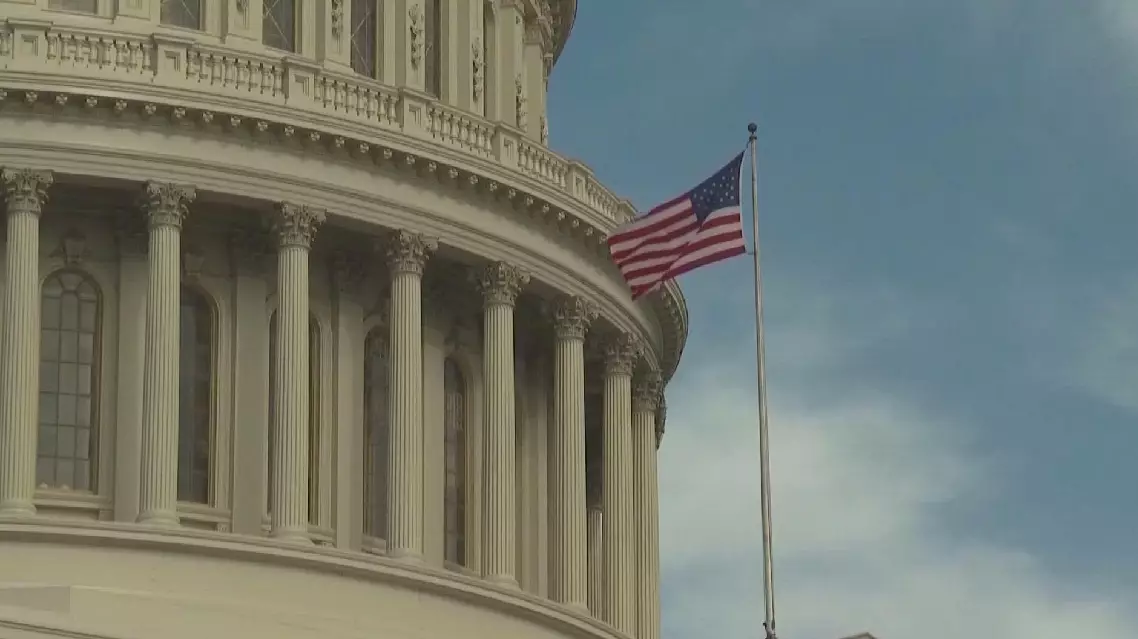
U.S. President Donald Trump said Thursday that the United States has a "massive" naval force heading toward Iran, while suggesting it may not be used as tensions remain high amid Iran's unrest.
"We have a lot of ships going that direction just in case. We have a big flotilla going in that direction. And we'll see what happens," Trump told reporters on Air Force One as he returned from the World Economic Forum in Davos, Switzerland.
"We have an armada. We have a massive fleet heading in that direction, and maybe we won't have to use it. We'll see," Trump added.
The USS Abraham Lincoln, along with three destroyers, was spotted making its way to the Middle East from Asia, according to Tuesday's ship-tracking data.
The USS George H.W. Bush has left Virginia and is at sea in the Atlantic, bound for Europe, said a New York Post report.
Trump reiterated that he prefers to avoid conflict, saying, "I'd rather not see anything happen, but we're watching them very closely."
The president said a planned 25-percent tariff on countries doing business with Iran would take effect "very soon."
Despite his tough rhetoric, including a recent call for regime change in Iran, Trump said he remains open to negotiations.
"Iran does want to talk, and we'll talk," Trump said during his stay in Davos.
Mohammad Pakpour, chief commander of Iran's Islamic Revolution Guards Corps (IRGC), said on Thursday that the U.S. and Israel should "draw lessons from historical experiences" and "refrain from any miscalculation" to avoid a "more painful and regret-inducing fate."
In an opinion article published Tuesday in the Wall Street Journal, Iranian Foreign Minister Seyed Abbas Araghchi said that while Iran "will always choose peace over war," if the country faced new attacks, "our powerful armed forces have no qualms about firing back with everything we have," citing a contrast with the "restraint" Iran showed in June 2025.
According to a Reuters report on Friday citing a senior Iranian official, Iran had noticed the U.S. deployment of additional troops to the Middle East.
The official said the Iranian military is prepared for the worst-case scenario, and that the nation is on high alert. Iran would regard any form of attack as all-out war against Iran and would respond with the strongest possible measures.
Trump touts "massive" U.S. forces heading toward Iran
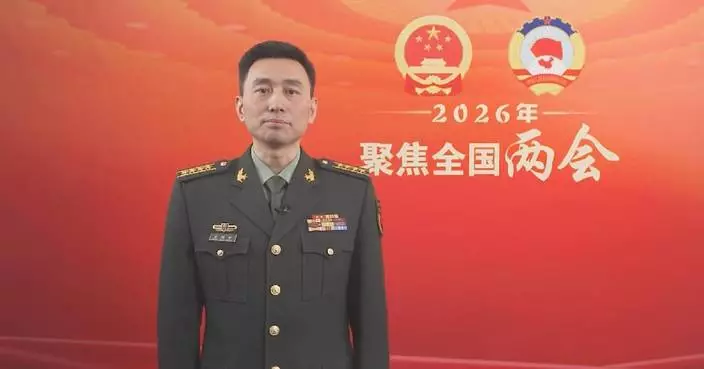
Highlighting the "Future Energy" as a key direction for China's strategic emerging industries, the country's nuclear energy development, guided by its three-step strategy, has seen major strides in the past year, said a member of the 14th National Committee of the Chinese People's Political Consultative Conference (CPPCC).
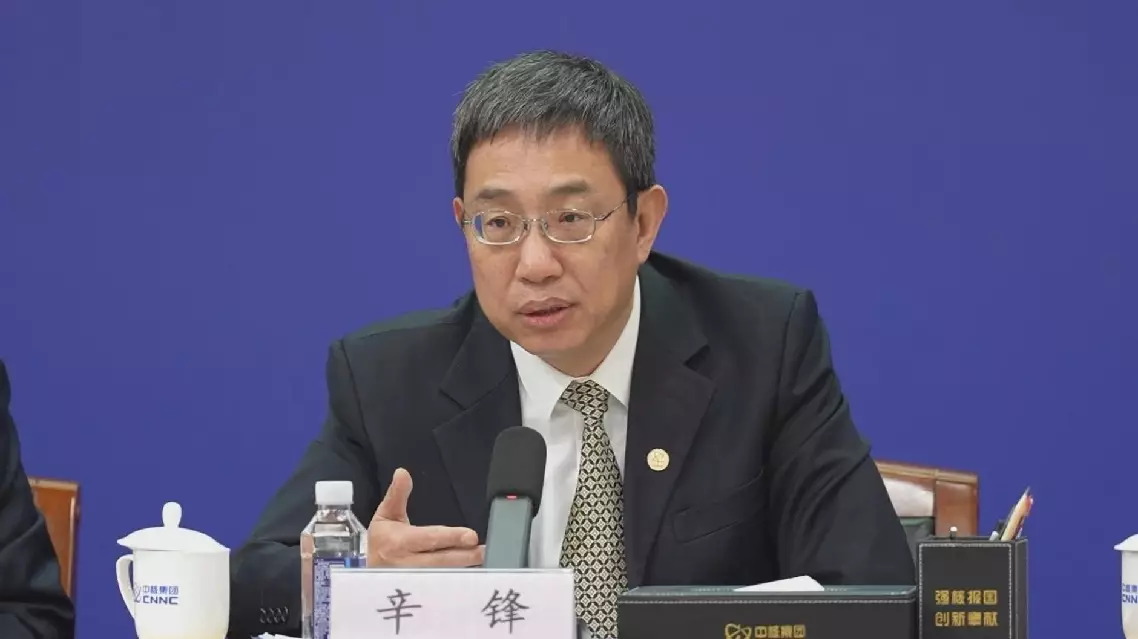
In a recent press briefing, Xin Feng, also deputy general manager of China National Nuclear Corporation (CNNC), updated the media on the progresses China has achieved under the strategy.
"China's three-step strategy for nuclear energy development -- from the thermal reactor to the fast reactor and the fusion reactor -- was formulated in 1983 as a medium- and long-term plan. For the thermal reactor, over the past year, our 2.0 version of the Hualong One technology has been approved. This is a unified and fully self-owned intellectual property based third-generation nuclear power technology solution. And the Linglong One small modular reactor also successfully completed its cold-state functional test last year and is expected to be put into commercial operation this year," he said.
For the second and third steps, Chinese researchers and engineers have achieved milestones in the past year with the government support, Xin noted.
"Then for the fast reactor, last year, a closed-cycle system for an integral fast reactor successfully achieved preliminary standard design. We will continue to solve its engineering technology challenges. As for the fusion reactor, in 2025, with national support, we established the China Fusion Energy Company in Shanghai. And our Huanliu-3, a platform for conducting research and development of fusion technology, made a big stride, with an iron temperature in it achieving 117 million Celsius and an electron temperature reaching 160 million Celsius. We will continue to adhere to the development strategy and focus on technological research and engineering technology development," Xin said.
The fourth session of the 14th NPC and the fourth session of the 14th National Committee of the CPPCC kicked off in Beijing on March 5 and March 4, respectively.
The "two sessions" -- which refer to the annual meetings of China's supreme organ of state power, the National People's Congress (NPC), and its top political advisory body, the National Committee of the CPPCC -- are a key event on the country's political calendar and offer a window into the country's development direction.
China's nuclear energy development makes great strides with three-step strategy: CPPCC member