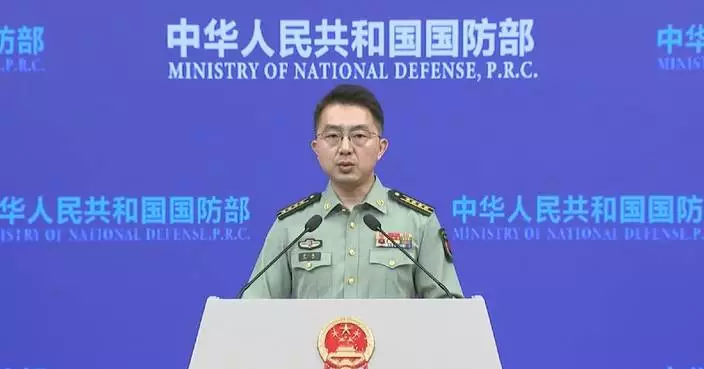
A draft law on promoting ethnic unity and progress, submitted to the fourth session of the 14th National People's Congress (NPC) for deliberation, offers a distinctive Chinese approach to resolving the issue, said a member of the 14th National Committee of the Chinese People's Political Consultative Conference (CPPCC).
Zheng Qian, also deputy director of the Chinese National Museum of Ethnology, said in an interview with China Global Television Network (CGTN) that museum documents show that the draft law presents an interpretation that differs from previous legislation of other countries.
She also highlighted the role of modern museums in promoting ethnic unity and culture preservation.
"After reviewing relevant materials, I found that similar legislation in most countries around the world generally follows several dimensions. One is anti-racism and anti-cultural discrimination. Another may emphasize multiculturalism or the cultural rights of specific ethnic groups or communities. In our case, however, we use keywords like "ethnic unity" and "promotion of progress" to engage young people in exhibition planning. We've also established projects for the digital restoration of cultural relics, transforming museums into social networks akin to friends' circles. Furthermore, we aim to turn all museum stakeholders into partners and co-builders," Zheng said.
The fourth session of the 14th NPC and the fourth session of the 14th National Committee of the CPPCC kicked off in Beijing on March 5 and March 4, respectively.
The "two sessions" are the annual meetings of China's supreme organ of state power, the NPC, and its top political advisory body, the CPPCC. Both bodies serve five-year terms and hold a plenary session each year.
National political advisor hails draft law as "Chinese approach" to ethnic unity
The first week of the U.S.-Israeli military operations against Iran has cost the United States an estimated 6 billion U.S. dollars, with analysts warning that the country can not afford this costly war, U.S. news media outlets reported recently.
The New York Times said in its report on Saturday that the Pentagon officials have told the U.S. Congress that the first week of the war had cost approximately 6 billion U.S. dollars, with about 4 billion U.S. dollars of that going toward ammunition procurement.
The Republicans are expecting President Donald Trump's administration to seek more funding from the Congress for the war, according to the report.
Meanwhile, A CNN report said on Friday that the strikes have now dragged on for days with no end in sight.
The Washington-based Center for Strategic and International Studies estimates that the conflict is costing roughly 890 million U.S. dollars per day, with air, naval and ground operations accounting for the bulk of the expenditures.
Air operations alone are projected to cost 30 million U.S. dollars daily, with naval operations running at approximately 15 million per day, including 6 million for aircraft carrier operations and 5 million for destroyers and ground operations costing about 1.6 million daily.
What Trump once called a war the country "can't afford to lose" is rapidly becoming one it "can't afford to fight," according to CNBC.
Estimates from several U.S. think tanks and a former Pentagon Comptroller revealed that beyond the staggering price tag, U.S. weapons stockpiles are being rapidly depleted in the joint U.S.-Israeli strikes against Iran.
Trump said on social media on Friday that he had convened meetings with defense contractors including Boeing, Lockheed Martin and Northrop Grumman to discuss ramping up weapons production.
He said the companies have agreed to increase output, with multiple production lines now running at full capacity.
Forbes magazine observed that while the U.S.-Israeli strikes on Iran have injected global uncertainty, the defense contractors holding Pentagon contracts stand as the conflict's most direct beneficiaries.
Military operations against Iran cost Washington 6 bln USD in 1st week: media