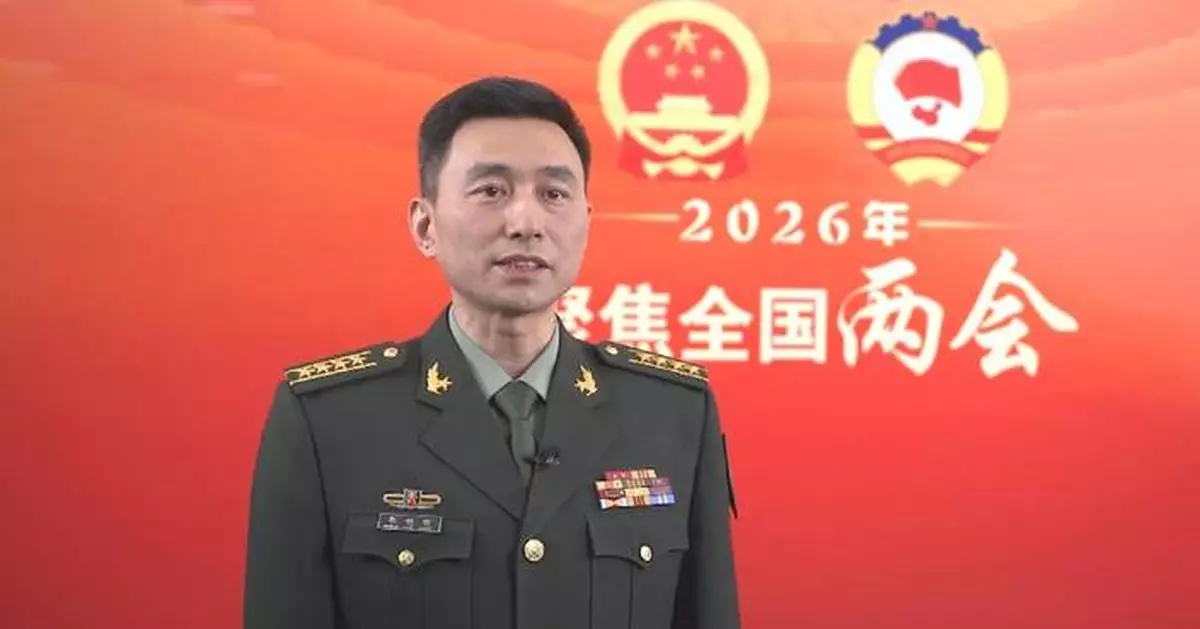
China's national defense spending in the 2026 general public budget is set at 1.94 trillion yuan, up 6.9 percent from the previous year's actual spending, Zhang Xiaogang, spokesman for the Chinese People's Liberation Army and Armed Police Force delegation to the fourth session of the 14th National People's Congress (NPC), China's national legislature, said in Beijing on Tuesday.
Of the figure, the central government expenditure stands at 1.91 trillion yuan, a seven-percent increase over the previous year's executed budget, Zhang said, stressing that the Chinese government keeps an appropriate size of defense expenditure to achieve coordinated development of national defense and economy.
"The Chinese government adheres to the principle of coordinated development of national defense and economic construction and reasonably sets the scale of defense spending. In recent years, in order to defend national sovereignty, security and development interests, and meet the requirements of military transformation with Chinese characteristics, the Chinese government, on the basis of promoting sound and stable socioeconomic development, has maintained a gradual and steady increase in defense spending, so as to ensure parallel progress in national defense capabilities and economic strength," said Zhang.
"Based on laws such as the National Defense Law and the Budget Law, the Chinese government includes defense expenditure in the annual government budget draft every year, which must be reviewed and approved by the National People's Congress. We manage and use the defense budget in accordance with the law and publicize the total figure of defense expenditure," he said.
Zhang also said national security and development needs were taken into account in setting the 2026 defense budget.
"Consolidated national defense and strong armed forces provide strategic support for Chinese modernization. Taking into account the needs of national security and development, to ensure that the modernization of national defense and armed forces is in step with national modernization, to comprehensively enhance our strategic capability to defend national sovereignty, security and development interests, and to achieve the military's centenary goal on schedule, the national general public budget for 2026 allocates 1.94 trillion yuan for defense spending, an increase of 6.9 percent over the previous year's executed budget. Of this amount, the central government expenditure stands at 1.91 trillion yuan, a seven-percent increase over the previous year's executed budget," said Zhang.
Zhang highlighted four priority areas for the increase in the defense budget this year.
"The increased defense spending will be primarily channeled to the following areas. First, in accordance with the new three-step roadmap for modernizing China's national defense and armed forces, we will advance the integrated development of mechanization, informatization and intelligentization, and enhance the strategic capability to safeguard national sovereignty, security and development interests. Second, we will optimize the joint operations system, promote a combat-oriented and systematic development of new-domain and new-quality combat capabilities in large scale, upgrade and transform traditional combat forces, and strengthen advanced operational capabilities. Third, we will accelerate the development of advanced weaponry and equipment and innovation in defense science and technology, and expedite the establishment of a modern logistics system. Fourth, we will continue to improve political conduct throughout the military, take solid steps to advance realistic training, refine policies and institutions for military human resources, elevate the level of education of military personnel, and cultivate new-type high-caliber and professional military personnel," Zhang said.
The spokesman said that the military will also push forward reforms in defense budget management.
"The military will advance the reform of defense budget management, achieve a dynamic balance between the supply and demand of defense funds, strengthen whole-of-chain management and performance evaluation of defense spending, and make sure that every penny is wisely spent for the best result," said Zhang.

China sets defense spending in 2026 general public budget at 1.94 trillion yuan: spokesman

China sets defense spending in 2026 general public budget at 1.94 trillion yuan: spokesman

China sets defense spending in 2026 general public budget at 1.94 trillion yuan: spokesman