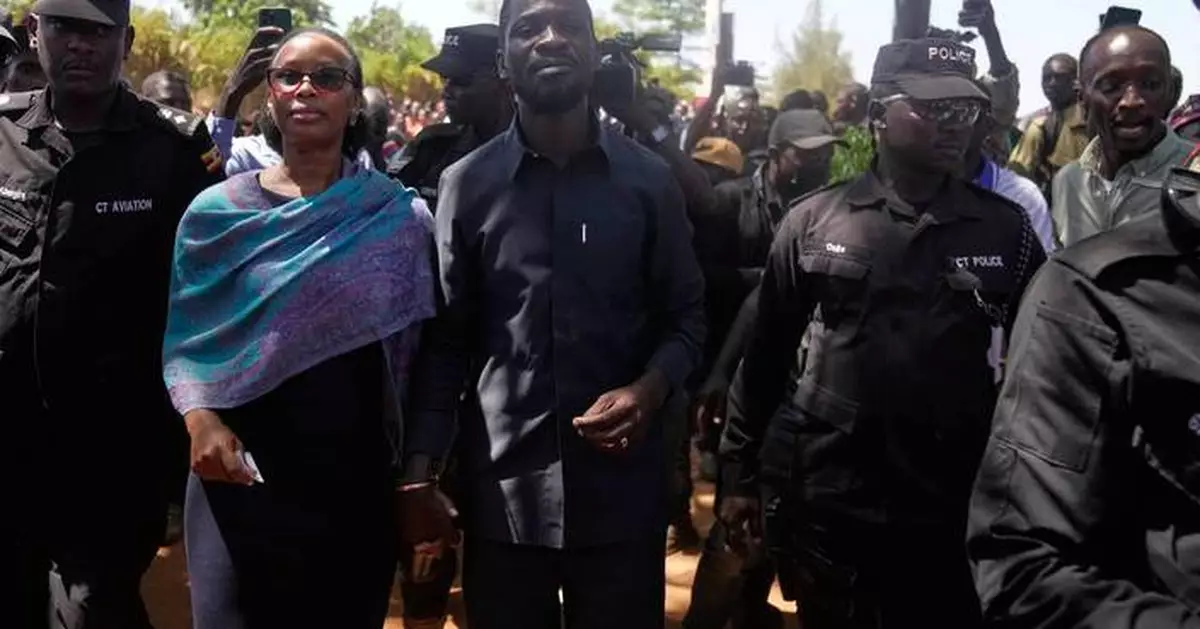
KAMPALA, Uganda (AP) — The wife of Ugandan opposition leader Bobi Wine described on Saturday how armed men forced their way into her home and attacked her as they demanded to know where he was.
Barbara Kyagulanyi, known affectionately as Barbie, told reporters gathered around her hospital bed that she did not cooperate with the dozens of men in military uniform who broke into her home on Friday night. She told them she didn’t know where her husband was — and she refused to unlock her mobile phone despite their demands.
The intruders harassed and insulted her, asking why she had married opposition leader Kyagulanyi Ssentamu — widely known as Bobi Wine — the most prominent of seven candidates who had challenged Ugandan President Yoweri Museveni in last week’s election.
Wine has been in hiding since Museveni was declared the winner of the Jan. 15 presidential polls, with 71.6% of the vote, according to official results. Wine's National Unity Platform party, or NUP, took 24.7% of the vote, a result he has rejected as fake.
Wine, who has called for peaceful protests, recently said he fears for his safety and is sheltering at an unknown location.
There has been a heavy security presence around Wine's home. On Friday night, the couple’s children were not at home and Kyagulanyi was alone in the house, except for a guard at the front gate, when the gunmen forcibly accessed the property.
Kyagulanyi recorded the intruders on her phone. The video, posted on X, shocked many Ugandans. She said from her hospital bed that after she saw the “swarm of men,” she called her brother-in-law and told him, “This is the end.”
Kyagulanyi says two men held her while the rest searched the house. One asked her to unlock her phone. When she refused, he lifted her off the floor and she kicked him, at which point the second man grabbed her, ripping off her pajama top and the buttons.
While this was happening, some of the men “looked away,” and others “were unbothered,” she said.
Later, Kyagulanyi said, a gunman pulled her by the hair and banged her head against a pillar. Four men forced her down and sat on her. She said she passed out and was taken to the hospital at 1 a.m.
At Nsambya Hospital, in the Ugandan capital of Kampala, she was being treated for bruises and anxiety on Saturday.
Kyagulanyi said she has no doubts that Gen. Muhoozi Kainerugaba — the army chief since 2024 and the president's son — was responsible for the raid, following his repeated threats against her husband on X.
Col. Chris Magezi, a spokesman for the military, did not respond to a request for comment.
Wine's lawyer, Robert Amsterdam, on Friday urged the international community “to demand immediate, verifiable guarantees” of Wine’s safety, citing the army chief's "reckless" threats against the opposition leader even as police say Wine has not committed any crime.
Kainerugaba's tweets on X are often offensive, and he has targeted Wine in recent days, calling him a “baboon” and a “terrorist.” He often deletes his posts later.
Kainerugaba said this week that over 2,000 of Wine’s supporters have been detained since the election. He also said he was operating with the powers of a commander-in-chief of the armed forces, authority vested in the president by law.
David Lewis Rubongoya, secretary-general of Wine's party, said on Saturday that NUP “is under attack,” describing the recent events as a "new phase of persecution.”
“Our leader is in hiding," Rubongoya said. “Several other party leaders are either missing or under arrest.”
Uganda’s election was marred by a dayslong internet shutdown and the failure of biometric voter identification machines that caused delays in the start of voting in areas, including in Kampala. Wine has also alleged that ballot boxes were stuffed in some areas seen as Museveni’s strongholds.
Museveni, who is a long-time U.S. ally on regional security, has accused the opposition of trying to foment violence during the voting.
In a statement on Friday, the chairman of the Senate Foreign Relations Committee, Idaho Republican Jim Risch, urged the Trump administration to “reassess the U.S. security relationship with Uganda, beginning with a review of whether sanctions are warranted under existing authorities against specific actors,” including Kainerugaba.
United Nations Secretary-General António Guterres has urged “restraint by all actors and respect for the rule of law and Uganda’s international human rights obligations.”
Ugandan security forces were a constant presence throughout the election campaign.
Wine said that authorities followed him and harassed his supporters, often using tear gas against them. He campaigned in a flak jacket and helmet for protection.
Museveni, 81, will now serve a seventh term that would bring him closer to five decades in power. His supporters credit him for the relative peace and stability that has made Uganda home to hundreds of thousands fleeing violence elsewhere in this part of Africa.
Follow AP’s Africa coverage at: https://apnews.com/hub/africa
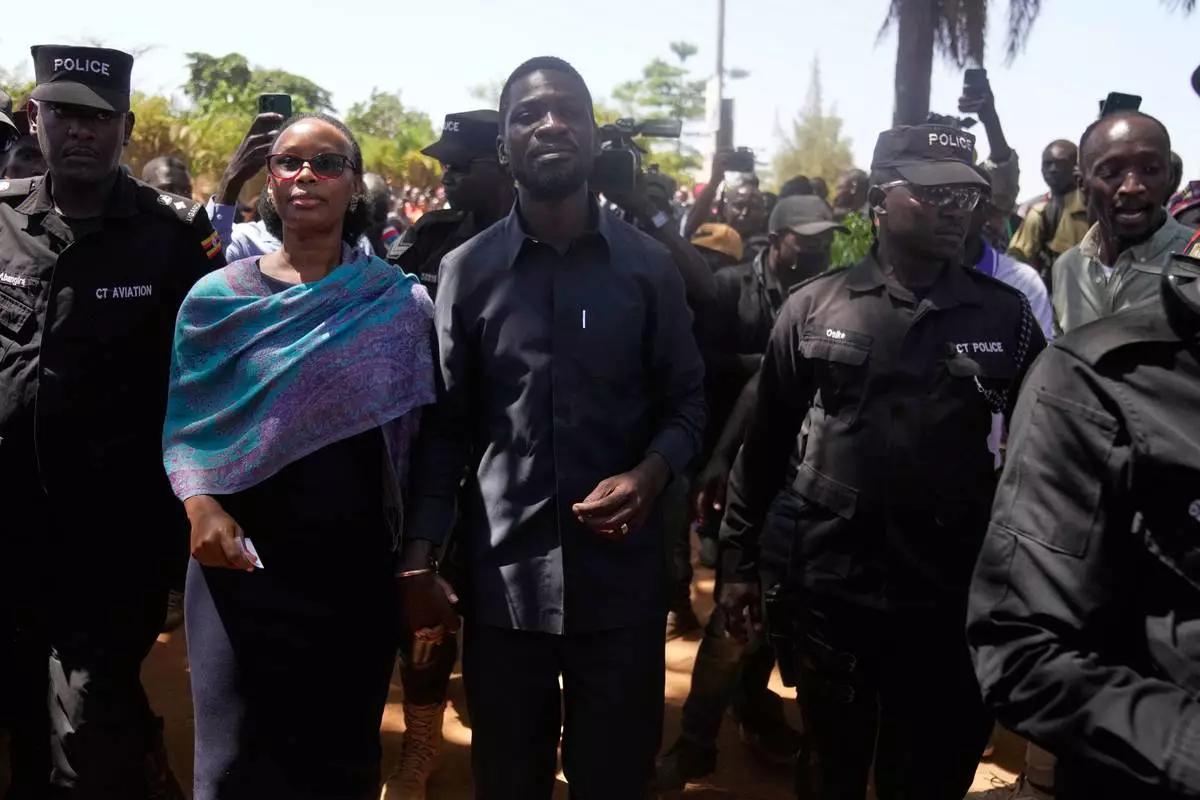
Uganda opposition presidential candidate Robert Kyagulanyi Ssentamu, famously known as Bobi Wine of the National Unity Platform (NUP), arrives with his wife to cast their votes, during the presidential election at a polling station, in Kampala, Uganda, Thursday, Jan. 15, 2026. (AP Photo/Brian Inganga)

PROVIDENCE, R.I. (AP) — Chuck Collins figures he won life’s lottery by inheriting vast sums of money through his great-grandfather Oscar Mayer’s processed meat company, but rather than fight to protect every dime Collins has helped push to hike taxes on the ultrarich like himself.
He was successful in helping implement a higher tax in Massachusetts on income over $1 million, and the idea has already taken hold in a handful of other blue states, including California, Maryland, Minnesota and New Jersey. Lawmakers in the state of Washington, which doesn't have an income tax, could send the governor this week a measure that would impose one on million-dollar earners.
“I think people are waking up to the harms of these inequalities,” said Collins, a founding member of the group Patriotic Millionaires, which calls for higher taxes on the country’s super affluent. “Including people who have wealth, who say, if we keep going down this road, it ain’t going to end well for anybody.”
Since a state Supreme Court decision nearly a century ago shot down an income tax, Washington has stood out as being one of few states controlled by Democrats without a tax on wages or salaries — though it does tax certain investment proceeds.
Facing a budget shortage, lawmakers are debating a proposal that would create a nearly 10% annual tax on personal earnings over $1 million. If adopted, the tax would collect billions of dollars of new revenue that would be designed to pay for free K-12 school meals, childcare services, a family tax credit and eliminate sales taxes on personal care items such as shampoo.
The state House adopted it this week after an all-night session deliberating amendments to the proposal. Now, it goes back to the Senate, which passed a version previously. Democratic Gov. Bob Ferguson has indicated support if the Legislature, which is controlled by his party, can send it to him before it adjourns Thursday.
“Washington is a state that has had an extremely regressive tax structure for 93 years,” House Majority Leader Joe Fitzgibbon, a Democrat, said in an interview. “It falls very heavily on working and middle class people in our state.” He said that if the change is adopted, it will help. “We don’t need to be a tax haven,” he said.
Others, including GOP lawmakers, caution that taxes on the wealthy are not a comprehensive solution to addressing worrisome state revenues and can drive away businesses.
Colin Hathaway, a millionaire businessman in Washington, said he's concerned the proposed tax would treat the money earned by his roofing company as income, even though he's putting most of it back into the business. He was already hit by the state's previous move to hike capital gains taxes, and said an additional tax could force him to move way from the state where his high school-aged children grew up.
“There’s a strong incentive to not be doing business here,” he said.
If the measure is adopted, it's likely to be challenged in court and with a ballot measure.
With affordability a hot topic in statehouses this session, a handful of progressive states are at least considering some kind of wealth tax.
Perhaps the most ambitious tax-the-rich effort is taking place in California – a state that already taxes its millionaire class. Advocates are working on a ballot measure that would place a one-time 5% tax on the assets of those with a $1 billion net worth. The proposal, backed by a large health care union, would use the extra revenue to backfill federal funding cuts to health services for lower-income people that were signed by President Donald Trump last year.
For critics, the wealth tax effort in California is the latest example of how the push to tax the rich in the U.S. is no longer about finding solutions to raise revenue but instead now backed by those who believe excessive wealth should be reduced or even erased, said Jared Walczak, a senior fellow at the Tax Foundation.
“You see that in the language around something like the California wealth tax, where the ballot language itself talks about it being a tax on sustaining excessive accumulations of wealth,” Walczak said.
Elsewhere, Rhode Island legislators are debating a budget proposal – backed by Democratic Gov. Dan McKee – that would enact higher taxes on residents earning $1 million or more.
In Michigan, organizers are working to collect enough signatures to get a ballot initiative in front of voters in November asking them to approve replacing the state’s current flat tax. Under the proposal, Michigan would place an additional 5% tax on those who make over $500,000 individually or $1 million for joint filers. The initiative, which is backed by the state’s board of education, would direct the new revenue to help fund K-12 schools.
And New York City Mayor Zohran Mamdani has reupped his push for New York state to raise taxes on the rich — though he faces opposition from Democratic Gov. Kathy Hochul. A similar call has been made by Chicago Mayor Brandon Johnson, but the Illinois Statehouse so far has not moved on imposing a millionaire tax.
The recent push by left-leaning leaders in blue states contrasts with what's being done in many Republican-led states, which have been more critical of passing higher taxes on their richest residents and have moved to abolish or significantly reduce personal income taxes.
Eight states have no income tax at all, and Walczak said the gap between states seeking tax relief and those seeking higher taxes on the wealthy “is larger than it has been for decades.”
Still, questions remain about whether such cuts result in spiking other taxes or eliminating funding for services.
“I think most Americans are pretty fed up because I think they understand that there’s really two tax systems. There’s one for your average person. You’re a nurse? You’re firefighter? Every two weeks you pay taxes. And then for the super wealthy, there’s all these tax breaks and all these special loopholes,” said David Kass, executive director of the left-leaning advocacy group Americans for Tax Fairness.
Massachusetts is often brought up in the debate over the effectiveness of millionaire taxes. Voters passed the Fair Share Amendment in 2022, which added a 4% surtax on income over $1 million; the threshold has risen annually for inflation. To date, the amendment has collected $6 billion for education and transportation, according to the state’s Executive Office for Administration and Finance.
“It’s good for everybody, in a time of grotesque inequality, for wealthy people to chip in a little bit more,” said Collins, Oscar Mayer's great-grandson. “Especially at a time when others are just struggling to keep up.”
Attansio reported from Seattle and Mulvihill from Haddonfield, New Jersey.
Colin Hathaway poses for a portrait in his office, Friday, Feb. 20, 2026, in Seattle. (AP Photo/Cedar Attanasio)
Chuck Collins tends to his chickens, Tuesday, Feb. 10, 2026, in Guilford, Vt. (AP Photo/Amanda Swinhart)
FILE - The interior of the House chamber at the Washington state Capitol is seen April 25, 2025, in Olympia, Wash. (AP Photo/Maddy Grassy, File)