Iran on Wednesday rejected any prospect of talks with the United States as long as Washington continues to threaten military action, after U.S. President Donald Trump escalated his rhetoric and announced the deployment of additional U.S. naval forces to the Middle East.
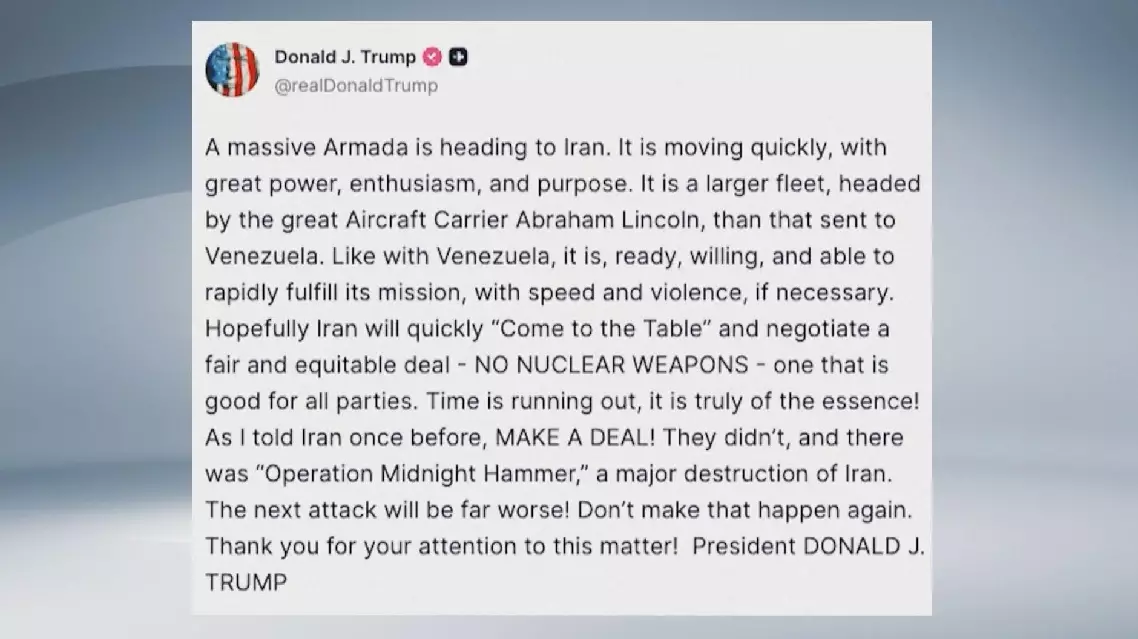
Trump said in a social media post on Wednesday that "a massive armada is heading to Iran" and "moving quickly, with great power", warning Tehran to make a deal or the attack will be far worse than previous military actions.
In response, Iranian Foreign Minister Seyed Abbas Araghchi said that there can be no negotiations in an atmosphere of threats, according to the state-run IRNA news agency.
Conducting diplomacy through military pressure is neither effective nor useful, Araghchi said, adding that if the U.S. wants negotiations, it must abandon threats, excessive demands, and irrational issues.
In a post on social media, Araghchi said Iranian forces are prepared to immediately and powerfully respond to any aggression.
Iran welcomes a mutually beneficial, fair and equitable nuclear deal, which ensures Iran's rights to peaceful nuclear technology and guarantees no nuclear weapons, the diplomat added.
Iran's deputy foreign minister Kazem Gharibabadi said at a press briefing in Tehran that Iran will not start a war, but it's ready for one.
The U.S. has made a request for negotiations, but Iran needs to make sure whether the U.S. wants serious discussions or just coercion, according to Gharibabadi.
Regarding the U.S. military buildup in the region, Gharibabadi said Iran will examine whether it's intended to pressure Iran or to launch a real military attack, stressing the U.S. is not trustworthy and that Iran will not accept U.S. pressure or threats.
The official said Iran will not attack its neighbors, but any location from which an attack against Iran is launched will be considered a legitimate target.
The increasing tensions come after the United States already dispatched its aircraft carrier USS Abraham Lincoln and accompanying guided-missile destroyers to the region. The U.S. Central Command said Monday that the carrier-led strike group had taken up position in Middle Eastern waters, without disclosing its exact location.
The heightened military posture comes roughly a month after protests first erupted across Iran, which Tehran has accused the United States and Israel of fomenting, with the demonstrations later turning violent and leading to significant casualties.
Trump has sent mixed signals, alternately calling for negotiations while refusing to rule out military intervention, while also referring to "Operation Midnight Hammer," which saw U.S. bombers target Iranian nuclear facilities in June last year.
Inside Iran, the response to the naval buildup has been defiant. Ali Shamkhani, an adviser to Iran's Supreme Leader Ayatollah Ali Khamenei, said Wednesday that any notion of a "limited strike" against Iran was an illusion. He warned that any U.S. military action "from any origin and at any level" would be considered the start of a war and would prompt an "immediate, all-out and unprecedented" response.
The advisor also made a threat to retaliate against Israel, with whom Iran engaged in a 12-day war last June, saying that the "heart of Tel Aviv" and all those who support the aggressor will be targeted.
Habibollah Sayyari, deputy chief of the Iranian Army for Coordination, warned on Wednesday that Iran's enemies are now waging hybrid and cognitive warfare, stressing that any hostile move against the country would cause serious damage and heavy costs for its adversaries.
According to Iranian media, the U.S. has set out four conditions for peace with Iran, comprising a complete halt to Iran's nuclear activities, the removal of all enriched uranium from Iran, limitations on the range of Iranian missiles, and a cessation of support for pro-Iranian armed groups in the region.
One Iranian analyst said the U.S. is inclined to seek an easy victory rather than get mired in a long war, and believes Trump hopes to force negotiations with the Iranian side by exerting pressure.
Iran rejects talks with U.S. amid military threats